
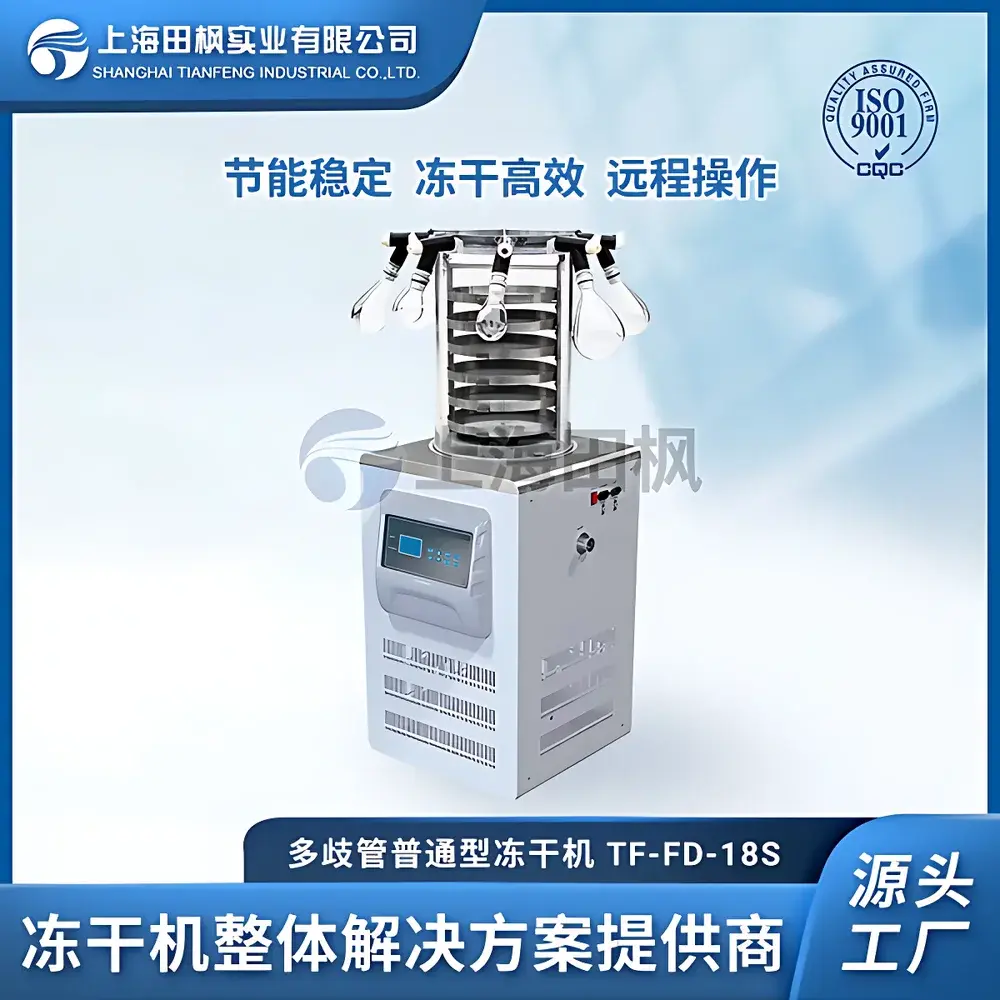
Tianfeng TF-FD-18S Multi-Manifold Stoppering Freeze Dryer
| Brand | Tianfeng |
|---|---|
| Origin | Shanghai, China |
| Manufacturer Type | Direct Manufacturer |
| Equipment Type | Multi-Manifold Freeze Dryer |
| Application | Laboratory-Scale Lyophilization |
| Shelf Area | 0.11 m² |
| Ultimate Vacuum (Empty Chamber) | <15 Pa |
| Condenser Temperature | <-60 °C |
| Ice Capacity | 6 kg/24 h |
| Power Supply | 220 V, 50 Hz |
| Rated Power | 1700 W |
| Dimensions (W×D×H, excl. chamber) | 550 × 550 × 960 mm |
| Shelf Configuration | 3-tier Φ220 mm trays |
| Heating System | Electrically Heated Shelves with Programmable Ramp/Soak Profiles |
| Display & Control | 7-inch Touchscreen with Real-Time Graphing (Shelf Temp, Chamber Pressure, Process Time) |
| Construction | 304 Stainless Steel Condenser & Internal Chamber |
| View Window | High-Transparency Acrylic Door |
| Optional Features | In-chamber Pressure Control Valve (N₂ or Ar), Coating-Compatible Sealing System, GLP-Compliant Data Logging Module |
Overview
The Tianfeng TF-FD-18S Multi-Manifold Stoppering Freeze Dryer is a laboratory-grade lyophilization system engineered for reproducible, scalable freeze-drying of heat-sensitive biological and pharmaceutical samples. It operates on the fundamental principle of sublimation: aqueous samples are first frozen solid at cryogenic temperatures (<−60 °C), then subjected to high vacuum (<15 Pa) to enable direct phase transition of ice to vapor without passing through the liquid state. This low-temperature, low-pressure process preserves structural integrity, enzymatic activity, immunogenicity, and reconstitution fidelity—critical attributes for vaccines, monoclonal antibodies, diagnostic reagents, cell therapies, and labile natural compounds. Unlike conventional drying methods involving thermal exposure above 0 °C, lyophilization minimizes protein denaturation, oxidation, and volatile loss, resulting in stable, sterile-ready powders with extended shelf life under ambient storage conditions.
Key Features
- Electrically heated shelves with programmable temperature profiles (ramp/soak), enabling controlled primary and secondary drying for optimized residual moisture content and cake morphology.
- Multi-manifold configuration with eight independent ports (compatible with 50–1000 mL vials), allowing parallel processing of heterogeneous samples while maintaining individual pressure isolation during stoppering.
- Integrated stoppering mechanism compatible with standard rubber stoppers; enables in-situ capping under vacuum or inert gas (N₂/Ar) to prevent rehydration and oxidation post-drying.
- 7-inch industrial touchscreen HMI with real-time graphical display of shelf temperature, chamber pressure, process time, and user-defined lyo curves—supporting intuitive parameter adjustment and immediate deviation recognition.
- High-efficiency dual-stage refrigeration system achieving condenser temperatures below −60 °C, ensuring reliable capture of water vapor and compatibility with low-volatility solvents (e.g., acetone, ethanol) when used in formulation development.
- Full 304 stainless steel condenser and internal chamber architecture—corrosion-resistant, non-porous, and compliant with cleaning validation protocols per ISO 14644 and cGMP Annex 1 requirements.
- Transparent acrylic viewing door with anti-fog coating provides uninterrupted visual monitoring of ice formation, sublimation front progression, and cake collapse events throughout the cycle.
Sample Compatibility & Compliance
The TF-FD-18S accommodates diverse sample formats including serum vials (50–1000 mL), scintillation vials, glass ampoules, and custom containers mounted on the multi-manifold arms. Its 0.11 m² effective shelf area supports batch sizes typical of preclinical R&D, QC release testing, and pilot-scale process development. The system meets core design and operational criteria aligned with ISO 22042:2016 (freeze-dryer performance qualification), ASTM F2476-21 (lyophilization cycle validation guidance), and EU GMP Annex 1 (sterile process simulation readiness). When equipped with optional data logging and electronic signature modules, it supports audit trails compliant with FDA 21 CFR Part 11 for regulated environments requiring traceability, version control, and user access management.
Software & Data Management
The embedded controller records all critical process parameters—including shelf setpoint, actual temperature, chamber pressure, elapsed time, and condenser load—at user-configurable intervals (1–60 seconds). Raw data exports in CSV format via USB port; optional Ethernet interface enables integration into LIMS or MES platforms. Cycle files are password-protected and timestamped, with automatic backup to internal flash memory. For GLP/GMP workflows, the optional Data Integrity Package adds electronic signatures, role-based permissions, and change history logs—ensuring full compliance with ALCOA+ principles (Attributable, Legible, Contemporaneous, Original, Accurate, Complete, Consistent, Enduring, Available).
Applications
This freeze dryer serves laboratories engaged in biopharmaceutical formulation optimization, stability studies per ICH Q5C, analytical reference standard preparation, microbial culture preservation (ATCC-type protocols), and biomaterial scaffold fabrication. It is routinely deployed in academic research labs studying protein aggregation kinetics, in contract development and manufacturing organizations (CDMOs) performing tech transfer of lyo cycles, and in quality control units validating sterility test media and rapid diagnostic kits. Its precise shelf heating capability makes it especially suitable for optimizing drying cycles of amorphous formulations containing trehalose or sucrose matrices, where controlled annealing and ramp rates directly impact collapse temperature (Tc) and final moisture content.
FAQ
What is the maximum allowable residual moisture for regulatory submissions using this system?
Residual moisture is not instrument-determined but method-dependent; however, the TF-FD-18S’s precise shelf temperature control (±0.5 °C) and stable vacuum (<15 Pa) support consistent achievement of ≤1.0% w/w moisture when paired with validated cycle development protocols.
Can the system be validated for GMP production use?
Yes—when supplied with IQ/OQ documentation packages, calibrated PT100 sensors (traceable to NIST), and optional 21 CFR Part 11-compliant software, it satisfies baseline qualification requirements for Phase I–II clinical material production.
Is remote monitoring supported?
Standard configuration includes local USB data export; optional Ethernet module enables secure remote access via HTTPS-enabled web interface for real-time status checks and alarm notifications.
What maintenance intervals are recommended?
Oil-free vacuum pump oil replacement every 6 months; condenser coil inspection quarterly; door seal integrity verification before each critical run; full system performance verification annually per ISO 22042.
Does the unit support solvent drying beyond water?
With condenser temperatures sustained below −60 °C and appropriate formulation screening, the system effectively captures methanol, ethanol, and acetone vapors—though chlorinated solvents require prior engineering review due to condenser material compatibility.



