
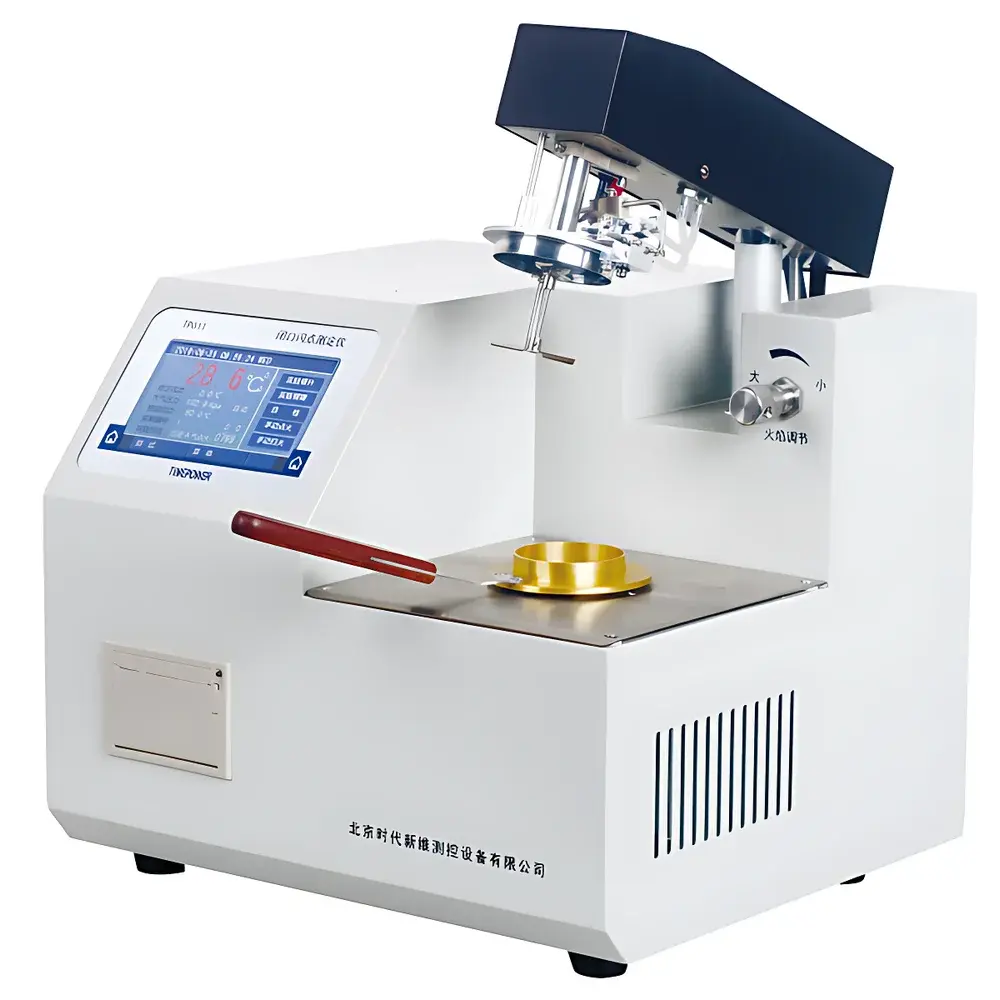
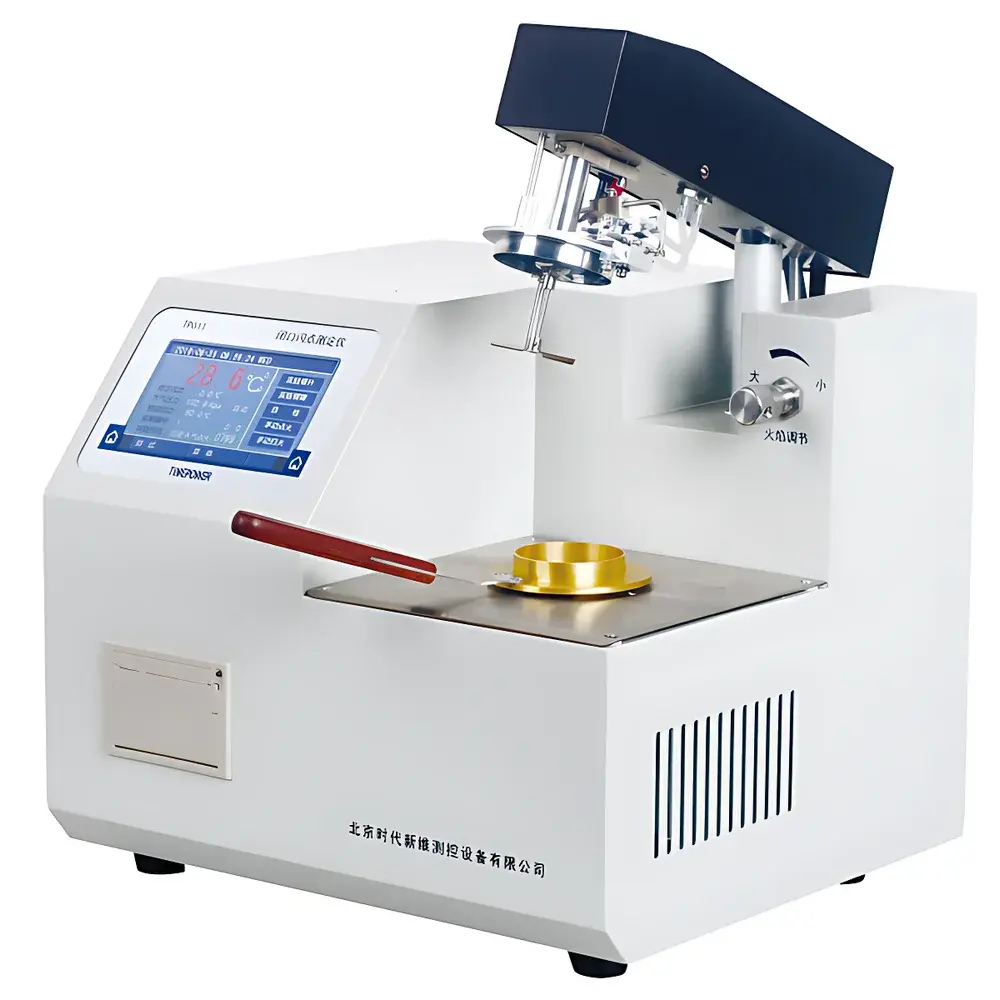
Timepower TP611 Automatic Closed-Cup Flash Point Tester
| Brand | Timepower |
|---|---|
| Origin | Beijing, China |
| Manufacturer Type | Direct Manufacturer |
| Country of Origin | China |
| Model | TP611 |
| Detection Method | Closed-Cup Method |
| Standards Compliance | GB/T 261, ASTM D93 |
| Measurement Range | 40–370 °C |
| Accuracy | ±1 °C (for flash point < 110 °C) |
| Repeatability | ≤2 °C |
| Resolution | 0.1 °C |
| Display | 260k-color TFT LCD (480 × 272) |
| Cooling Method | Integrated Forced-Air Cooling |
| Printer | Thermal, 36-character Chinese/English output |
| Power Supply | AC 220 V ±10 %, 50 Hz ±10 % |
| Power Consumption | ≤500 W |
| Dimensions | 350 × 310 × 300 mm |
| Weight | 13.5 kg |
| Environmental Operating Conditions | 5–40 °C, RH ≤85 % |
| Safety Features | Overtemperature cutoff, self-diagnostic system, atmospheric pressure compensation, flame-scan mode selection (gas or electronic ignition) |
Overview
The Timepower TP611 Automatic Closed-Cup Flash Point Tester is a precision-engineered instrument designed for the accurate and repeatable determination of the closed-cup flash point of petroleum products, lubricants, solvents, and related hydrocarbon-based liquids. It operates on the principle of controlled heating under sealed conditions, in strict accordance with standardized test protocols—primarily GB/T 261 (Chinese National Standard) and ASTM D93 (Standard Test Method for Flash Point by Pensky-Martens Closed Cup Tester). In this method, a sample is heated at a defined rate inside a standardized test cup; a flame is periodically introduced across the vapor space above the liquid surface. The lowest temperature at which the vapor-air mixture ignites momentarily upon exposure to the test flame is recorded as the flash point. This parameter is critical for hazard classification, transportation safety assessment (e.g., UN GHS labeling), storage compliance, and quality control in refining, power generation, petrochemical processing, and regulatory testing laboratories.
Key Features
- Fully automated operation sequence—including cup lifting, temperature ramping, stirrer activation, flame introduction, flash detection, data logging, thermal shutdown, and post-test arm retraction—eliminates manual intervention and operator variability.
- Programmable heating rate and stirring speed ensure compatibility with multiple international and regional standards beyond GB/T 261 and ASTM D93, including ISO 2719 and IP 34.
- Integrated atmospheric pressure sensor enables real-time correction of flash point values, improving inter-laboratory reproducibility and traceability per ISO/IEC 17025 requirements.
- Dual-mode ignition system supports both gas-fueled flame scanning (using LPG or butane) and electronic arc ignition—enhancing operational flexibility, reducing consumables dependency, and minimizing ignition source variability.
- Self-diagnostic firmware continuously monitors heater integrity, thermocouple response, cup positioning, gas flow (if applicable), and flame detection circuitry—reporting fault codes for rapid troubleshooting and preventive maintenance planning.
- High-resolution 260k-color TFT display (480 × 272 pixels) provides intuitive graphical interface with multilingual menu navigation (English and Chinese), real-time temperature curve visualization, and status alerts.
- Onboard thermal printer delivers permanent, tamper-evident records with embedded test parameters, ambient conditions, operator ID (optional via software integration), and timestamp—supporting GLP/GMP documentation requirements.
Sample Compatibility & Compliance
The TP611 is validated for use with transparent and opaque petroleum distillates, residual fuels, diesel blends, transformer oils, hydraulic fluids, and industrial solvents—provided they meet viscosity and volatility constraints typical of closed-cup testing (e.g., kinematic viscosity ≤ 50 mm²/s at 40 °C). It is not intended for highly volatile substances (e.g., gasoline, acetone) requiring open-cup methods (ASTM D56) or low-flash-point aerosols. All hardware components—including the brass test cup, stainless-steel stirrer, and flame delivery assembly—are constructed to resist corrosion from sulfur-containing or acidic samples. The instrument conforms to electromagnetic compatibility (EMC) directives IEC 61326-1 and safety standard IEC 61010-1, and its design supports audit readiness for ISO/IEC 17025-accredited laboratories and FDA-regulated environments where flash point data informs stability protocols (e.g., ICH Q1A).
Software & Data Management
While the TP611 operates as a standalone unit with embedded firmware, it features an RS232 serial interface for bidirectional communication with external laboratory information management systems (LIMS) or PC-based analytical software. Exported data includes raw temperature vs. time arrays, detected flash point value, atmospheric pressure reading, operator input fields, and diagnostic logs—all formatted in ASCII CSV for seamless import into statistical process control (SPC) platforms or electronic lab notebooks (ELN). Optional firmware upgrades may enable 21 CFR Part 11-compliant user authentication, electronic signatures, and audit trail generation—facilitating compliance in regulated pharmaceutical or energy-sector QA/QC workflows.
Applications
- Quality assurance of insulating oils in electrical utilities and transformer manufacturing facilities.
- Batch release testing of diesel fuel, jet fuel (Jet A-1), and marine distillates per ISO 8217 specifications.
- Hazard evaluation of new formulations during R&D in chemical synthesis and specialty lubricant development.
- Regulatory submission support for REACH, CLP, and OSHA HCS documentation requiring flash point classification.
- Periodic verification of stored hydrocarbon inventory in refinery terminals and distribution depots.
- Academic and metrology laboratory use for method validation studies and interlaboratory comparison exercises.
FAQ
What standards does the TP611 comply with?
The instrument is fully compliant with GB/T 261 and ASTM D93, and functionally compatible with ISO 2719 and IP 34 through adjustable heating and stirring profiles.
Can the TP611 be used for biodiesel or bio-blended fuels?
Yes—provided the sample exhibits sufficient thermal stability and does not decompose below its flash point; users should verify cup cleaning protocols between high-ash or polymer-containing samples.
Is external ventilation required during operation?
Yes. Testing must be conducted inside a certified fume hood with controlled airflow to prevent vapor accumulation and ensure operator safety per OSHA 1910.1200 and local fire codes.
How is calibration verified?
Calibration is performed using certified reference materials (CRMs) such as n-decane (flash point ≈ 46 °C) or 1-methylnaphthalene (flash point ≈ 108 °C), with verification traceable to NIM (National Institute of Metrology, China) or NIST SRMs.
Does the instrument support network connectivity or remote monitoring?
Not natively—but the RS232 port allows integration with SCADA systems or custom middleware for centralized fleet monitoring in multi-instrument labs.





