
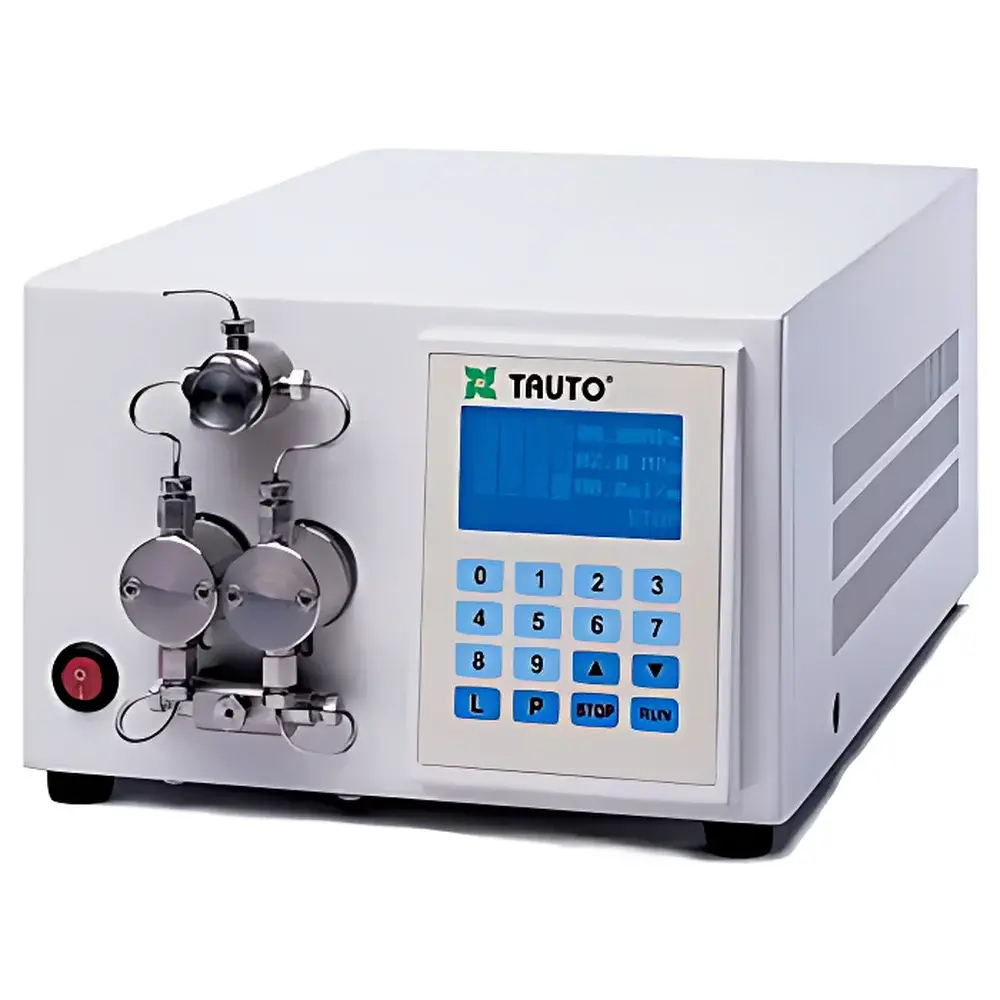
Tongtian Grad10 Binary Medium-Pressure Gradient Pump
| Brand | Tongtian |
|---|---|
| Model | Grad10 |
| Pressure Range | 0–5.0 MPa |
| Flow Rate Range | 0.1–10.0 mL/min |
| Flow Increment | 0.1–10.0 mL/min |
| Gradient Mixing Range | 0.0–100% |
| Gradient Accuracy | ±1% |
| Pressure Pulsation | ≤0.08 MPa |
| Pressure Accuracy | ≤0.05 MPa |
| Flow Setting Error | ≤1% |
| Flow Precision (RSD) | ≤1% |
| Wetted Materials | Sapphire, 316L Stainless Steel, Zirconia Ceramic |
| Power Supply | 220 V ±10%, 50/60 Hz |
| Power Consumption | 75 W |
| Dimensions | 360 × 255 × 160 mm |
| Weight | 12 kg |
Overview
The Tongtian Grad10 Binary Medium-Pressure Gradient Pump is an engineered solution for precise, reproducible solvent delivery in preparative chromatography, method development, and analytical-scale gradient elution applications. Unlike low-pressure (post-mix) gradient systems, the Grad10 implements a medium-pressure (pre-mix) architecture: two independent high-performance dual-piston pumps generate gradients at the pump outlet—prior to the injection valve and column inlet. This design eliminates mixing dead volume inherent in low-pressure manifolds, suppresses bubble formation during volatile or viscous solvent blending, and ensures superior gradient fidelity and retention time stability across repeated runs. The pump operates on a microprocessor-controlled closed-loop flow regulation system, integrating real-time pressure feedback, automatic flow calibration, and over-pressure shutdown protection. Its fundamental measurement principle relies on positive displacement via precision sapphire-plunger assemblies and ceramic check valves—enabling accurate volumetric displacement with minimal pulsation (<0.08 MPa) and long-term mechanical stability under continuous operation.
Key Features
- Dual independent pump heads with fully separate control—ensures system redundancy; failure of one pump does not halt the entire gradient sequence
- Medium-pressure gradient generation at pump outlet—reduces dwell volume to <150 µL, enabling sharp gradient transitions and improved method transferability
- Chemically inert wetted path constructed from sapphire, 316L stainless steel, and zirconia ceramic—compatible with aggressive solvents including acetonitrile, THF, chloroform, concentrated acids (e.g., TFA), and alkaline mobile phases (pH 1–13)
- Flow precision of RSD ≤1% and gradient accuracy of ±1% across 0.1–10.0 mL/min range—validated per ISO 5725-2 for repeatability under GLP-compliant conditions
- Integrated air-elimination module with manual purge valve and self-venting check valves—minimizes entrained gas without requiring external degassers
- Large backlit LCD interface with memory for up to 10 user-defined methods—including flow, pressure, gradient profile, and timer-based start/stop sequences
- Built-in over-pressure protection (settable threshold up to 5.0 MPa) and automatic flow recalibration routine—supports unattended overnight operation
Sample Compatibility & Compliance
The Grad10 accommodates a broad spectrum of liquid-phase applications requiring chemical resilience and metrological integrity. Its wetted materials meet USP Class VI biocompatibility requirements for sapphire and zirconia components, making it suitable for bioactive compound purification (e.g., peptides, oligonucleotides, natural product isolates). The pump complies with IEC 61010-1 for laboratory equipment safety and supports audit-ready operation when integrated into validated workflows: electronic logs record all parameter changes with timestamp, operator ID (via optional USB keyboard), and system events—fully traceable per FDA 21 CFR Part 11 Annex 11 requirements. It is routinely deployed in laboratories adhering to ISO/IEC 17025, ASTM D4052 (density/viscosity-coupled methods), and USP chromatographic system suitability protocols.
Software & Data Management
The Grad10 communicates via RS-232 and optional USB-to-serial interface, supporting native integration with third-party chromatography data systems (CDS) such as Chromeleon, Empower, and OpenLab. Its embedded firmware provides real-time telemetry—including instantaneous pressure, setpoint deviation, flow error %, and motor load status—streamed at 10 Hz resolution. All operational parameters are logged internally (non-volatile memory) with cyclic overwrite protection. Exportable CSV files include full gradient timeline metadata (time, %B, flow, pressure), enabling post-run correlation with UV/ELSD detector outputs. Remote configuration and firmware updates are supported through Tongtian’s T-PumpControl Suite (Windows 10/11 compatible), which enforces password-protected parameter locking for QA/QC environments.
Applications
- Preparative HPLC and flash chromatography—especially for scale-up of pharmaceutical intermediates and natural product fractionation
- Method scouting and robustness testing under ICH Q2(R2) guidelines, where gradient reproducibility directly impacts peak symmetry and resolution
- Multi-solvent extraction systems in environmental analysis (e.g., EPA Method 8081B organochlorine pesticides)
- Continuous-flow synthesis setups requiring stoichiometric co-delivery of reagents at defined molar ratios
- Quality control labs performing compendial assays per Ph. Eur. 2.2.46 or JP 6.03—where flow accuracy directly affects assay precision
- Academic research in polymer characterization (GPC/SEC), where narrow molecular weight distributions demand ultra-stable flow profiles
FAQ
What distinguishes medium-pressure gradient formation from low-pressure gradient systems?
Medium-pressure gradients are generated by independently controlling two pumps upstream of the injector, minimizing dwell volume and eliminating solvent compressibility-induced delays. Low-pressure systems mix solvents pre-pump, introducing significant compressibility artifacts and bubble nucleation—particularly problematic with THF/water or CO₂-containing mobile phases.
Can the Grad10 be used in GMP-regulated environments?
Yes—when operated with enabled audit trail logging, electronic signatures, and periodic flow/pressure verification per SOP-INST-023, the Grad10 satisfies ALCOA+ data integrity principles required for FDA and EMA inspections.
Is PEEK-compatible fluidic path available for this model?
The standard Grad10 uses sapphire/zirconia/316L construction. For extended compatibility with HF or hot concentrated phosphoric acid, Tongtian offers the Grad10-K variant with PEEK pump heads and tubing—contact technical support for material compatibility matrices.
How is flow calibration performed and how often is it required?
Calibration is executed via the front-panel menu using gravimetric validation (ASTM D3427). Under normal use (≤8 hrs/day, non-abrasive solvents), recalibration is recommended every 90 days or after maintenance involving plunger replacement.
Does the pump support gradient delay compensation for system dwell volume?
Yes—the T-PumpControl software allows input of empirically measured dwell volume (determined via step-gradient test), enabling automatic timing offset correction for consistent retention time alignment across instrument platforms.



