
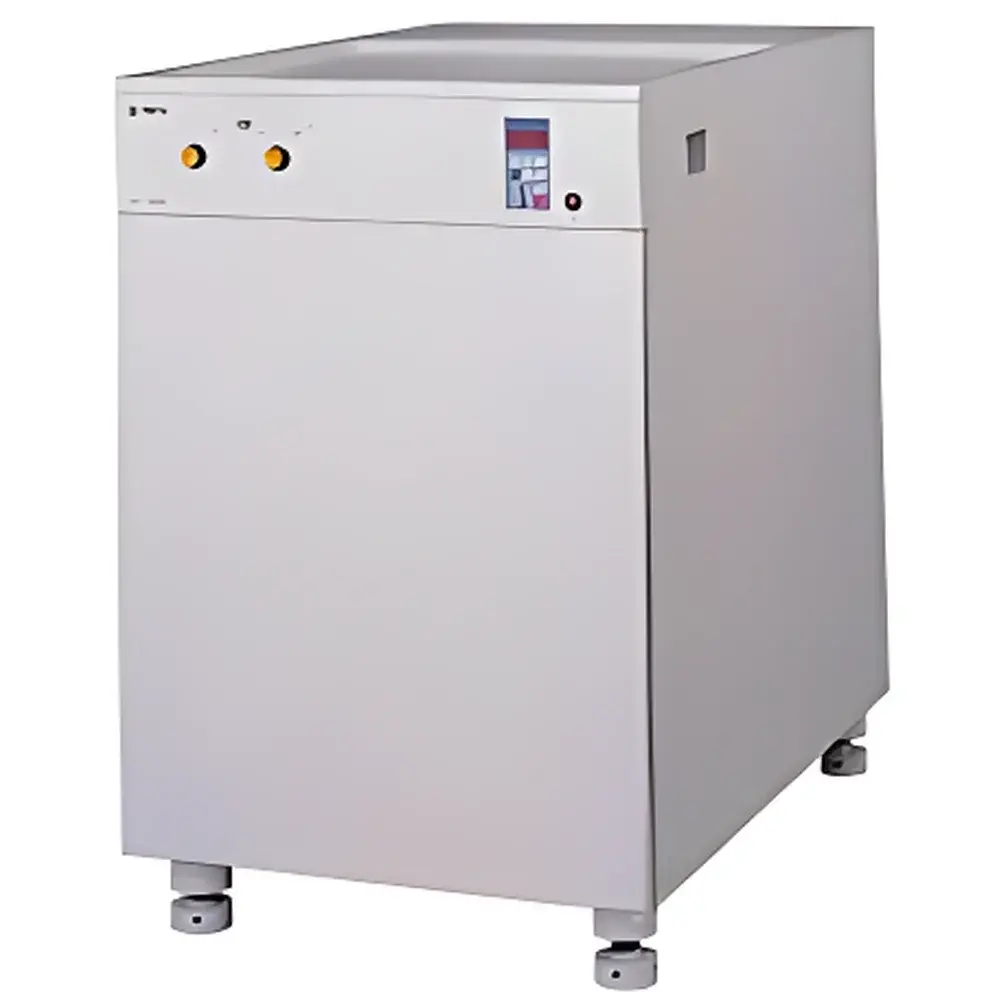
Tongtian TBE-5000A High-Speed Counter-Current Chromatography (HSCCC) System
| Brand | Tongtian |
|---|---|
| Origin | Shanghai, China |
| Model | TBE-5000A |
| Power Supply | 220 V ±20 V, 50 Hz ±0.5 Hz |
| Host Power | 1500 W |
| Total Column Capacity | 4800 mL |
| Sample Injection Volume | 200 mL |
| Dimensions (W×D×H) | 730 × 1100 × 1122 mm |
| Rotational Speed Range | 0–600 rpm |
| Optimal Separation Speed | 400–550 rpm (infinitely variable frequency control) |
| Mobile Phase Flow Rate | 0.1–180 mL/min |
| Typical Separation Flow Rate | 20–50 mL/min |
| System Pressure Limit | 0–2 MPa |
| UV Detector Wavelengths | 254 nm & 280 nm |
| Temperature Control Module (external chiller required) | 15–40 °C, ±0.5 °C accuracy, coolant flow rate 1–20 L/min |
Overview
The Tongtian TBE-5000A High-Speed Counter-Current Chromatography (HSCCC) System is a preparative-scale liquid–liquid partition chromatography instrument engineered for high-resolution, solvent-based separation without solid stationary-phase adsorption. Unlike conventional column chromatography, HSCCC relies on the differential partitioning of analytes between two immiscible liquid phases—stationary and mobile—under precise centrifugal force conditions. The TBE-5000A implements a triple-spiral column configuration mounted in series, dynamically balanced to minimize vibration and acoustic emission during high-speed rotation (up to 600 rpm). This architecture ensures mechanical stability, long-term operational reproducibility, and compatibility with diverse solvent systems—including polar, nonpolar, and pH-modulated biphasic systems—without irreversible sample adsorption or column fouling. Its design eliminates silica- or polymer-based stationary phase limitations, making it especially suitable for labile natural products, thermosensitive biomolecules, and chiral compounds where surface interaction must be avoided.
Key Features
- Triple-spiral coil column assembly with dynamic mechanical balancing for enhanced rotational stability and low-noise operation
- Infinitely variable frequency-controlled motor enabling precise, stepless speed regulation from 0 to 600 rpm; optimal separation range maintained at 400–550 rpm
- Integrated temperature control module (requires external recirculating chiller) supporting precise thermal management from 15 to 40 °C with ±0.5 °C accuracy—critical for preserving conformational integrity of peptides, enzymes, and unstable secondary metabolites
- Dual six-port switching valves enabling automated fraction collection, system reconfiguration, and real-time online detection via dual-wavelength UV absorbance (254 nm and 280 nm)
- High-capacity fluid handling: 4800 mL total column volume and up to 200 mL single-injection capacity support gram-to-multi-gram scale purification
- Wide-flow-range peristaltic pump (0.1–180 mL/min), calibrated for consistent delivery across viscosity gradients and solvent polarity shifts
Sample Compatibility & Compliance
The TBE-5000A accommodates a broad spectrum of sample types—including crude plant extracts, fermentation broths, synthetic reaction mixtures, marine-derived bioactive fractions, radiolabeled compounds, and protein/peptide digests—without derivatization or immobilization. Its liquid–liquid partition mechanism preserves native molecular structure and biological activity, fulfilling requirements for GLP-compliant natural product isolation and early-stage pharmaceutical process development. While not pre-certified to specific regulatory frameworks, the system’s design supports adherence to ISO/IEC 17025 analytical method validation principles and aligns with USP and ICH Q5A guidelines for biopolymer characterization. Full audit trails, user access controls, and electronic signature readiness can be implemented via third-party LIMS or validated chromatography data systems (CDS) interfaced through standard analog/digital I/O.
Software & Data Management
The TBE-5000A operates via dedicated industrial-grade control firmware with local touchscreen interface and optional Ethernet connectivity. Real-time monitoring includes rotational speed, flow rate, UV absorbance, pressure, and chiller temperature—all logged with timestamped metadata. Raw chromatographic data (absorbance vs. time/volume) are exportable in ASCII or CSV format for post-processing in MATLAB, OriginLab, or OpenChrom. For regulated environments, integration with 21 CFR Part 11–compliant CDS platforms (e.g., Empower, Chromeleon) is achievable using analog output signals and hardware-triggered fraction collection logic. System calibration records, maintenance logs, and method parameters are stored locally with password-protected user roles (operator, supervisor, administrator).
Applications
- Isolation and purification of known bioactive constituents from botanical matrices (e.g., flavonoids, alkaloids, terpenoids)
- Separation of synthetic intermediates and final APIs where residual catalysts or isomers require removal without thermal degradation
- Preparative-scale generation of reference standards for herbal monograph development under Chinese Pharmacopoeia and WHO guidelines
- Fingerprint profiling of traditional herbal formulations for quality consistency assessment and batch release testing
- Purification of antibiotics (e.g., macrolides, glycopeptides) from complex microbial supernatants
- Discovery-driven isolation of novel natural product scaffolds from endophytic fungi, actinomycetes, and marine invertebrate symbionts
- Enantiomeric resolution of racemic drug candidates using chiral solvent systems (e.g., D-limonene/n-hexane/methanol/water)
- Radiochemical purification of 99mTc- or 18F-labeled tracers under shielded hot-cell-compatible configurations
- Intact separation of hydrophobic membrane proteins and post-translationally modified peptides incompatible with reversed-phase HPLC
FAQ
Does the TBE-5000A require column packing or conditioning before use?
No—HSCCC uses only liquid stationary phase retained by centrifugal force; no column packing, silanization, or equilibration is needed.
Can the system be validated for GMP manufacturing environments?
Yes—when integrated with qualified CDS and operated under documented SOPs, it meets foundational requirements for Stage 1–2 process development and clinical trial material purification.
What solvent systems are compatible with the triple-spiral column design?
All standard HSCCC biphasic systems apply—including hexane/ethyl acetate/methanol/water (HEMWAT), chloroform/methanol/water, and acidic/basic aqueous buffers paired with organic solvents—provided density and interfacial tension permit stable phase retention.
Is UV detection sufficient for non-chromophoric compounds?
For analytes lacking UV absorbance, the system supports post-column derivatization interfaces or offline coupling to MS, ELSD, or CAD detectors via fraction collector output.
How is method scalability ensured from analytical to preparative runs?
Retention time (KD) and selectivity (α) remain invariant across scales; linear flow velocity and g-force are preserved through proportional adjustment of flow rate and rotation speed—enabling direct translation from mg- to g-scale separations.
Related Products





