
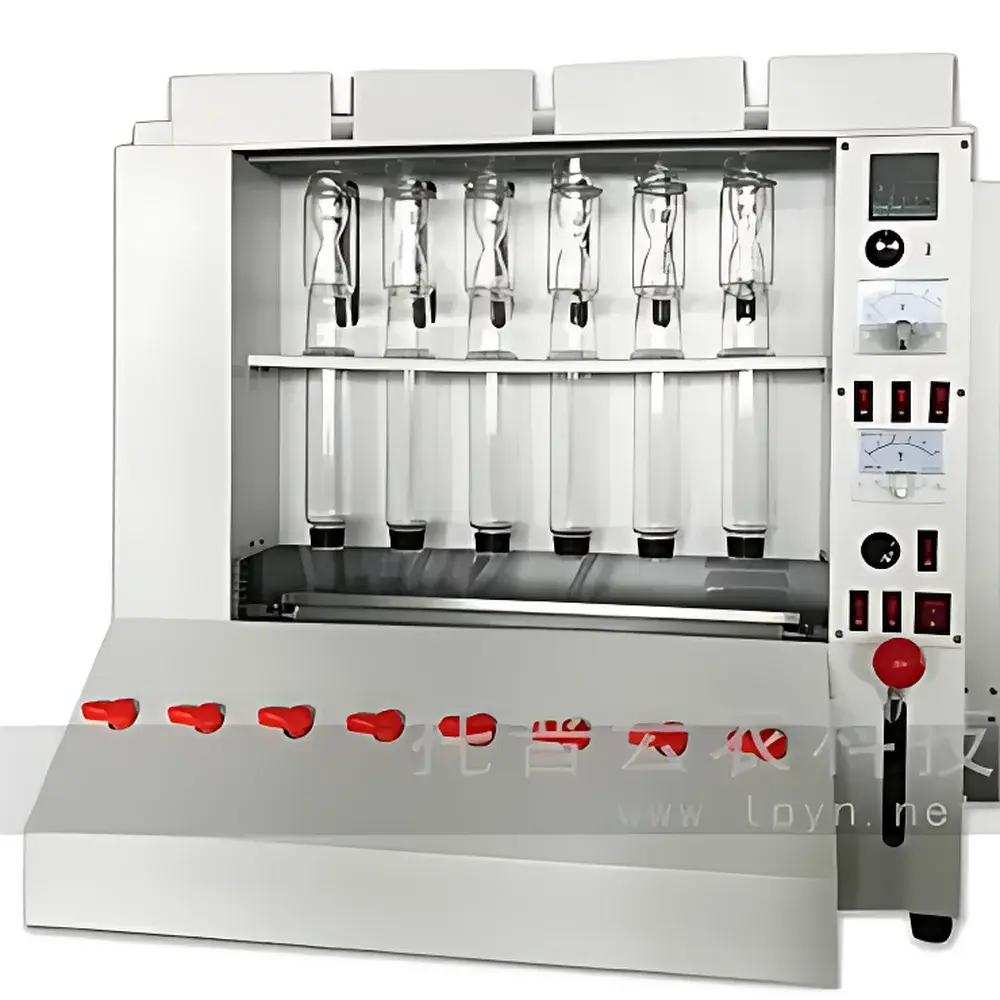
Top Cloud-agri CXC-06 Automated Crude Fiber Analyzer
| Brand | Top Cloud-agri |
|---|---|
| Origin | Zhejiang, China |
| Manufacturer Type | Direct Manufacturer |
| Country of Origin | China |
| Model | CXC-06 |
| Power | 2800 W |
| Voltage/Frequency | AC 220 V / 50 Hz |
| Dimensions (W×D×H) | 670 × 450 × 670 mm |
| Weight | 30 kg |
| Sample Capacity | 6 samples per run |
| Analyte | Crude fiber content in feed, grain, forage, food, and agricultural products |
| Digestion Time | ~100 min per batch (acid digestion: 40 min |
| alkaline digestion | 40 min |
| filtration & washing | ~20 min) |
| Repeatability | ≤0.4% absolute error for samples with crude fiber <10% |
| Cooling Water Requirement | Inlet water temperature <20 °C |
| Compliance Basis | AOAC 962.09, ISO 5498:2022, GB/T 6434–2006 |
Overview
The Top Cloud-agri CXC-06 Automated Crude Fiber Analyzer is a dedicated benchtop instrument engineered for precise, standardized determination of crude fiber content in animal feed, cereals, forages, foodstuffs, and agricultural commodities. It implements the classical acid-base digestion methodology—fully aligned with internationally recognized reference procedures including AOAC Official Method 962.09, ISO 5498:2022, and Chinese national standard GB/T 6434–2006. Crude fiber is not a chemically defined polymer but a gravimetric residue obtained after sequential boiling of dried, defatted samples in dilute sulfuric acid and sodium hydroxide solutions, followed by ethanol extraction to remove soluble non-fibrous residues, drying, and high-temperature incineration (typically 500–600 °C) to ash mineral components. The remaining mass—expressed as a percentage of the original dry sample weight—represents the crude fiber fraction, primarily composed of cellulose, with minor contributions from resistant hemicellulose and lignin derivatives. The CXC-06 automates all critical thermal and fluid-handling steps—including reagent dosing, timed digestion cycles, vacuum-assisted filtration, solvent rinsing, and controlled drying—minimizing manual intervention and operator-induced variability.
Key Features
- Fully automated six-position digestion system enabling parallel processing of up to six samples per analytical run, improving laboratory throughput without compromising procedural fidelity.
- Precisely regulated heating modules with independent temperature control for acid and alkali digestion vessels, maintaining ±1 °C stability at prescribed boiling points (e.g., 100 °C for H2SO4 and NaOH digestions) to ensure method compliance.
- Integrated vacuum filtration manifold with stainless-steel filter holders and heat-resistant glass crucibles (G3/G4 porosity), supporting rapid, uniform solid–liquid separation post-digestion.
- Programmable solvent delivery system for automatic ethanol washing, eliminating manual transfer risks and ensuring consistent removal of residual solubles.
- Digital touchscreen interface with preloaded AOAC/ISO/GB method templates, real-time status monitoring, and audit-ready operation logs.
- Robust stainless-steel chassis and chemical-resistant internal housing designed for long-term exposure to aggressive acids, bases, and organic solvents under routine QC/QA laboratory conditions.
Sample Compatibility & Compliance
The CXC-06 accommodates a broad spectrum of solid particulate matrices: pelleted and mash feeds, cereal grains (corn, wheat, barley), hay and silage, oilseed meals (soybean, rapeseed), bakery by-products, and processed food ingredients. Sample preparation follows standardized grinding (≤1 mm particle size) and moisture equilibration per AOAC guidelines. All operational parameters—including digestion duration, reagent concentration, filtration vacuum level, and drying temperature—are configurable to meet specific regulatory or internal SOP requirements. Instrument design supports GLP-compliant workflows: user access levels, electronic signature capability, and timestamped event logging align with FDA 21 CFR Part 11 readiness when integrated with validated LIMS environments.
Software & Data Management
The embedded firmware provides intuitive step-by-step guidance through each phase of the AOAC 962.09 workflow. Method files store complete parameter sets—including acid/alkali volumes, heating ramp profiles, hold times, and wash cycles—for rapid recall and inter-laboratory reproducibility. Raw mass data (pre-digestion, post-digestion, post-ash) are automatically recorded and calculated using built-in equations per ISO 5498. Export options include CSV and PDF reports with metadata (operator ID, date/time, sample IDs, instrument serial number). Optional USB or Ethernet connectivity enables centralized data archiving and integration with enterprise quality management systems.
Applications
- Feed formulation labs verifying crude fiber specifications against contractual guarantees and nutritional labeling requirements.
- Regulatory testing facilities conducting official inspections of commercial animal feed under national feed safety regulations.
- Agricultural extension services performing on-site quality screening of forage crops to support ruminant ration balancing.
- Food ingredient suppliers validating fiber content claims for functional food labeling (e.g., “high-fiber” cereal products).
- Academic research groups studying dietary fiber–animal performance relationships in controlled feeding trials.
FAQ
What standards does the CXC-06 comply with?
It is validated for AOAC 962.09, ISO 5498:2022, and GB/T 6434–2006. Full validation documentation, including precision studies and inter-laboratory comparison data, is available upon request.
Is the instrument suitable for GMP/GLP-regulated environments?
Yes—when deployed with configured user roles, electronic signatures, and audit-trail-enabled software, it meets core requirements for traceability and data integrity under GLP and GMP frameworks.
Can digestion temperature be adjusted beyond standard boiling?
No—the system is optimized for atmospheric-pressure reflux digestion at 100 °C. Pressure-assisted or sub-boiling protocols are outside its operational scope.
What maintenance is required for long-term reliability?
Routine cleaning of crucibles and filtration lines after each run; annual calibration of temperature sensors and vacuum pressure transducers using NIST-traceable references.
Does the CXC-06 include a muffle furnace?
No—it is designed for integration with external certified muffle furnaces (e.g., operating at 550 ±10 °C per ISO 5498); ashing is performed offline to maintain thermal isolation and analytical independence.
Related Products






