
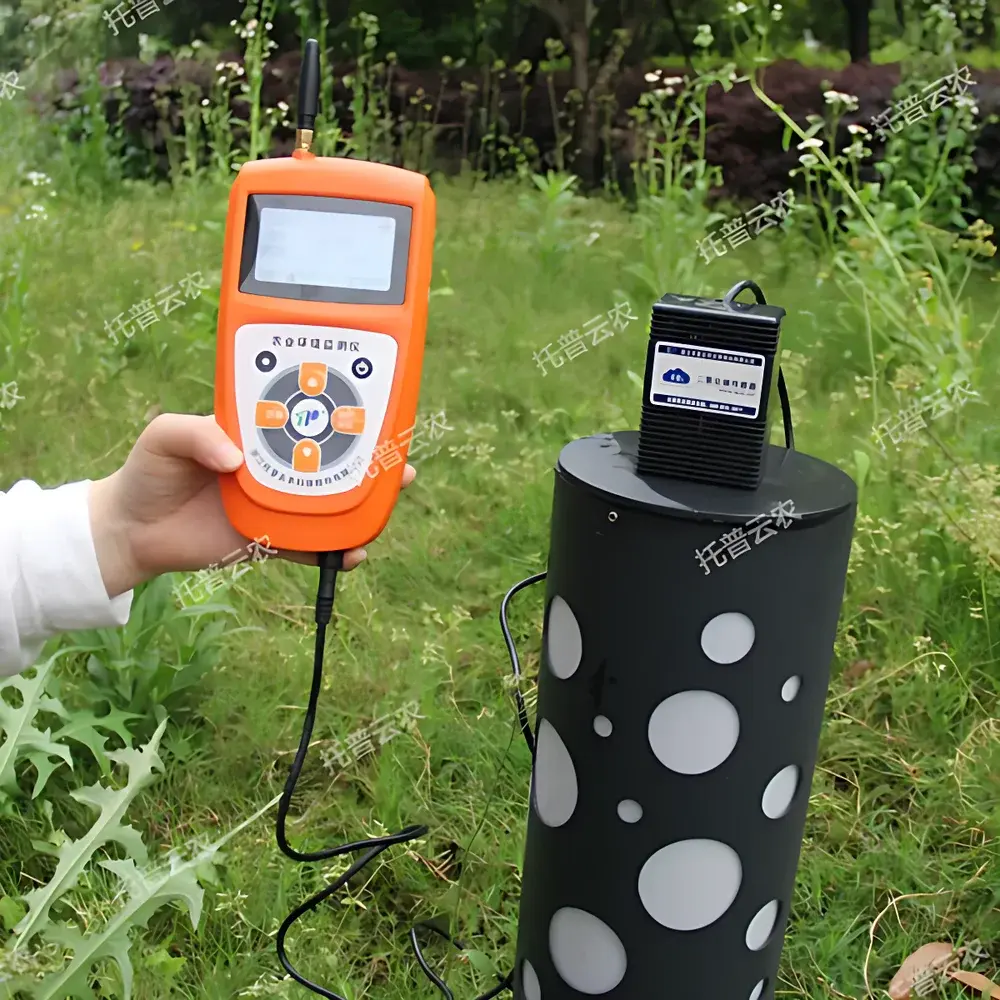
Top Cloud-agri TPJ-26-G Portable Carbon Dioxide Analyzer
| Brand | Top Cloud-agri |
|---|---|
| Origin | Zhejiang, China |
| Manufacturer Type | Direct Manufacturer |
| Instrument Type | Portable |
| Model | TPJ-26-G |
| Measurement Ranges | 0–2000 ppm / 0–5000 ppm |
| Resolution | 1 ppm |
| Accuracy | ±(50 ppm + 3% of reading) |
| GPS Integration | Yes |
| Data Transmission | GPRS-enabled |
| Onboard Storage | 30,000 records (Flash) + optional 4 GB microSD |
| Power Supply | 7.4 V / 2.8 Ah rechargeable Li-ion battery (with low-voltage warning and charging protection) |
| Operating Current | 10 mA (standby), variable under active measurement |
| Sampling Interval | Configurable from 5 minutes to 99 hours |
| Language Interface | Chinese LCD display with Mandarin voice prompts and alarm |
Overview
The Top Cloud-agri TPJ-26-G is a field-deployable, non-dispersive infrared (NDIR) based portable carbon dioxide (CO₂) analyzer engineered for quantitative ambient air monitoring in indoor and outdoor environmental settings. Utilizing dual-wavelength NDIR detection technology, the instrument delivers stable, interference-resistant CO₂ concentration measurements across two selectable full-scale ranges—0–2000 ppm and 0–5000 ppm—optimized for applications ranging from indoor air quality (IAQ) assessment in occupied buildings to occupational hygiene surveys and environmental baseline studies. Its compact form factor, integrated GPS module, and embedded GPRS connectivity enable georeferenced, time-stamped data acquisition without requiring external positioning hardware or manual logbook entries. Designed in accordance with general principles of environmental instrumentation per ISO 16000-23 (Indoor air — Part 23: Determination of carbon dioxide), the TPJ-26-G supports traceable, repeatable field measurements under variable temperature and humidity conditions typical of real-world deployment.
Key Features
- Non-dispersive infrared (NDIR) optical sensing architecture with temperature-compensated detector for long-term signal stability
- Dual-range configuration (0–2000 ppm / 0–5000 ppm) selectable via firmware interface; default factory setting is 0–2000 ppm
- 1 ppm resolution with stated accuracy of ±(50 ppm + 3% of reading), validated across the full dynamic range per manufacturer calibration protocol
- Integrated GPS receiver providing WGS84 coordinates (latitude/longitude) synchronized with each measurement timestamp
- GPRS-based wireless telemetry supporting configurable upload intervals (e.g., every 5 min, hourly, or on-demand) to centralized cloud infrastructure
- Local storage capacity: 30,000 measurement records in internal Flash memory; expandable via removable 4 GB microSD card (FAT32 formatted)
- Rechargeable 7.4 V / 2.8 Ah lithium-ion battery with intelligent charge management, low-voltage alert, and >12-hour continuous operation under typical sampling duty cycles
- Chinese-language OLED display with real-time CO₂ value, date/time stamp, GPS status, memory usage, and battery level indicator
- Voice feedback system supporting Mandarin speech synthesis for measurement confirmation, threshold alerts, and error notifications
- Modular sensor expansion capability via IP67-rated multi-sensor hub (up to 32 channels), enabling co-monitoring of temperature, relative humidity, CO, TVOC, or particulate matter without cross-sensitivity
Sample Compatibility & Compliance
The TPJ-26-G is intended for direct analysis of ambient atmospheric samples drawn via built-in axial fan aspiration. It requires no sample conditioning, scrubbing, or dilution for standard indoor/outdoor use cases. The instrument complies with functional design expectations outlined in ISO 7211-1 (Air quality — Vocabulary) and aligns with measurement practices referenced in national public health guidelines for CO₂ exposure assessment (e.g., China’s WS/T 706–2022 for indoor air quality monitoring). While not certified to EN 12021 or ASTM D6281 for occupational respiratory air testing, its performance envelope meets typical requirements for IAQ screening per ASHRAE Standard 62.1 and WHO Air Quality Guidelines (2021). Calibration traceability is maintained through factory-applied NIST-traceable reference gas verification at 1000 ppm CO₂ prior to shipment.
Software & Data Management
The TPJ-26-G operates within the Top Cloud-agri Instrument Cloud Platform—a secure, browser-accessible C/S architecture platform supporting both web and native mobile clients (iOS and Android). All device-generated data—including CO₂ concentration, GPS coordinates, timestamp, sensor ID, and battery voltage—are transmitted via encrypted GPRS payload or manually imported via USB mass-storage mode. Platform functionalities include: persistent archival with immutable audit trail; exportable CSV/Excel reports; temporal trend visualization with customizable time windows; geospatial mapping overlays using integrated coordinate metadata; and scheduled PDF report generation. The platform enforces role-based access control and supports versioned firmware updates over-the-air (OTA), ensuring consistent operational compliance across heterogeneous device fleets. Data retention policies adhere to local data sovereignty requirements, with server infrastructure hosted in mainland China unless otherwise contracted.
Applications
- Indoor air quality audits in commercial facilities (hotels, shopping malls, hospitals, theaters, schools)
- Public health surveillance by CDC-affiliated institutions and municipal health inspection agencies
- Occupational safety assessments in confined spaces and ventilation-limited work environments
- Environmental baseline studies for green building certification (e.g., LEED, China Green Building Label)
- Educational fieldwork and undergraduate environmental science laboratories requiring portable, student-safe instrumentation
- Urban microclimate monitoring networks integrating CO₂ with meteorological and pollutant parameters
FAQ
What is the recommended calibration frequency for the TPJ-26-G?
Calibration is advised before initial deployment and annually thereafter under normal operating conditions; more frequent verification is recommended if used in high-dust or high-humidity environments.
Does the device support external power during continuous operation?
Yes—8.4 V DC input (≥1000 mA) enables uninterrupted operation while simultaneously charging the internal battery.
Can measurement data be exported in machine-readable formats?
Yes—CSV, Excel (.xlsx), and PDF exports are available via the cloud platform; raw binary logs may be retrieved directly from microSD card.
Is the GPS module capable of logging altitude or speed data?
No—the GPS subsystem provides only latitude, longitude, and UTC timestamp; elevation and velocity are not computed or stored.
How does the instrument handle condensation or high relative humidity?
The NDIR optical path includes hydrophobic filtration and thermal stabilization; however, prolonged exposure above 95% RH may require periodic desiccant maintenance as specified in the user manual.







