
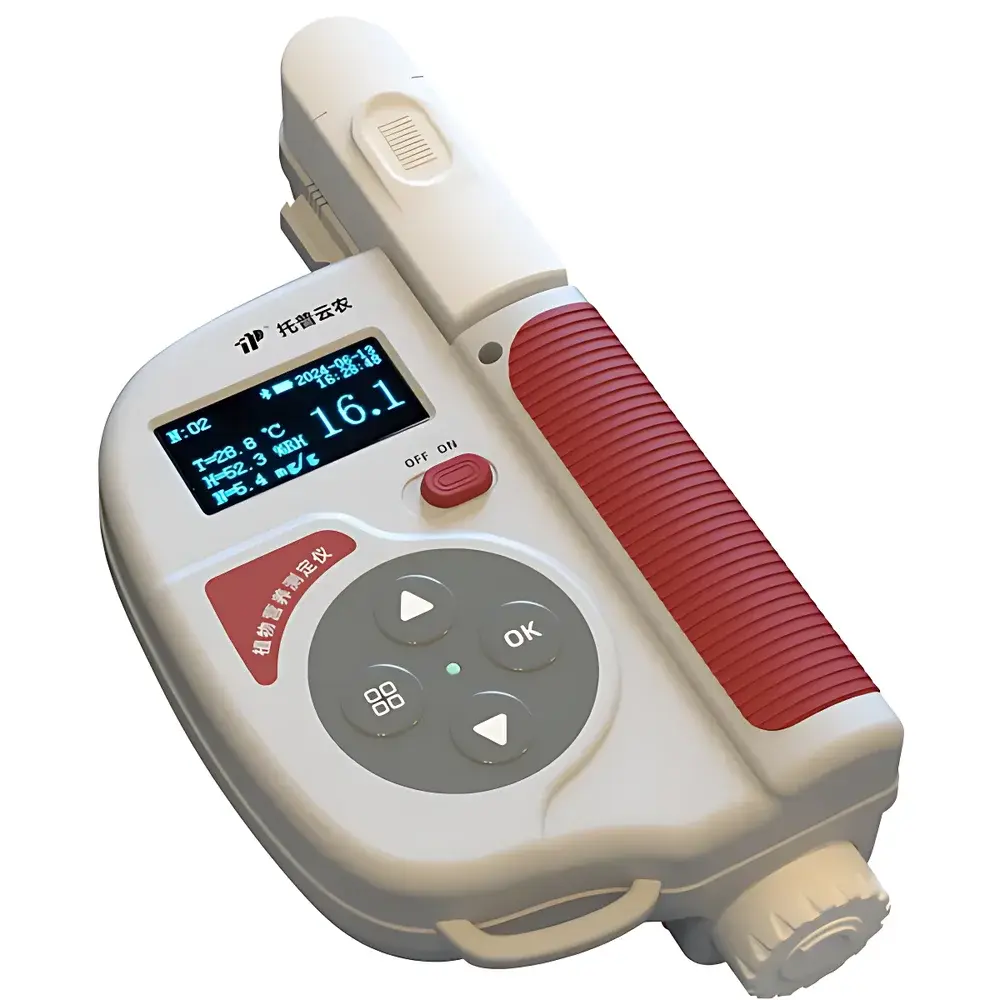
Top Cloud-agri TYS-4N Portable Chlorophyll & Plant Nutrient Analyzer
| Brand | Top Cloud-agri |
|---|---|
| Origin | Zhejiang, China |
| Manufacturer Type | OEM/ODM Manufacturer |
| Country of Origin | China |
| Model | TYS-4N |
| Measurement Range | Chlorophyll (SPAD): 0.0–99.9 SPAD |
| Leaf Surface Temperature | 0–50 °C (customizable) |
| Leaf Relative Humidity | 0.0–99.9 %RH |
| Nitrogen Content | 0.0–99.9 mg/g |
| Measurement Interval | <2 s |
| Measurement Area | 2 mm × 2 mm |
| Accuracy | Chlorophyll: ±1.0 SPAD (at 25 °C, SPAD 0–50) |
| Leaf Temperature | ±0.5 °C |
| Leaf RH | ±5.0 %RH |
| Nitrogen | ±5% |
| Repeatability | Chlorophyll: ±0.3 SPAD |
| Leaf Temperature | ±0.2 °C |
| Leaf RH | ±0.5 %RH |
| Nitrogen | ±0.5 mg/g |
| Display | 1.3″ OLED |
| Data Transfer | Bluetooth 5.0 |
| Power | Two 1.5 V AA batteries (≥5,000 measurements per set) |
| Onboard Storage | 2,000 records |
| Battery Alert | Visual + audible alert at ≤20% charge |
Overview
The Top Cloud-agri TYS-4N Portable Chlorophyll & Plant Nutrient Analyzer is a field-deployable, non-destructive optical instrument engineered for rapid in situ assessment of key physiological indicators in living plant foliage. It operates on dual-wavelength (650 nm and 940 nm) transmittance spectroscopy principles to quantify relative chlorophyll content via the SPAD (Soil-Plant Analysis Development) index—a dimensionless proxy validated against laboratory-extracted chlorophyll concentrations. Concurrently, integrated thermistor and capacitive humidity sensors measure leaf surface temperature and relative humidity, while a calibrated regression algorithm—trained against destructive Kjeldahl or Dumas nitrogen reference data—estimates tissue nitrogen concentration (mg/g dry weight equivalent) from spectral and environmental inputs. Designed for high reproducibility under variable ambient conditions, the device enables real-time monitoring of photosynthetic capacity, water status, thermal stress, and nitrogen sufficiency—parameters critical for phenotyping, precision nutrition management, and ecological field studies.
Key Features
- Non-invasive leaf measurement: Clamping mechanism with 2 mm × 2 mm optical aperture ensures minimal mechanical perturbation; no tissue excision or chemical extraction required.
- Multimodal parameter acquisition: Simultaneous quantification of SPAD-indexed chlorophyll, leaf surface temperature (°C), relative humidity (%RH), and estimated nitrogen content (mg/g) in a single 2-second cycle.
- Optical interference mitigation: Dual-layer light-shielding leaf chamber with internal baffling and ambient-light compensation algorithms minimizes spectral contamination from solar irradiance and reflected glare.
- High-resolution OLED interface: 1.3-inch monochrome OLED display delivers crisp contrast and wide viewing angles, enabling legible readings under full sunlight or low-light field conditions.
- On-device statistical processing: Computes and displays rolling statistics (mean, min, max) across the most recent 30 measurements—facilitating immediate trend recognition without external software.
- Low-power architecture: Optimized circuitry supports ≥5,000 consecutive measurements on two standard AA alkaline cells; intelligent power management includes auto-sleep and battery-level warning at ≤20% remaining charge.
Sample Compatibility & Compliance
The TYS-4N is compatible with dicot and monocot leaves up to 1.2 mm thickness—including but not limited to maize, rice, wheat, soybean, tomato, Arabidopsis, and broadleaf ornamentals. Its measurement protocol aligns with established agronomic field practices referenced in ISO 10212:2021 (Plant nutrition—Determination of chlorophyll by optical methods) and ASTM D7720-18 (Standard Guide for Statistical Sampling and Monitoring of In-Field Crop Parameters). While not certified for regulatory GLP or GMP environments, its calibration traceability, repeatability metrics (±0.3 SPAD), and documented uncertainty budgets support use in ISO/IEC 17025-accredited research laboratories conducting plant physiology validation studies. Device firmware and cloud platform architecture comply with GDPR-compliant data handling protocols for anonymized field data transmission.
Software & Data Management
Data synchronization occurs via Bluetooth 5.0 to the proprietary Top Cloud-agri PlantPhysio™ mobile application (iOS/Android), which provides timestamped georeferenced logging, sample annotation (name, ID, location, image capture), and Excel export functionality. All measurements—including embedded metadata and optional photo attachments—are encrypted during transfer and stored locally on-device (2,000 records) and remotely on the Top Cloud-agri AgriData Cloud Platform. The cloud interface supports role-based access control, time-series filtering (by date, crop type, treatment group), and automated visualization: dynamic line charts for longitudinal SPAD trends, comparative bar graphs for inter-plot nitrogen differentials, and scatter plots correlating chlorophyll with leaf temperature. For agronomic decision support, the platform integrates user-input fertilizer composition and uptake efficiency parameters to generate nitrogen balance reports and site-specific top-dressing recommendations—aligned with FAO’s Fertilizer Use Efficiency Framework.
Applications
- Field-based nitrogen use efficiency (NUE) trials across cereal and horticultural cropping systems
- Early detection of abiotic stress (drought, heat, nutrient deficiency) via SPAD–temperature–humidity triad analysis
- Validation of remote sensing vegetation indices (e.g., NDVI, PRI) using ground-truth SPAD and nitrogen data
- Phenotyping programs assessing genetic variation in chlorophyll retention under senescence or stress
- Extension services delivering real-time nutrient diagnostics to smallholder farmers via mobile-linked advisory modules
- University teaching labs demonstrating plant physiological responses to controlled-environment treatments
FAQ
What calibration standards are used for SPAD and nitrogen estimation?
The SPAD algorithm is factory-calibrated against NIST-traceable optical reference tiles and verified using leaf discs analyzed via spectrophotometric chlorophyll extraction (Arnon method). Nitrogen regression models are derived from >1,200 paired field samples tested against AOAC 990.03-compliant combustion analysis.
Can the device operate in high-humidity tropical environments?
Yes—the sealed leaf chamber and conformal-coated sensor electronics meet IP54 ingress protection rating; RH accuracy remains within ±5% up to 95% ambient RH at 35°C.
Is raw spectral data accessible for custom modeling?
No—the device outputs only processed parameters (SPAD, °C, %RH, mg/g); spectral reflectance/transmittance files are not exposed to users per current firmware architecture.
How frequently should field recalibration be performed?
Annual verification against reference leaf standards is recommended; no user-serviceable recalibration is required under normal operating conditions.
Does the cloud platform support API integration with farm management software (FMS)?
Yes—RESTful JSON APIs are available under enterprise licensing agreements, enabling bidirectional sync with platforms such as Granular, Climate FieldView, and FarmLogs.




