
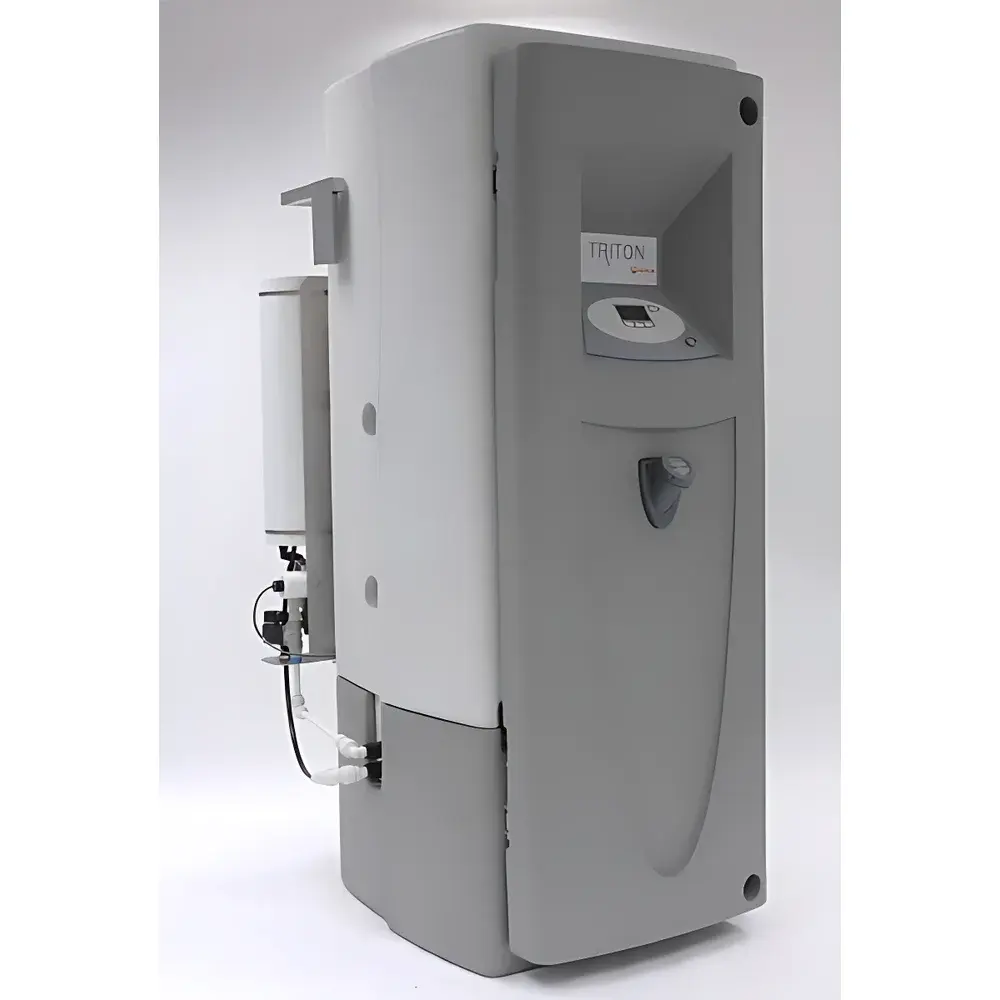
TRITON Integrated Ultra-Pure Water System by ELGA Veolia
| Brand | ELGA Veolia |
|---|---|
| Origin | Shanghai, China |
| Manufacturer Type | OEM Manufacturer |
| Origin Category | Domestic (China) |
| Model | TRITON |
| Pure Water Grade | ASTM Type II |
| Resistivity | 1–18.2 MΩ·cm at 25 °C |
| Heavy Metals & Soluble Silica | <0.1 ppb |
| Total Organic Carbon (TOC) | <10 ppb |
| Microbial Count | <0.25 EU/mL |
| Particulates (>0.1 µm) | <1 particle/mL |
| Flow Rate Options | 160, 240, 350, or 480 L/h |
Overview
The TRITON Integrated Ultra-Pure Water System is an engineered solution developed by ELGA Veolia for laboratories requiring consistent, high-reliability Type II pure water and on-demand ultrapure water (UPW) in research, clinical trial support, and early-stage process development environments. Designed around a closed-loop purification architecture, the system integrates reverse osmosis (RO), electrodeionization (EDI), and dual-wavelength UV photo-oxidation (185/254 nm) within a single compact footprint. Its core measurement principle relies on real-time resistivity monitoring (via temperature-compensated conductivity cells), TOC oxidation-detection via UV/persulfate catalysis, and end-point microbial control through continuous recirculation and integrated ultraviolet irradiation. The system meets ASTM D1193-20 (Type II specification), ISO 3696:1987 (Grade 2), and supports alignment with USP water quality guidance for pharmaceutical R&D applications.
Key Features
- Integrated modular design: All purification stages—including RO pre-treatment, EDI polishing, 350 L insulated storage tank, UV-based TOC reduction, and optional ultrafiltration (UF) for endotoxin removal—are housed within a single enclosure.
- Secure access architecture: Parameter configuration, maintenance logs, and system diagnostics require physical key authentication to prevent unauthorized modification—supporting GLP/GMP-aligned operational integrity.
- Low-noise operation: Acoustic emission maintained below 45 dB(A) at 1 m distance, enabling deployment in shared laboratory spaces without acoustic interference.
- Active temperature stabilization: Internal tank and distribution loop maintain water at 20–25 °C ±1.5 °C to minimize microbial proliferation and ensure stable resistivity readings.
- Space-optimized footprint: Occupies less than 0.8 m² floor area while delivering flow rates scalable from 160 to 480 L/h—ideal for pilot-scale labs transitioning from discovery to process validation.
Sample Compatibility & Compliance
The TRITON system produces water suitable for analytical instrumentation (e.g., HPLC mobile phase preparation, ICP-MS diluent, GC rinse solvents), cell culture media formulation, and reagent-grade buffer preparation. Its output complies with ASTM Type II specifications and exceeds ISO 3696 Grade 2 requirements for conductivity, TOC, and particle content. Optional UF modules reduce endotoxin levels to <0.25 EU/mL—meeting USP criteria for water used in parenteral formulation development. All critical sensors (resistivity, TOC, UV intensity, flow, pressure) are calibrated traceable to NIST standards. Audit trails, user access logs, and event timestamps are retained for ≥12 months to support FDA 21 CFR Part 11 readiness when paired with ELGA’s optional compliance software package.
Software & Data Management
The TRITON features an embedded touchscreen HMI with intuitive navigation and multilingual interface (English, Chinese, Japanese). Real-time water quality parameters—including resistivity, TOC, UV lamp status, filter saturation indicators, and pump runtime—are continuously logged with timestamped entries. Data export is supported via USB or Ethernet (Modbus TCP) for integration into LIMS or centralized lab informatics platforms. Optional cloud-enabled remote monitoring allows authorized personnel to receive SMS/email alerts for maintenance events (e.g., cartridge replacement due date, UV lamp aging threshold exceeded). All configuration changes trigger immutable audit records including operator ID, timestamp, and previous/updated values—enabling full traceability per ALCOA+ principles.
Applications
- Clinical trial material (CTM) manufacturing: Consistent Type II water supply for non-sterile API handling, excipient dissolution, and stability study sample preparation.
- Process feasibility and pilot-scale development: Scalable flow options support tech transfer from benchtop to 10–100 L batch synthesis workflows.
- Biopharmaceutical R&D: UF-equipped configurations provide low-endotoxin water for monoclonal antibody buffer exchange and column cleaning protocols.
- Materials science labs: Low-metal, low-silica water minimizes interference in thin-film deposition, nanoparticle synthesis, and electrochemical characterization.
- Academic core facilities: Modular expandability and secure access control accommodate multi-user environments with differentiated permission tiers.
FAQ
What water grade does the TRITON system produce?
It delivers ASTM Type II pure water as standard; with optional ultrafiltration and enhanced UV treatment, it achieves ultrapure water meeting USP specifications for critical R&D use.
Is the system compliant with FDA 21 CFR Part 11 requirements?
Out-of-the-box electronic records meet foundational data integrity criteria; full Part 11 compliance requires activation of the ELGA Compliance Suite, including digital signatures, role-based access, and electronic audit trail export.
Can the TRITON be integrated into an existing lab water network?
Yes—it supports both point-of-use delivery and connection to centralized distribution loops via sanitary tri-clamp or ISO 8536-compliant fittings.
How often do consumables require replacement?
RO membranes typically last 2–3 years under typical feed water conditions (TDS <200 ppm); EDI stacks exceed 5 years; UV lamps are rated for 12,000 hours; pre-filters and final UF cartridges follow usage-based scheduling tracked automatically by the onboard system.
Does the system support remote diagnostics?
With optional Ethernet connectivity and ELGA Connect subscription, field engineers can perform secure remote health checks, firmware updates, and troubleshooting—reducing downtime and service dispatch frequency.



