
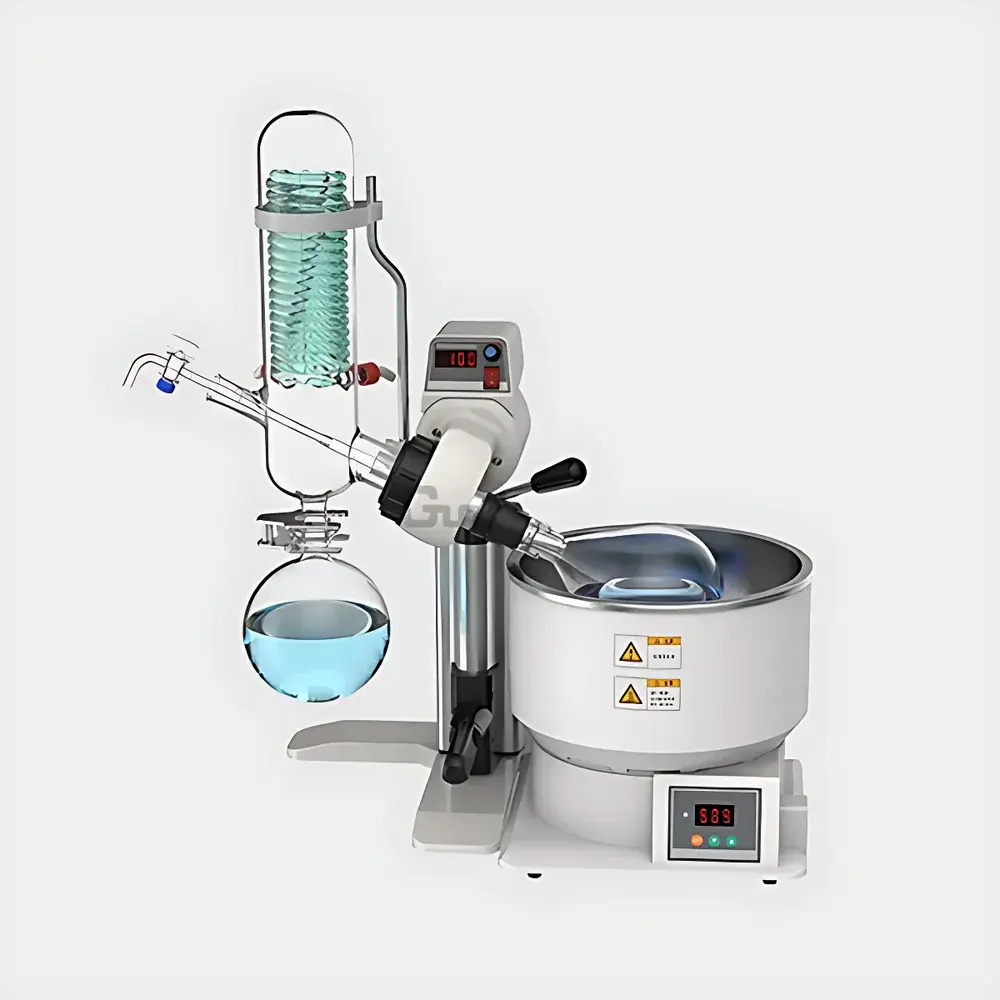
Truelab R-1001 Manual-Lift Rotary Evaporator
| Brand | Truelab |
|---|---|
| Origin | Shanghai, China |
| Model | R-1001 |
| Capacity | 0.9 L |
| Ultimate Vacuum | 1 mbar |
| Rotation Speed | 20–180 rpm |
| Bath Temperature Range | Ambient +5°C to 95°C |
| Temperature Control Accuracy | ±1.5°C (nominal), 0.1°C resolution |
| Condenser Surface Area | 0.126 m² |
| Sealing | Dual PTFE + FKM O-rings |
| Rotating Flask Tilt Angle | 15°–45° |
| Bath Material | 06Cr19Ni10 stainless steel (Φ254 mm × 130 mm) |
| Glassware | DIN ISO 3585 borosilicate 3.3 |
| Power Supply | 220–240 V~, 50/60 Hz |
| Heating Power | 1050 W |
| Total Power Consumption | 1080 W |
| IP Rating | IP20 |
| Max. Altitude | 2000 m |
| Operating Environment | 5–35°C, ≤70% RH |
Overview
The Truelab R-1001 Manual-Lift Rotary Evaporator is a precision-engineered benchtop system designed for efficient solvent removal, sample concentration, and gentle distillation under reduced pressure. It operates on the principle of rotary evaporation—combining controlled rotation of the sample flask, regulated heating of the water or oil bath, and vacuum-assisted lowering of the solvent’s boiling point—to achieve rapid, reproducible, and thermally sensitive separations. Engineered for reliability in academic laboratories, QC environments, and pilot-scale R&D, the R-1001 delivers consistent performance across diverse organic, aqueous, and semi-polar solvent systems. Its modular architecture—featuring a detachable heating bath and rigid support frame—enables flexible integration with external vacuum pumps, recirculating chillers, and cold traps, ensuring compatibility with standard laboratory infrastructure.
Key Features
- Manual vertical lift mechanism with smooth, backlash-free linear motion and secure mechanical locking at any height—optimized for safe flask installation and removal without compromising vacuum integrity.
- Dual-seal design using PTFE inner gaskets and fluorocarbon (FKM) outer O-rings ensures long-term vacuum stability and chemical resistance against common solvents including acetone, ethanol, ethyl acetate, and dichloromethane.
- Adjustable rotating flask tilt angle (15°–45°) accommodates standard 24/40 and 40/45 ground-glass joints, supporting both 500 mL and 1000 mL evaporation flasks for scalable throughput.
- PID-controlled digital temperature regulation (±1.5°C nominal accuracy, 0.1°C display resolution) using a calibrated PT-100 sensor embedded in the 06Cr19Ni10 stainless steel bath (Φ254 mm × 130 mm).
- Stepless electronic speed control (20–180 rpm) with real-time digital RPM readout ensures precise rotational shear management—critical for foaming-prone or viscous samples.
- High-efficiency dual-path condenser with 0.126 m² effective cooling surface area maximizes condensate recovery and minimizes solvent loss, even during extended runs.
- All glass components conform to DIN ISO 3585 specifications for borosilicate 3.3 glass—offering thermal shock resistance (>150 K), low coefficient of expansion (3.3 × 10⁻⁶ K⁻¹), and high hydrolytic stability (Class HGB 1 per ISO 719).
Sample Compatibility & Compliance
The R-1001 supports a broad range of sample types, including heat-labile natural extracts (e.g., terpenes, polyphenols), pharmaceutical intermediates, polymer solutions, and food-grade concentrates. Its construction materials—borosilicate 3.3 glass, PTFE, FKM, and passivated stainless steel—are compliant with USP , FDA 21 CFR Part 177, and EU Regulation (EC) No. 1935/2004 for indirect food contact. While not certified for GMP manufacturing, the system meets GLP documentation requirements when paired with validated external vacuum and cooling units. Vacuum stability (≤0.33 kPa/min leakage rate) supports operation down to 1 mbar, enabling distillation of solvents with boiling points up to 150°C at atmospheric pressure—such as toluene (bp 111°C), DMF (bp 153°C), and NMP (bp 202°C)—under mild thermal conditions.
Software & Data Management
The R-1001 operates as a standalone analog-digital hybrid instrument with no embedded firmware or network interface. All operational parameters—including bath temperature, rotation speed, and run duration—are manually set and digitally displayed via front-panel LED indicators. For traceability in regulated environments, users are advised to log settings and observations manually or integrate the unit with external data acquisition systems (e.g., LabVIEW or custom SCADA) via optional analog voltage outputs (0–10 V) for temperature and speed signals. The absence of onboard software eliminates cybersecurity risks and simplifies 21 CFR Part 11 compliance pathways when used in conjunction with validated electronic lab notebooks (ELNs) and audit-trail-enabled environmental monitoring systems.
Applications
- Natural Product Extraction: Gentle concentration of botanical infusions (e.g., rosemary extract, green tea catechins) without thermal degradation—preserving volatile aroma compounds and antioxidant activity.
- Food & Beverage R&D: Low-temperature juice concentration (e.g., citrus, berry), coffee essence recovery, and wine aroma fractionation while retaining sensory profiles.
- Academic Teaching: Demonstrating Raoult’s law, vapor pressure depression, and azeotropic behavior in undergraduate organic chemistry labs.
- Pharmaceutical Process Development: Solvent exchange prior to lyophilization, removal of reaction residuals (e.g., THF, DCM), and API intermediate purification under inert atmosphere (when coupled with nitrogen purge).
- Fine Chemical Synthesis: Continuous thin-film evaporation of high-boiling-point solvents in catalyst recovery workflows and chiral resolution protocols.
FAQ
What vacuum level is required for optimal operation?
A stable vacuum of ≤10 mbar is recommended for most applications; the system achieves reliable operation down to 1 mbar when paired with a two-stage rotary vane pump and appropriate cold trap.
Can the R-1001 be used with corrosive solvents like HCl or HF?
No. While PTFE and FKM seals resist many organics and weak acids, hydrochloric acid, hydrofluoric acid, and strong oxidizers (e.g., nitric acid, bromine) will degrade seals and attack borosilicate glass over time.
Is the heating bath compatible with silicone oil?
Yes—the stainless steel bath is rated for continuous use with silicone oils up to 200°C; however, the standard temperature controller is limited to 95°C, requiring external PID control for higher-temperature applications.
What maintenance is required for long-term vacuum integrity?
Biannual inspection of PTFE/FKM seals, cleaning of ground-glass joints with ethanol, and verification of bath sensor calibration using a reference thermometer are recommended.
Does the R-1001 support automatic distillate collection switching?
No. Fraction collection requires manual flask exchange or integration with third-party fraction collectors via external trigger signals.



