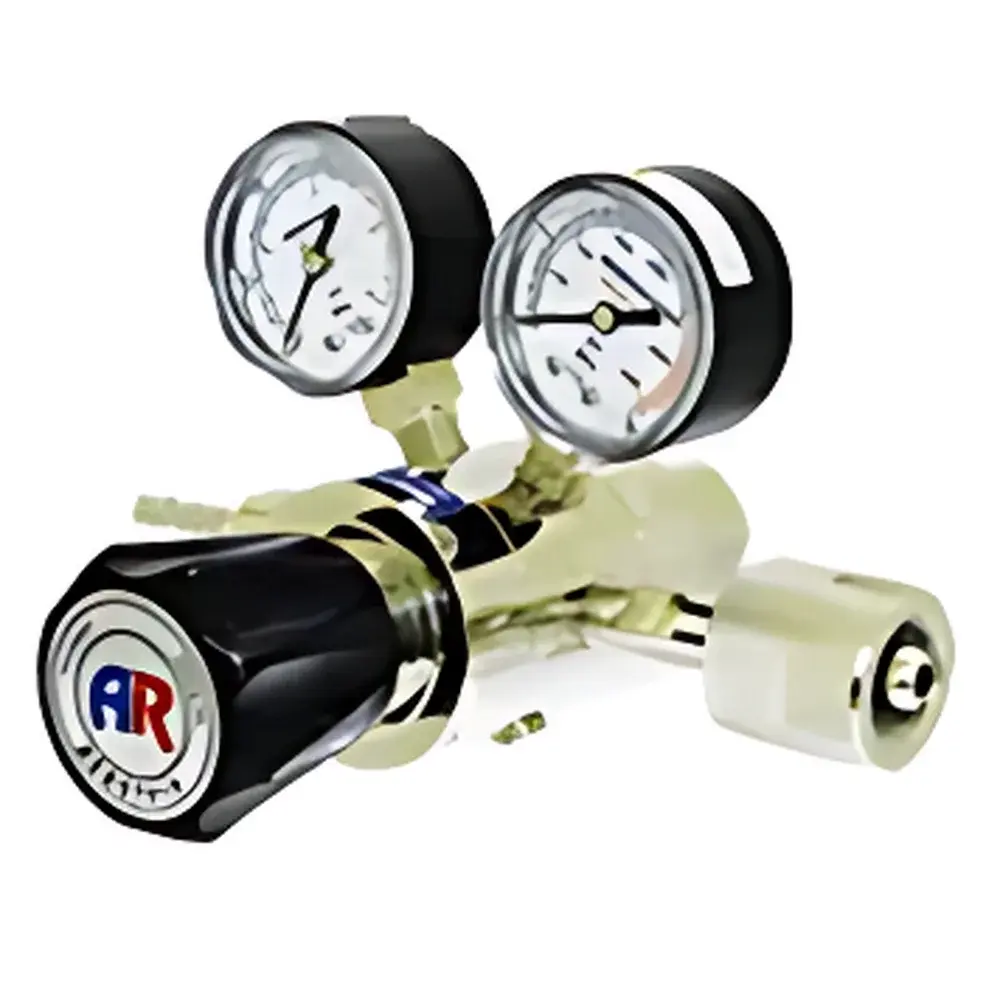
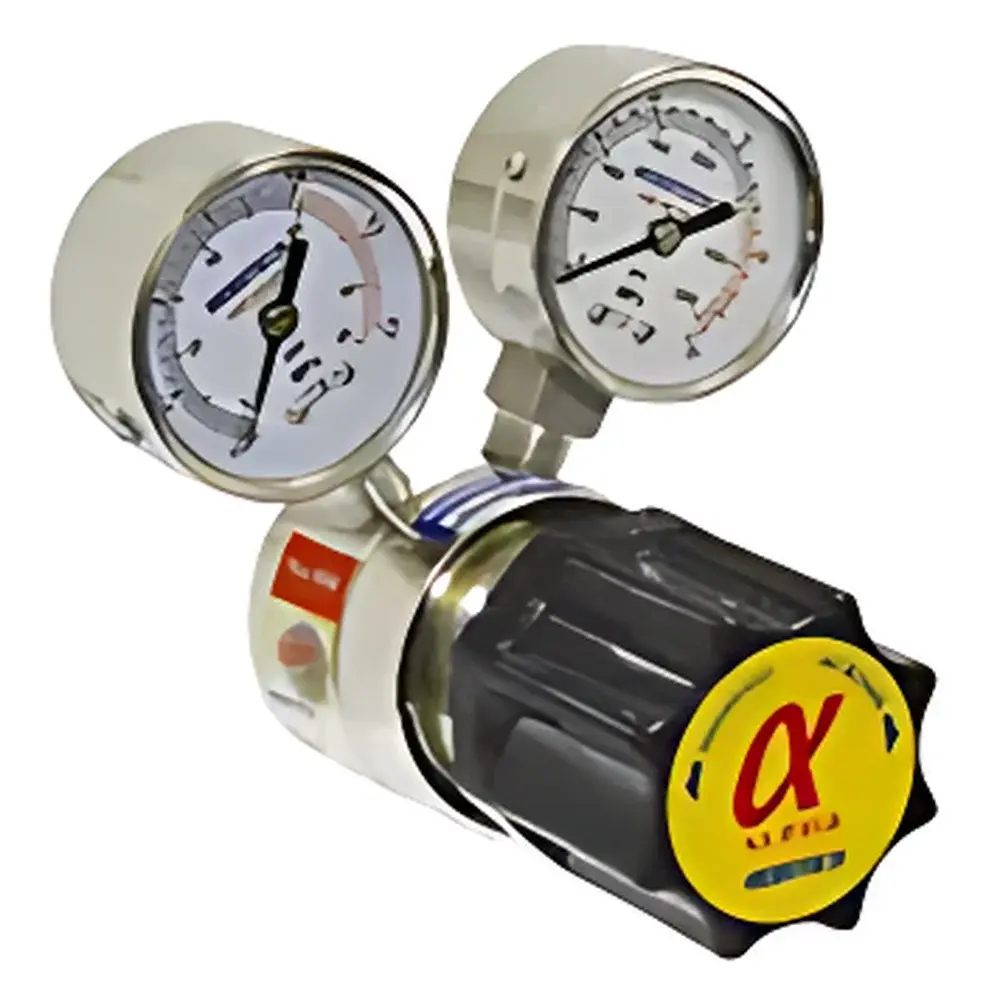
Truelab A-1H High-Purity Gas Pressure Regulator for Hydrogen, Nitrogen & Helium
| Key | Brand: Truelab |
|---|---|
| Origin | Beijing, China |
| Model Series | A-1H / A-2H / Ba-1H / Ba-2H / Sa-1H / Sa-2H |
| Inlet Pressure Range | 0–15 MPa |
| Outlet Pressure Range | 0–0.12 / 0.4 / 0.6 / 0.99 MPa |
| High-Pressure Gauge Range | 0–25 MPa |
| Low-Pressure Gauge Range | 0–0.16 / 0.6 / 1 / 1.6 MPa |
| Inlet Connection | G5/8 (RH), W21.8-14 (RH or LH) |
| Outlet Connection | 8 mm soft tubing with threaded ferrule |
| Material | Brass body with stainless steel diaphragm and internal components (A-series) |
| Dead Volume | < 1.2 mL |
| Operating Temperature | –10 °C to +50 °C |
| Compliance | Designed per ISO 8503-2 (surface profile), compatible with ASTM E2653 (gas purity verification protocols), suitable for GLP/GMP environments requiring traceable gas delivery |
Overview
The Truelab A-1H is a high-integrity single-stage pressure regulator engineered for precise, stable, and contamination-free delivery of high-purity gases—including hydrogen (H₂), nitrogen (N₂), and helium (He)—in analytical laboratory and industrial process control applications. Unlike general-purpose industrial regulators, the A-1H series is purpose-built for integration with sensitive instrumentation such as gas chromatographs (GC), GC-mass spectrometers (GC-MS), atomic absorption spectrometers (AA), and other gas-dependent analytical platforms. Its design prioritizes minimal dead volume, low adsorption surface area, and chemically inert internal pathways—critical parameters when maintaining gas integrity below 1 ppm total hydrocarbon and moisture levels. The regulator operates on a direct-acting diaphragm principle: inlet pressure acts against a calibrated spring-loaded diaphragm to modulate valve orifice opening, delivering consistent outlet pressure independent of fluctuating cylinder supply pressure or downstream flow demand—within its specified operating envelope.
Key Features
- Optimized for ultra-low dead volume (< 1.2 mL), enabling rapid gas purging and minimizing cross-contamination between analyses.
- Interchangeable inlet connections accommodate common cylinder valve threads: G5/8 (right-hand), W21.8-14 (right-hand and left-hand), ensuring compatibility with international gas cylinder standards (DIN 477, CGA, BS 341).
- Standardized 8 mm OD soft-tube outlet with integrated threaded ferrule enables leak-tight connection to PTFE, stainless steel, or copper tubing without additional adapters.
- Two-tier pressure indication: high-pressure gauge (0–25 MPa) for real-time cylinder pressure monitoring; low-pressure gauge (selectable ranges: 0–0.16, 0.6, 1, or 1.6 MPa) for accurate regulation feedback.
- A-series features brass body with 316 stainless steel diaphragm and internal wetted parts; Ba- and Sa-series offer full 316 SS construction for enhanced corrosion resistance and ultra-high-purity service (e.g., semiconductor-grade He, UHP H₂).
- Smooth, linear pressure adjustment via knurled stainless steel control knob with tactile feedback and fine-threaded stem for reproducible setpoint repeatability (±0.5% of full scale).
Sample Compatibility & Compliance
The A-1H series is validated for non-corrosive, non-reactive gases including N₂, O₂, Ar, He, H₂, and CO₂. It is not rated for use with halogenated gases, ammonia, hydrogen sulfide, or any oxidizing or acidic media. All models comply with mechanical safety requirements outlined in PED 2014/68/EU for Category I pressure equipment (PN ≤ 15 MPa). Wetted materials meet USP Class VI biocompatibility standards for elastomer components (where applicable). When deployed in regulated environments (e.g., pharmaceutical QC labs), the regulator supports audit-ready operation when paired with documented calibration certificates (NIST-traceable), maintenance logs, and change-control records—fully aligning with FDA 21 CFR Part 11 data integrity expectations for instrument-associated gas delivery systems.
Software & Data Management
While the A-1H is a purely mechanical, analog pressure regulation device with no embedded electronics or digital interface, it integrates seamlessly into automated gas management ecosystems. Its standardized outlet port and stable pressure output allow reliable interfacing with external pressure transmitters (e.g., 4–20 mA or HART-enabled sensors), PLC-controlled solenoid manifolds, and centralized gas monitoring platforms. Users may log inlet/outlet pressures manually or via connected DAQ systems; Truelab provides optional calibration documentation packages—including as-found/as-left reports, uncertainty budgets, and ISO/IEC 17025-compliant calibration certificates—for integration into LIMS or ELN workflows.
Applications
- Carrier and fuel gas supply for GC and GC-MS systems requiring stable, pulse-free flow profiles.
- Shield gas regulation in laser ablation ICP-MS sample introduction circuits.
- Calibration gas delivery in environmental air monitoring stations (e.g., EPA Method TO-15, ASTM D6420).
- H₂ supply for PEM fuel cell test benches and electrochemical reactors where pressure stability directly affects current density reproducibility.
- N₂ blanketing in pharmaceutical lyophilization and API synthesis reactors under cGMP conditions.
- He carrier gas for residual gas analyzers (RGA) and vacuum chamber leak detection systems.
FAQ
What gases are approved for use with the A-1H regulator?
Hydrogen (H₂), nitrogen (N₂), helium (He), argon (Ar), oxygen (O₂), and carbon dioxide (CO₂) — provided they are free of corrosive contaminants and maintained within dew point specifications (< –40 °C).
Can the A-1H be used for oxygen service?
Yes, but only when cleaned and certified for oxygen service (oil- and hydrocarbon-free); standard units require dedicated O₂ cleaning per CGA G-4.1 prior to first use.
Is the A-1H compatible with DIN 477 No. 5 cylinder valves?
Yes — the W21.8-14 (LH) inlet option matches DIN 477 No. 5 left-hand thread configuration used for flammable gases including H₂ and C₂H₂.
What is the recommended recalibration interval?
Annual calibration is advised for regulated environments; more frequent verification (e.g., quarterly) is recommended when used in critical applications or following physical impact or exposure to extreme temperature cycling.
Do Ba-series and Sa-series regulators require special handling during installation?
Yes — full stainless steel bodies exhibit higher thermal conductivity; install with appropriate thermal breaks in cryogenic or high-temperature ambient settings to prevent condensation or heat-induced pressure drift.
Related Products