
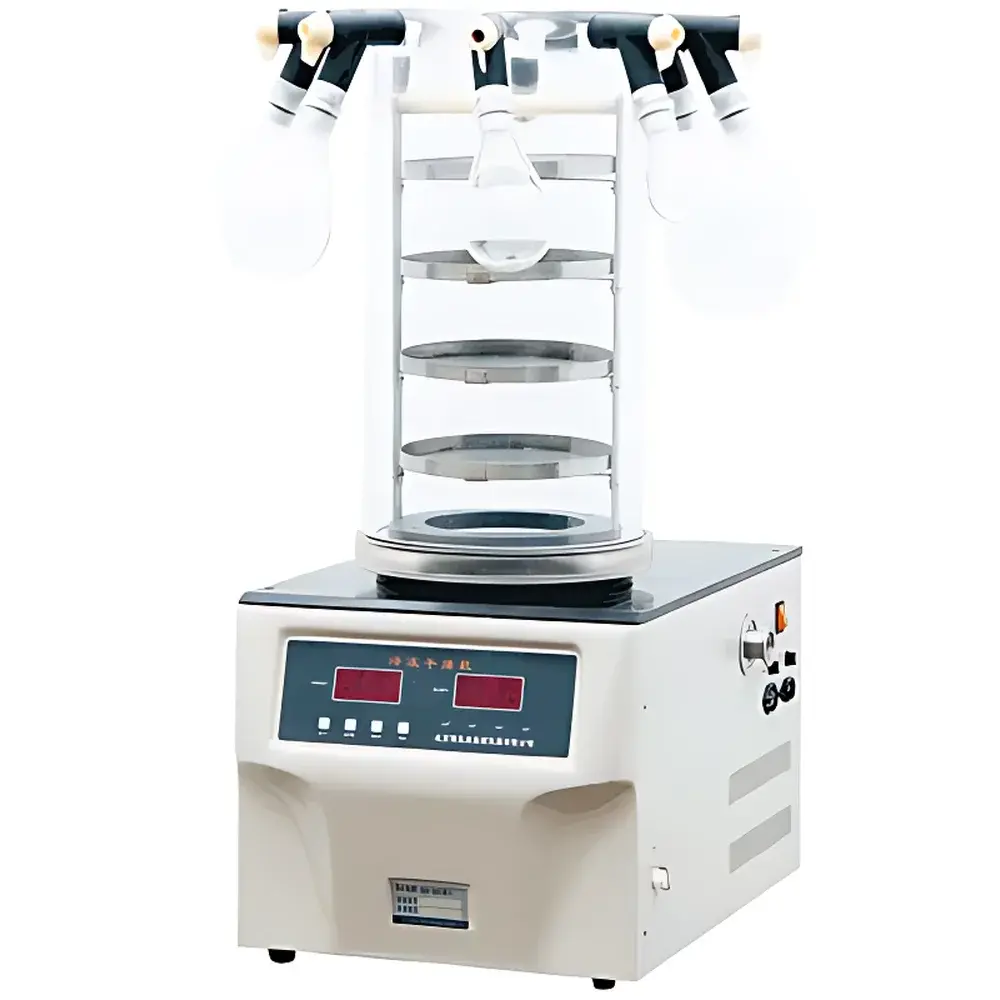
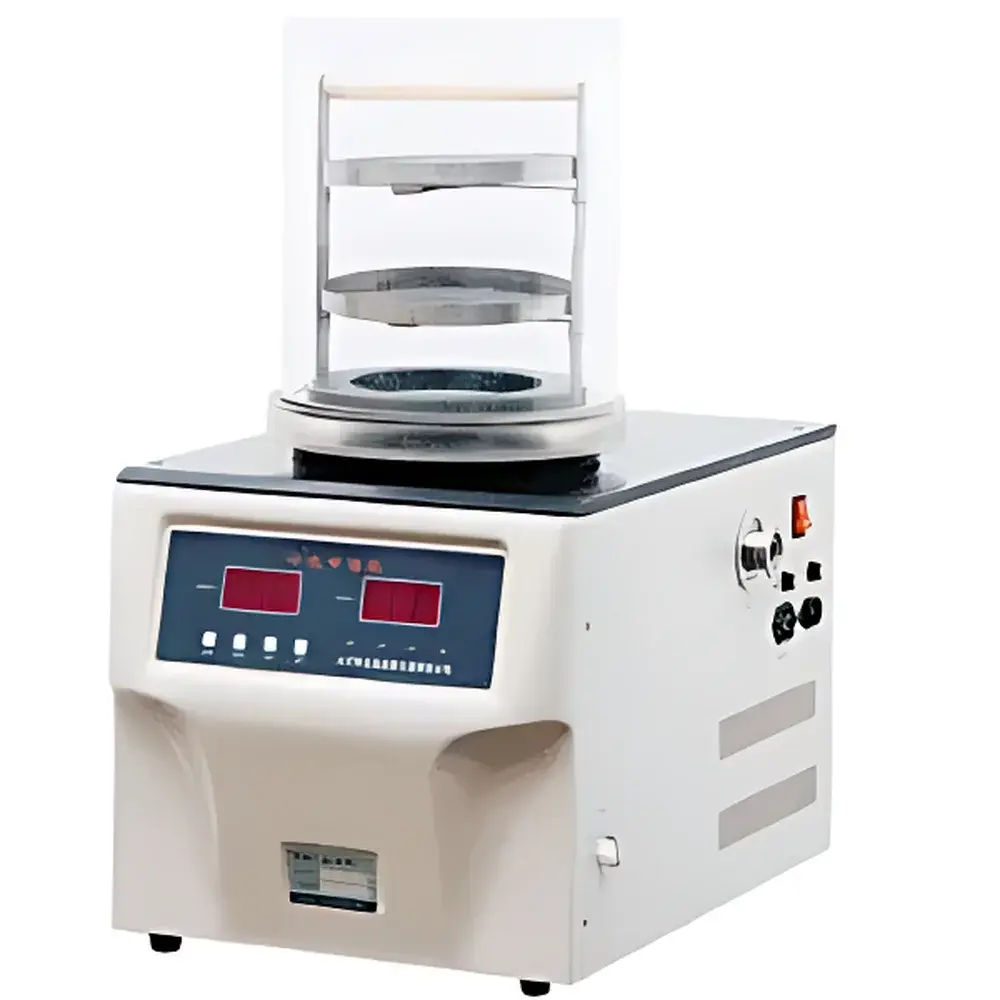
Truelab FD-1A-50 Benchtop Freeze Dryer
| Brand | Truelab |
|---|---|
| Origin | Shanghai, China |
| Model | FD-1A-50 |
| Instrument Type | Standard Shelf-Type Freeze Dryer |
| Application | Laboratory-Scale Lyophilization |
| Freeze-Drying Area | 0.12 m² |
| Ultimate Vacuum | < 20 Pa |
| Condenser Temperature | −50 °C |
| Water Capture Capacity | 3 kg/24 h |
| Condenser Dimensions | Stainless Steel, Open-Top Design with Pre-Freezing Capability |
| Shelf Configuration | 4 Adjustable Stainless Steel Trays (Φ200 mm) |
| Tray Capacity | ~1.2 L (at 10 mm sample depth) |
| Power Supply | 220 V, 50 Hz, 850 W |
| Unit Dimensions | 380 × 600 × 345 mm |
| Compliance | Designed for GLP-aligned laboratory workflows |
| Software Interface | Digital Vacuum & Temperature Display (Optional Sample Temperature Monitoring) |
Overview
The Truelab FD-1A-50 is a compact, benchtop shelf-type freeze dryer engineered for reliable, reproducible lyophilization of heat-sensitive biological and pharmaceutical materials in research and quality control laboratories. Operating on the principle of sublimation—where ice transitions directly from solid to vapor under deep vacuum and low temperature—the system enables gentle dehydration without thermal degradation. With a condenser temperature of −50 °C and ultimate vacuum capability below 20 Pa, the FD-1A-50 achieves efficient primary drying for samples such as enzymes, monoclonal antibodies, microbial cultures, and small-molecule APIs. Its modular architecture supports multiple drying configurations—including bulk material processing in stainless steel trays, vial-based lyophilization using optional chamber assemblies, and ampoule or flask drying via multi-port manifolds—making it adaptable across early-stage formulation development, stability testing, and strain preservation protocols.
Key Features
- Robust condenser system fabricated from electropolished stainless steel, featuring an open-top design that permits direct pre-freezing of small-volume samples within the cold trap
- Four independently adjustable stainless steel shelves (Φ200 mm), optimized for uniform heat transfer and flexible loading; total usable area: 0.12 m²
- Imported hermetic refrigeration compressor delivering stable −50 °C condenser performance with low acoustic emission (<55 dB(A))
- Patented baffle-guided airflow design enhances condenser surface efficiency and water vapor capture kinetics
- Standard digital interface displaying real-time chamber pressure (in Pa) and condenser temperature (±0.5 °C accuracy); optional probe-based sample temperature monitoring available
- ISO-standard KF-16 vacuum flange enables seamless integration with external vacuum pumps—including oil-free scroll, diaphragm, or two-stage rotary vane units
- Gas inlet valve compatible with dry nitrogen or inert gas backfilling (e.g., argon), supporting oxygen-sensitive formulations and residual moisture control
- Transparent acrylic drying chamber (non-bonded, injection-molded construction) provides full process visibility and eliminates seal-related leakage risks
Sample Compatibility & Compliance
The FD-1A-50 accommodates diverse sample formats without hardware modification: bulk suspensions in stainless trays (up to 1.2 L at 10 mm depth), serum vials (with optional stoppering chamber), Erlenmeyer flasks (via manifold kit), and sealed ampoules (using T-shaped manifold accessory). All wetted surfaces comply with ISO 8573-1 Class 3 compressed air purity standards when used with appropriate filtration. While not certified for GMP manufacturing environments, the unit supports GLP-compliant documentation practices through manual logbook entries and optional data export (RS232/USB). It meets general safety requirements per IEC 61010-1:2010 for laboratory electrical equipment and operates within ambient temperature ranges of 15–30 °C and relative humidity ≤70% non-condensing.
Software & Data Management
The FD-1A-50 employs an embedded microcontroller-based control system with dual-channel digital display—vacuum level (0–1000 Pa range, resolution 1 Pa) and condenser temperature (−60 to +50 °C, resolution 0.1 °C). No proprietary software is required for basic operation; however, optional PC connectivity allows time-stamped logging of pressure and temperature profiles for audit-ready records. When paired with validated vacuum pumps and calibrated thermocouples, the system supports traceable process documentation aligned with FDA 21 CFR Part 11 expectations for electronic records—provided users implement appropriate procedural controls (e.g., password-protected access, operator ID entry, and change logs).
Applications
- Stabilization of labile biologics including vaccines, cytokines, and recombinant proteins
- Long-term preservation of bacterial and fungal strains for culture collections
- Preparation of reference standards and calibration materials in analytical chemistry labs
- Drying of botanical extracts, nutraceuticals, and functional food ingredients while retaining bioactive integrity
- Method development and cycle optimization prior to scale-up on pilot or production freeze dryers
- Routine QC testing of lyophilized dosage forms in pharmaceutical R&D settings
FAQ
Can the FD-1A-50 be used for sterile processing?
No—it lacks integrated sterilization capability or ISO Class 5 cleanroom compatibility. Aseptic handling must occur upstream or downstream of lyophilization.
Is the condenser suitable for organic solvent removal?
The −50 °C condenser is optimized for aqueous ice sublimation. Solvents with freezing points below −50 °C (e.g., acetonitrile, methanol) require deeper cryogenic trapping and are not recommended without hardware modification.
What vacuum pump specifications are recommended?
A two-stage rotary vane pump with ultimate vacuum ≤5 Pa and pumping speed ≥2 L/s is advised for optimal drying kinetics; oil mist filters and anti-suckback valves are strongly recommended.
Does the unit include validation documentation?
Factory calibration certificates for vacuum and temperature sensors are provided. IQ/OQ documentation templates can be supplied upon request for internal qualification.
How often does the refrigerant require servicing?
Under normal operating conditions (≤8 h/day), the sealed refrigeration circuit requires no scheduled maintenance for ≥5 years; annual visual inspection of compressor vibration and condenser coil cleanliness is advised.



