
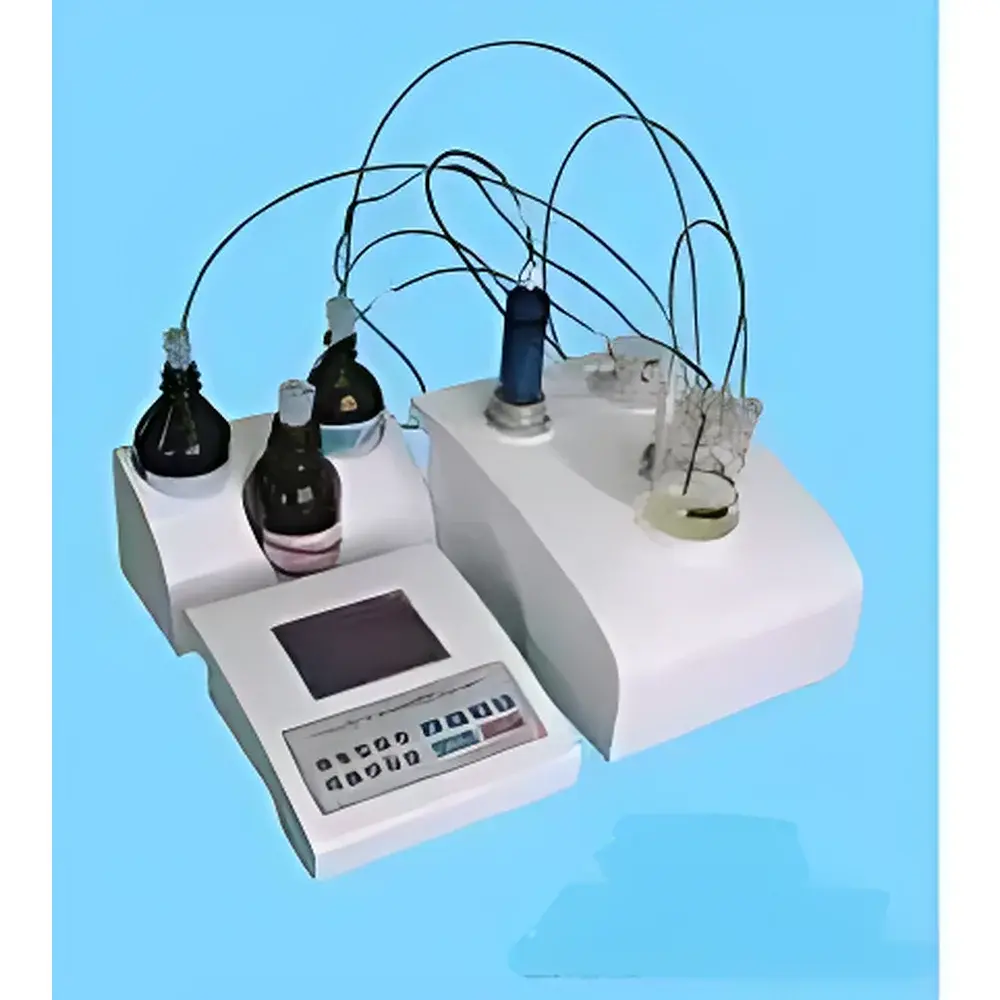
Truelab KF-4 Karl Fischer Moisture Analyzer
| Brand | Truelab |
|---|---|
| Origin | Shanghai, China |
| Model | KF-4 |
| Titration Method | Fully Automatic Volumetric Titration |
| Principle | Volumetric Karl Fischer Titration |
| Moisture Range | 10 ppm to 100% H₂O |
| Resolution | 0.1 µL (volumetric) |
| Accuracy | ±0.01% (relative) |
| Minimum Dispensing Volume | 0.005 mL |
| Titration Precision | ±0.1% RSD |
| Stirring Control | Multi-stage Adjustable |
| Display | Large LCD with Real-time Process Monitoring |
| Data Storage | Internal Memory + RS-232/USB Output |
| Dimensions (W×D×H) | 260 × 330 × 170 mm |
| Weight | 3.0 kg |
| Power Supply | AC 220 V, 50/60 Hz |
| Compliance | Designed for GLP-compliant environments |
Overview
The Truelab KF-4 Karl Fischer Moisture Analyzer is a fully automated volumetric titration system engineered for precise, reproducible quantification of water content in solid, liquid, and gaseous samples across industrial and research laboratories. It operates on the classical Karl Fischer (KF) reaction—where iodine, sulfur dioxide, methanol, and a base react stoichiometrically with water—and implements this chemistry via a high-precision dosing system calibrated to deliver titrant volumes down to 0.005 mL per increment. Unlike coulometric KF analyzers suited for trace-level (<100 ppm) analysis, the KF-4 is optimized for broader dynamic range applications—from low-concentration pharmaceutical excipients (10 ppm) to hygroscopic solvents or polymer melts approaching 100% water content. Its architecture integrates a corrosion-resistant fluidic path, hermetically sealed reagent handling, and real-time endpoint detection based on bipotentiometric (dual-platinum electrode) monitoring, ensuring robust performance under routine QC/QA workflows.
Key Features
- Fully automatic titration sequence: auto-sampling (via optional autosampler interface), solvent addition, titrant delivery, endpoint detection, and waste disposal—all controlled by an embedded microprocessor
- High-accuracy dual-piston precision burette with 20 mL capacity and volumetric resolution of 0.1 µL equivalent (0.005 mL minimum dispensing step)
- Chemically inert fluidic components—including PTFE-coated three-way valves and fluoropolymer tubing—to ensure long-term stability with aggressive KF reagents (e.g., pyridine-free or imidazole-based)
- Multi-level magnetic stirring control (5 adjustable speeds) to optimize mixing efficiency without splashing or emulsion formation in viscous or heterogeneous samples
- Integrated back-flush function to prevent cross-contamination between sequential analyses and maintain consistent electrode response
- Large backlit LCD display showing real-time titration curve, consumed volume, calculated water content (% w/w or ppm), and system status flags
- Onboard memory stores up to 200 result records with timestamp, sample ID, method name, and operator code; exportable via RS-232 or USB to LIMS or Excel-compatible formats
Sample Compatibility & Compliance
The KF-4 accommodates diverse sample matrices including organic solvents (acetone, chloroform, THF), pharmaceutical powders (lactose, microcrystalline cellulose), petrochemical fractions (diesel, lubricants), food-grade oils, and polymer granules. Sample introduction is manual by syringe or vial, with compatibility for optional oven attachment (KF-4-Oven Kit, sold separately) for volatile or thermally labile materials. The instrument adheres to core principles outlined in ASTM D6304, ISO 760, and USP , and its data management architecture supports compliance with GLP and GMP documentation standards. When used with validated software and procedural controls, it meets foundational requirements for FDA 21 CFR Part 11 electronic record integrity—including user authentication, audit trail generation, and non-modifiable result archiving.
Software & Data Management
While the KF-4 operates autonomously via its built-in controller, it provides standardized serial (RS-232) and USB communication protocols for integration into laboratory informatics systems. Raw measurement data—including titrant volume, mV signal profile, endpoint time, and final concentration—is transmitted in ASCII format with configurable delimiters. Third-party software packages (e.g., LabX, Empower, or custom Python/Excel scripts) can parse these outputs for statistical process control (SPC), trend analysis, or automated report generation. The device supports user-defined method templates with preset parameters (e.g., blank correction, drift compensation, equivalence point algorithm selection), enabling method transfer consistency across multiple instruments and operators.
Applications
- Pharmaceutical manufacturing: moisture verification of active pharmaceutical ingredients (APIs), excipients, and lyophilized products per ICH Q5C guidelines
- Petrochemical QA: water content testing in crude oil fractions, jet fuels, and transformer oils per ASTM D95 and D1744
- Food & beverage R&D: quantification of residual moisture in dried fruits, dairy powders, and starch-based thickeners
- Electronics materials: detection of adsorbed moisture in solder pastes, conformal coatings, and encapsulation resins prior to thermal processing
- Academic research: kinetic studies of hydration/dehydration reactions, sorption isotherm modeling, and method validation exercises in analytical chemistry curricula
FAQ
What titration principle does the KF-4 employ?
It uses volumetric Karl Fischer titration with bipotentiometric endpoint detection.
Can the KF-4 perform coulometric analysis?
No—it is exclusively a volumetric system; coulometric capability requires dedicated hardware (e.g., generator electrodes, constant-current source).
Is the instrument compatible with non-pyridine KF reagents?
Yes—the fluidic pathway is chemically resistant to modern imidazole- or diethanolamine-based reagents.
Does the KF-4 support external sample changers?
It features a TTL-compatible trigger port and RS-232 handshake protocol for integration with third-party autosamplers.
How is calibration verified on the KF-4?
Using certified water standards (e.g., sodium tartrate dihydrate, 15.66% H₂O; or 1.00 mg H₂O standards), following manufacturer-recommended daily blank and standardization procedures.






