
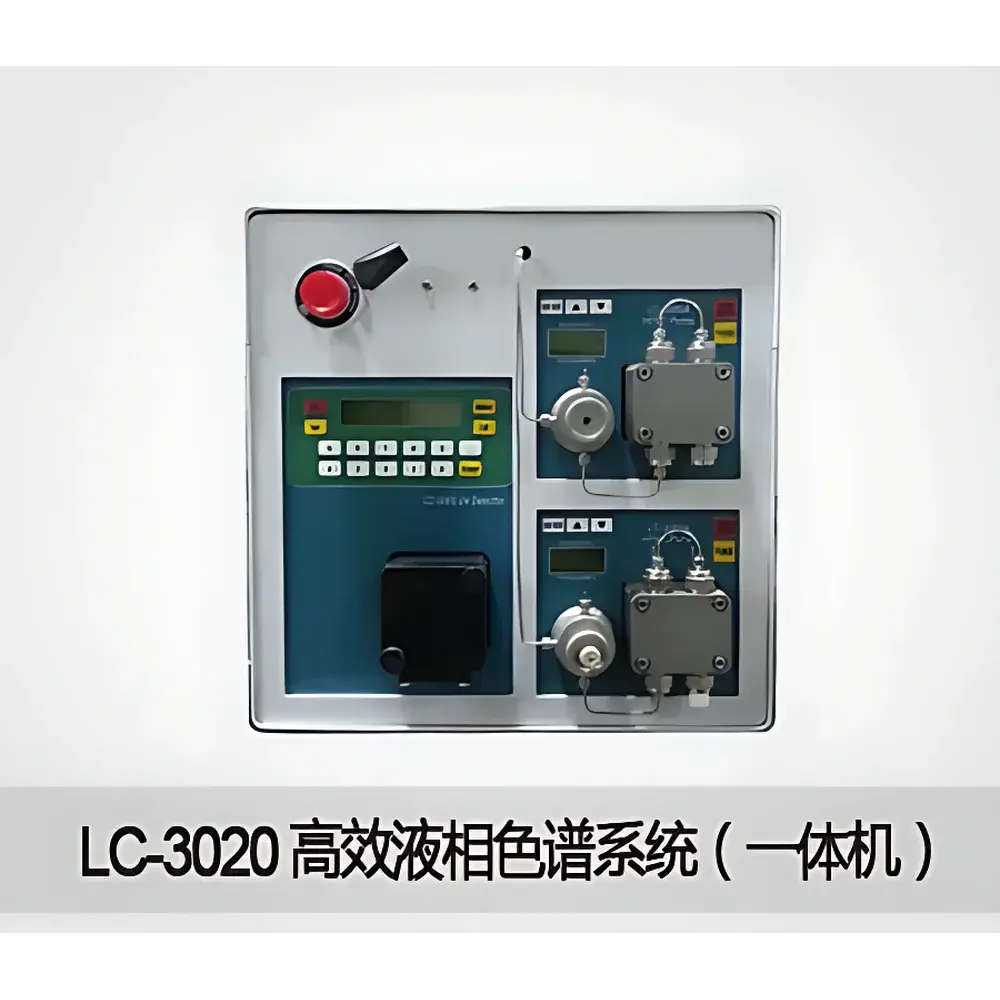
Truelab LC-3020 Integrated Preparative High-Performance Liquid Chromatography System
| Brand | Truelab |
|---|---|
| Origin | Beijing, China |
| Model | LC-3020 |
| Instrument Type | High-Pressure Preparative HPLC System |
| Flow Rate Range | 0.01–9.99 mL/min (analytical mode) |
| Flow Accuracy | ±0.14% (1 mL/min, deionized water, RT) |
| Flow Precision | 0.03% RSD (1 mL/min, deionized water, RT) |
| Max Pressure | 0–45 MPa (analytical) |
| Wavelength Range | 190–700 nm |
| Wavelength Accuracy | ±1 nm |
| Wavelength Repeatability | ±1 nm |
| Baseline Noise | 2×10⁻⁵ AU (254 nm, 1 mL/min, methanol) |
| Drift | 1×10⁻⁴ AU/h (254 nm, 1 mL/min, methanol) |
| Detection Limit | 4.7×10⁻⁹ g/mL (naphthalene, 254 nm, 1 mL/min, methanol) |
| Data Acquisition Rate | 5 Hz |
| Gradient Accuracy | ±1% |
| Detector Optical Path | 10 mm (standard), optional 2 mm / 1.25 mm / 0.5 mm flow cells |
| Pump Architecture | Dual-piston serial configuration with electronic pressure pulsation suppression |
| Control Interface | RS-232 and RS-485 |
| Software | Fully remote-controllable chromatography workstation with instrument parameter setting, method development, data acquisition, peak integration, and report generation |
Overview
The Truelab LC-3020 is an integrated high-pressure preparative liquid chromatography system engineered for laboratory-scale purification, method development, and quantitative analysis of small molecules, natural products, pharmaceutical intermediates, and synthetic compounds. Unlike modular HPLC configurations requiring on-site assembly, the LC-3020 adopts a factory-integrated architecture—where the dual high-pressure gradient pump, 7725i manual injection valve, UV-Vis detector, and optional column oven are pre-assembled, leak-tested, and functionally validated within a single chassis. This design eliminates post-installation capillary cutting, tubing routing, and inter-component alignment—common sources of dead volume, contamination, and mechanical failure in traditional systems. The system operates on the principle of high-pressure liquid separation, where mobile phase delivery under precisely controlled flow and pressure gradients drives analyte partitioning across a stationary phase. Its compact layout minimizes dwell volume (<150 µL typical), ensuring rapid gradient equilibration and minimal band broadening—critical for reproducible retention time and peak shape in both analytical and semi-preparative workflows.
Key Features
- Factory-integrated monolithic chassis with pre-validated fluidic pathways, eliminating field assembly risks and reducing installation time by >70% compared to modular systems.
- Dual-piston serial pump architecture with electronic pressure pulsation suppression—replacing mechanical dampers—to deliver stable flow across variable backpressures (0–45 MPa), with <0.1 MPa pressure ripple at 15 MPa load.
- UV-Vis detector featuring direct-coupled grating drive (stepper motor shaft-mounted), enabling precise wavelength selection without sine-bar mechanics; automatic wavelength calibration at power-on ensures long-term photometric accuracy.
- Z-shaped thermostatted flow cell with dual-beam optical design to minimize thermal drift and environmental light interference; baseline stability maintained at ≤1×10⁻⁴ AU/h (254 nm, 1 mL/min, methanol).
- Modular flow cell options (10 mm, 2 mm, 1.25 mm, 0.5 mm pathlength) support seamless transition from analytical detection to semi-preparative collection without hardware replacement—only software-defined gain and pathlength compensation required.
- Full remote control via embedded RS-232/RS-485 interfaces: all parameters—including pump flow, gradient profile, detector wavelength, lamp on/off, and auto-zero—are configurable and adjustable through the workstation software interface.
Sample Compatibility & Compliance
The LC-3020 supports reversed-phase, normal-phase, ion-exchange, and size-exclusion chromatography with standard stainless-steel or PEEK-lined columns (2–30 mm ID, up to 250 mm length). It accommodates common organic solvents (acetonitrile, methanol, THF), aqueous buffers (pH 2–8), and low-viscosity mobile phases compatible with 45 MPa maximum pressure. The system meets core requirements for GLP-compliant laboratories: audit-trail-enabled software logs all method changes, instrument events, and user actions with timestamps and operator IDs. While not pre-certified for FDA 21 CFR Part 11, its architecture supports validation packages including IQ/OQ/PQ protocols, electronic signature implementation, and data integrity controls per ALCOA+ principles. All optical and hydraulic components comply with ISO 9001 manufacturing standards; UV detector spectral accuracy aligns with ASTM E275 and USP verification guidelines.
Software & Data Management
The Truelab Chromatography Workstation is a Windows-based, fully remote-controllable application supporting method development, real-time monitoring, peak integration (tangent skim, valley-to-valley, exponential baseline correction), purity analysis, and customizable reporting. Raw data are stored in vendor-neutral .CDF format (compatible with OpenChrom and Chromeleon viewers). The software implements role-based access control (administrator, analyst, reviewer), method locking, and electronic signature workflows. Audit trails record every parameter modification, injection event, and report export with immutable timestamps. Data backups can be scheduled to network drives or cloud repositories; raw files include embedded metadata (instrument ID, firmware version, calibration dates, flow cell pathlength). For regulated environments, optional 21 CFR Part 11 add-ons provide digital certificate management, biometric login integration, and electronic signature validation reports.
Applications
- Purification of synthetic peptides and oligonucleotides using C18 or ion-pairing columns at flow rates up to 49.99 mL/min (semi-preparative configuration).
- Stability-indicating assays for pharmaceutical active ingredients—resolving degradation products with <0.03% flow RSD and ±1 nm wavelength fidelity.
- Natural product isolation from plant extracts, leveraging gradient robustness and low baseline noise (2×10⁻⁵ AU) for trace-level detection of flavonoids and alkaloids.
- QC/QA testing of excipients and raw materials per USP monographs requiring specified resolution, tailing factor, and system suitability criteria.
- Method transfer between analytical and semi-preparative scales—enabled by consistent pump dynamics, identical detector electronics, and scalable flow cell geometry.
- Academic research in medicinal chemistry, where rapid method scouting and reproducible fraction collection are essential for structure–activity relationship studies.
FAQ
Is the LC-3020 compliant with 21 CFR Part 11 out of the box?
No—the base software includes audit trail and user authentication features, but full 21 CFR Part 11 compliance requires optional validation-ready modules, electronic signature configuration, and documented IQ/OQ/PQ execution.
Can the system operate in isocratic mode?
The LC-3020 is designed exclusively as a binary high-pressure gradient system; isocratic operation is achieved by setting both solvent channels to identical composition and disabling gradient programming.
What maintenance intervals are recommended for the pump seals and flow cell?
Pump piston seals require inspection every 3,000 operating hours or annually—whichever occurs first; flow cell windows should be cleaned after each solvent change involving high-salt or viscous buffers to prevent crystallization or residue buildup.
Does the detector support time-programmed wavelength switching during a run?
Yes—the workstation allows up to 16 discrete wavelength steps per method, enabling multi-analyte detection without post-run reprocessing.
Is column oven integration optional or mandatory?
The column oven is an optional accessory; the base system operates at ambient temperature, but oven mounting brackets and thermal interface provisions are built into the chassis for field installation.
Related Products




