
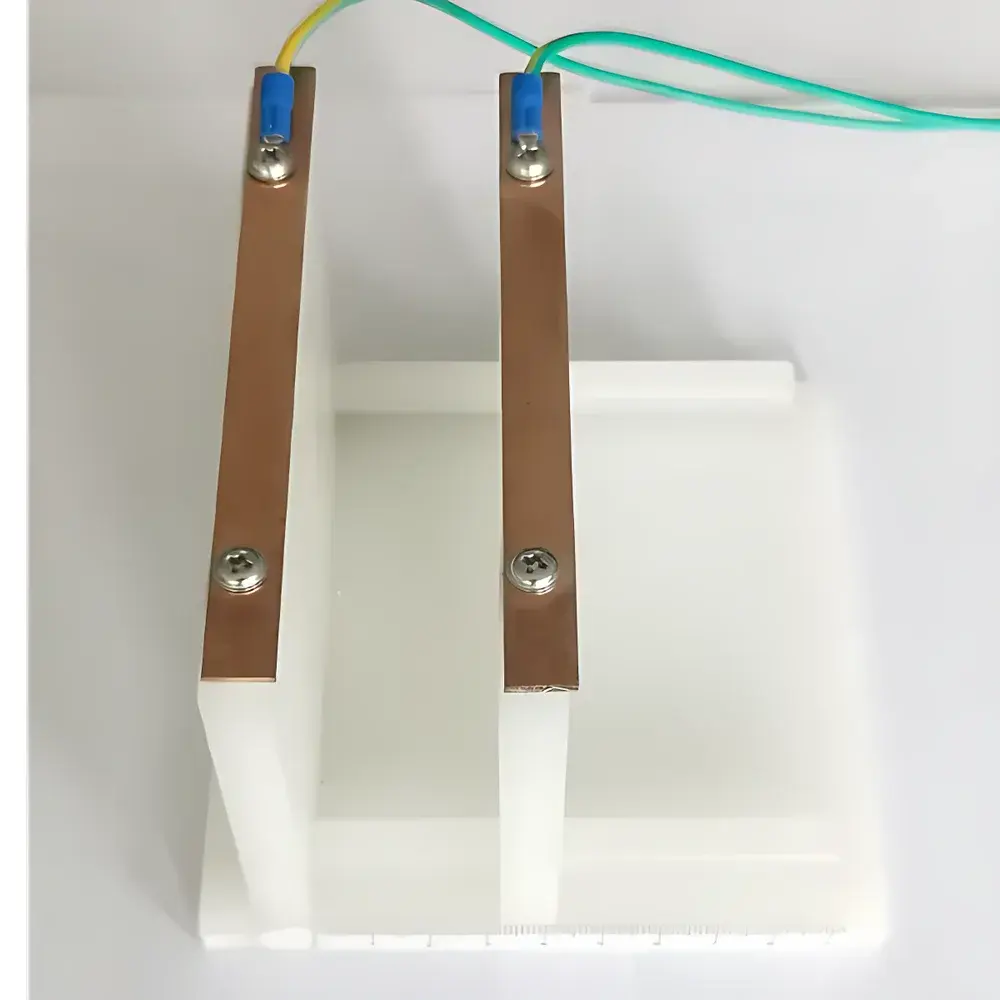
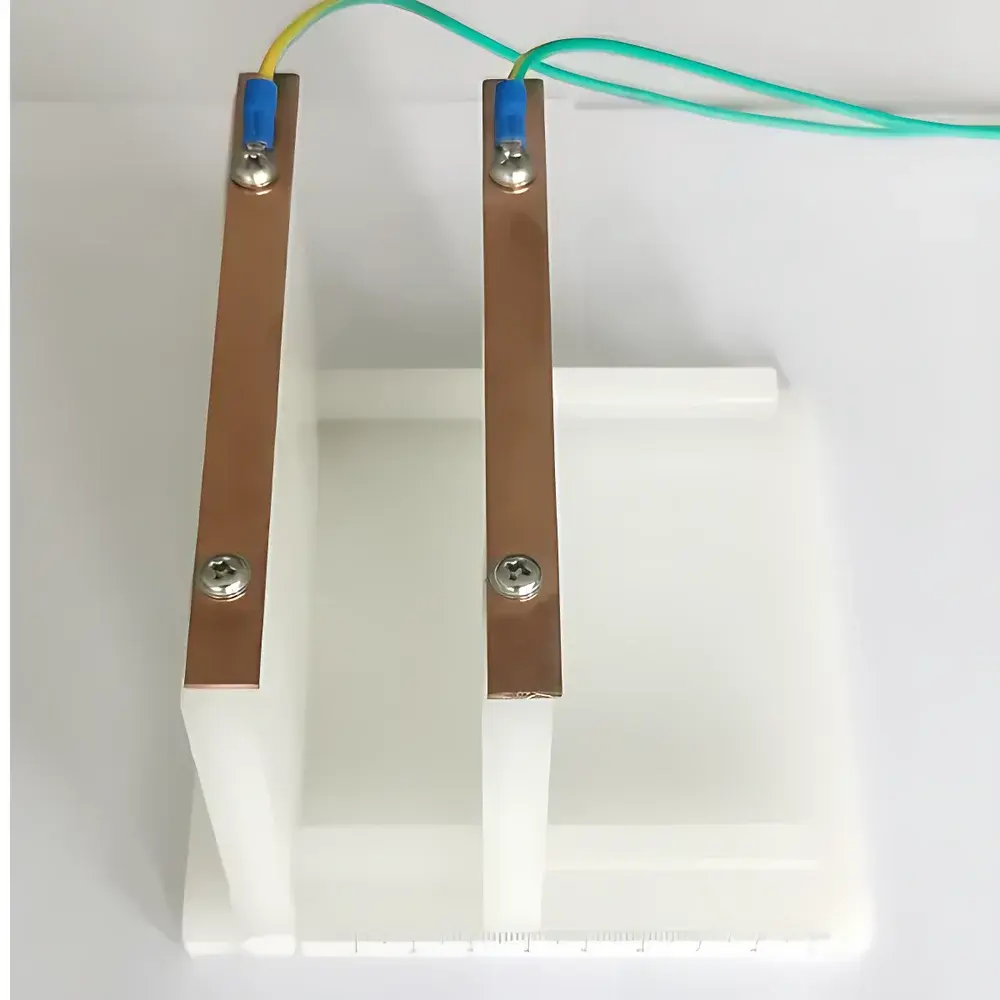
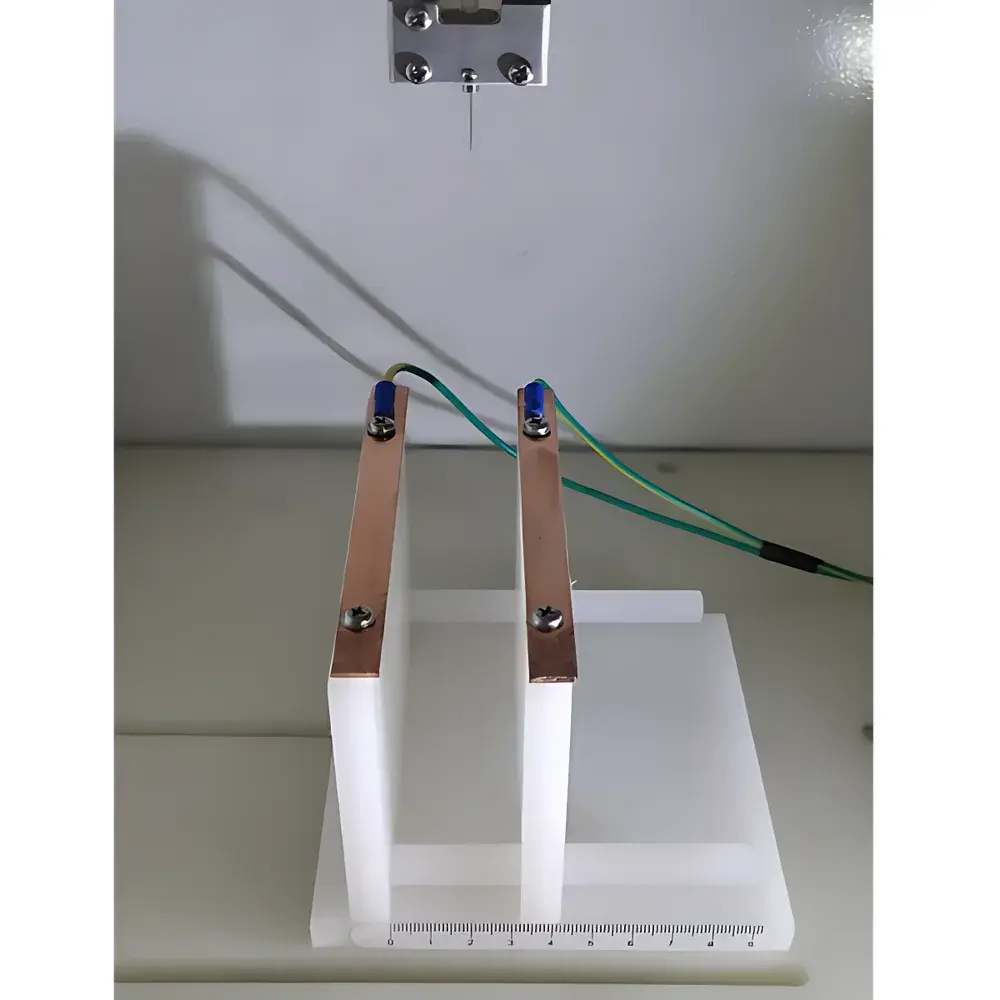
Truelab PEC-1 Parallel-Electrode Collector for Electrospinning
| Brand | Truelab |
|---|---|
| Origin | Shanghai, China |
| Manufacturer Type | Authorized Distributor |
| Country of Origin | China |
| Model | PEC-1 |
| Price Range | USD 125 – 140 |
| Electrode Spacing | 0–80 mm |
| Electrode Length | 100 mm |
| Electrode Width | 10 mm |
| Overall Dimensions (L×W×H) | 120 × 120 × 90 mm |
| Electrode Material | Oxygen-Free Copper (OFHC) |
| Electrode Holder & Base Material | Polypropylene (PP) |
| Surface Finish | Sharp-edged collection faces |
| Alignment Tolerance | < 0.1° deviation over full length |
| Weight | ~1.3 kg |
Overview
The Truelab PEC-1 Parallel-Electrode Collector is a precision-engineered electrostatic collection system designed specifically for the controlled, uniaxial alignment of nanofibers during high-voltage electrospinning processes. Unlike conventional drum or static plate collectors, the PEC-1 employs two parallel, conductive copper electrodes separated by a precisely adjustable air gap—enabling electric field-directed fiber bridging and deterministic orientation. This configuration leverages Coulombic forces and dielectrophoretic torque to stretch and align charged polymer jets across the inter-electrode region, resulting in macroscopically ordered, single-axis nanofiber arrays with high spatial uniformity and reproducibility. The device operates as a passive, field-coupled component within standard electrospinning setups—requiring no external power supply or active control—and is compatible with both needle-based and needleless electrospinning sources. Its mechanical stability, geometric fidelity, and material selection are optimized to minimize parasitic field distortion and surface charge accumulation—critical factors affecting fiber trajectory consistency and alignment fidelity.
Key Features
- Two high-conductivity oxygen-free copper (OFHC) electrodes with sharp, knife-edge collection surfaces—engineered to concentrate electric field gradients and promote consistent fiber anchoring and axial stretching.
- Manually adjustable electrode spacing (0–80 mm), calibrated via integrated engraved scale ruler with ±0.5 mm resolution—enabling systematic optimization of field strength (kV/mm) and fiber morphology.
- Modular polypropylene (PP) base and support structure—chemically inert, electrostatically dissipative (surface resistivity ~10¹⁰ Ω/sq), and resistant to common solvents (e.g., DMF, chloroform, HFIP) used in polymer electrospinning.
- Sub-0.1° parallelism tolerance maintained across full 100 mm electrode length—achieved via rigid PP bracket geometry and interference-fit mounting—ensuring uniform field distribution without edge asymmetry.
- Low-profile footprint (120 × 120 × 90 mm) and open-frame design—facilitating integration into commercial electrospinning enclosures (e.g., IME, Inovenso, Fluidnatek systems) or custom-built Faraday cages.
- Tool-free fiber transfer capability: aligned nanofiber mats can be directly lifted from electrode edges using siliconized glass slides or PDMS stamps—preserving orientation integrity for downstream characterization (SEM, XRD, tensile testing) or device integration (sensors, scaffolds).
Sample Compatibility & Compliance
The PEC-1 collector supports a broad range of electrospinnable polymers—including PCL, PLA, PAN, PVDF, gelatin, and chitosan—in both organic and aqueous solvent systems. Its PP construction complies with ISO 10993-5 (cytotoxicity) and USP Class VI biocompatibility standards for research-grade biomaterial handling. While the collector itself is not a regulated medical device, its materials and geometry conform to GLP-aligned lab practices for nanomaterial fabrication documentation. No electrical certification (e.g., CE, UL) applies, as it functions solely as a grounded passive collector—not an active high-voltage component. Users must ensure proper grounding of electrodes per IEC 61000-4-2 ESD protection guidelines when interfacing with HV power supplies (>10 kV).
Software & Data Management
The PEC-1 operates independently of software control and does not incorporate embedded electronics, firmware, or data logging capabilities. It is fully compatible with third-party electrospinning control platforms (e.g., Bioinicia Spinneret, Nanoscaffold Control Suite) that manage voltage, feed rate, and environmental parameters. For traceability, users are advised to record electrode spacing, applied voltage, working distance, and ambient RH/T alongside SEM micrographs and alignment angle histograms (e.g., ImageJ Fiji Fiber Orientation Analyzer). The device supports audit-ready documentation workflows compliant with ISO/IEC 17025 clause 7.7 (reporting of measurement uncertainty) when paired with calibrated HV meters and digital calipers.
Applications
- Preparation of anisotropic nanofibrous scaffolds for neural tissue engineering—where contact guidance cues require >85% fiber alignment (measured by Fast Fourier Transform orientation analysis).
- Fabrication of piezoelectric PVDF nanofiber membranes with enhanced β-phase content via field-induced molecular stretching.
- High-throughput screening of polymer-solvent-electrode geometry interactions on fiber diameter distribution (CV 0.92).
- Integration into roll-to-roll electrospinning lines for continuous production of aligned nanofiber webs—validated at linear speeds up to 5 cm/min under laminar N₂ purge.
- Teaching laboratory use: enables direct visualization of electrostatic fiber bridging phenomena, Coulomb-driven elongation, and critical spacing thresholds for stable jet splitting.
FAQ
Is the PEC-1 compatible with high-humidity environments?
Yes—PP construction prevents hygroscopic swelling, and sharp electrode edges maintain field concentration even at RH > 60%. However, optimal alignment is achieved at RH 30–50% to minimize jet instability.
Can the electrodes be cleaned and reused after polymer residue buildup?
Yes—OFHC electrodes tolerate ultrasonic cleaning in acetone or ethanol (5 min, 40 kHz), followed by nitrogen drying. Avoid abrasive scrubbing to preserve edge geometry.
Does the collector require grounding, and how should it be connected?
Yes—both electrodes must be connected to earth ground via 12 AWG copper wire, preferably at a single point near the HV power supply’s ground terminal to avoid ground loops.
What is the maximum recommended operating voltage for safe use with the PEC-1?
No intrinsic voltage limit exists—the system has been validated at 15–30 kV DC with standard syringe pump electrospinning. Always observe manufacturer guidelines for your HV supply and enclosure.
Can the PEC-1 be modified for curved or multi-segment electrode configurations?
Not out-of-the-box. The current design is strictly planar and parallel. Custom electrode geometries require OEM consultation and mechanical re-engineering of the PP base.





