
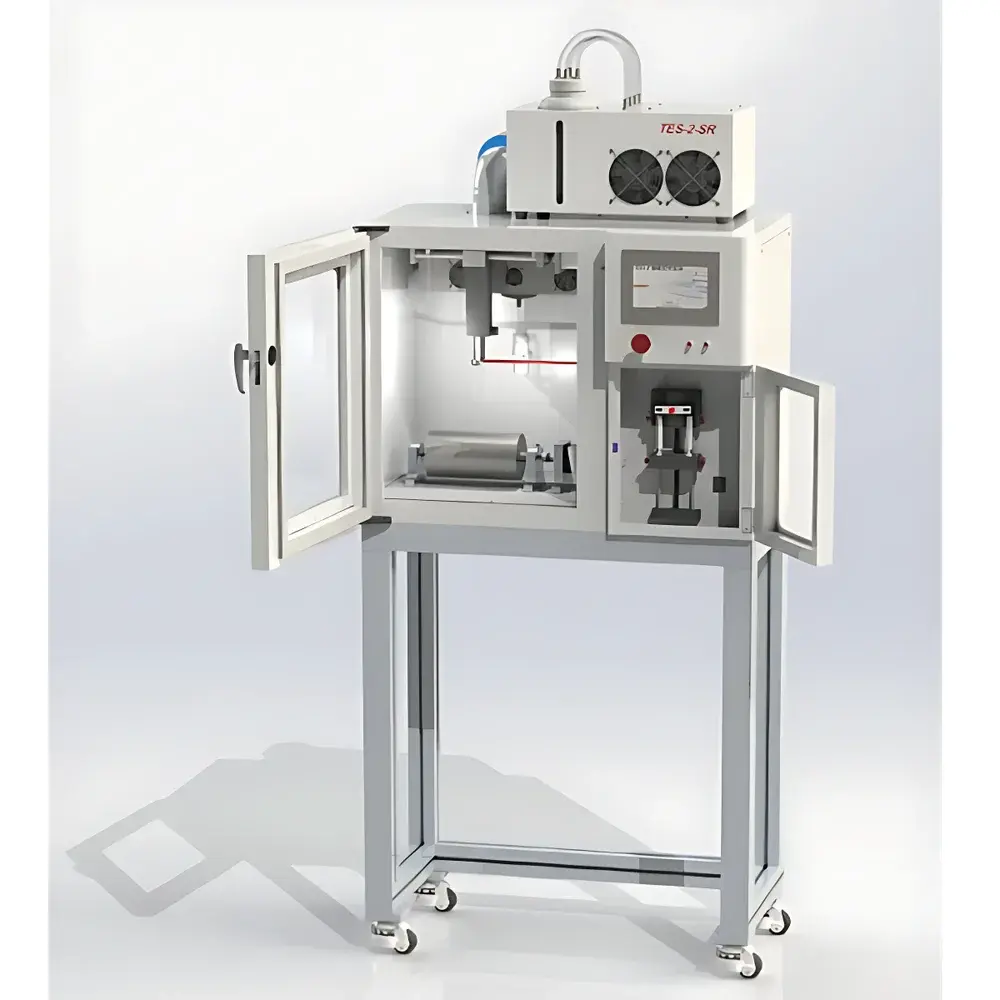
Truelab TES-2 Laboratory-Scale Automated Electrospinning System
| Brand | Truelab |
|---|---|
| Origin | Shanghai, China |
| Model | TES-2 |
| Power Supply | ±30.0 kV (0.1 kV resolution) |
| Dual-Channel Syringe Pump | 100 µL/h – 7.62 L/h, max 60 mL syringe |
| Collector Speed | 0–600 ±1 rpm, reversible |
| Nozzle Traverse Range | 40–200 mm |
| Nozzle Travel Speed | 0–1000 ±1 mm/min |
| Tip-to-Collector Gap Adjustment | up to 180 mm |
| Temperature Control | RT–50 ±1.0 °C |
| Humidity Control | 20–80 ±3 %RH |
| Chamber Dimensions (w/d/h) | 833×466×995 mm (standalone), 833×466×1800 mm (with mobile base) |
| Weight | 110 kg (standalone), 125 kg (with base) |
| Total Power Consumption | 625 W |
| Safety Compliance | Integrated emergency stop, interlocked access door, full-system grounding, overtemperature protection, ESD-safe materials (PFA tubing, anti-static polymers, carbon-brush grounding rods) |
Overview
The Truelab TES-2 Laboratory-Scale Automated Electrospinning System is an integrated, PLC-controlled platform engineered for reproducible nanofiber fabrication under precisely regulated environmental conditions. It operates on the principle of electrohydrodynamic jetting—applying high-voltage electric fields (±30.0 kV) across a polymer solution to induce Taylor cone formation and continuous jet elongation, followed by solvent evaporation and solidification into submicron or nanoscale fibers. Unlike benchtop single-component setups, the TES-2 unifies critical subsystems—including dual-channel precision syringe pumping, motorized reciprocating nozzle positioning, dynamically balanced rotating collectors, closed-loop temperature and humidity regulation, and real-time exhaust management—within a shielded, grounded enclosure. Its architecture supports fundamental research and process development in polymer science, biomaterials, filtration media, wound dressing scaffolds, and battery separator engineering. Designed for ISO/IEC 17025-aligned laboratories, the system meets mechanical and electrical safety requirements per IEC 61010-1 and incorporates design elements compatible with GLP documentation workflows.
Key Features
- Integrated dual-channel syringe pump with PFA fluidic path isolation—prevents high-voltage coupling to drive electronics and extends pump service life; transparent observation window enables real-time monitoring of syringe fill level and flow stability.
- Motorized, programmable nozzle traverse mechanism with adjustable stroke (40–200 mm) and velocity (0–1000 ±1 mm/min); auto-zeroing on power-up ensures repeatable positional referencing.
- Dynamically balanced cylindrical collector (Ø100 × L200 mm standard) with 0–600 ±1 rpm speed control and bidirectional rotation; carbon-brush grounding rod ensures uniform electric field distribution and minimizes charge accumulation on collector surfaces.
- Closed-chamber environmental control using internal air recirculation: thermoelectric heating (400 W, RT–50 ±1.0 °C) with overtemperature cutoff and dual-mode humidity regulation (refrigerative dehumidification + bubbling humidification) for 20–80 ±3 %RH stability.
- Full ESD mitigation: anti-static polymer nozzle mounts, conductive carbon-fiber motion rails, grounded stainless-steel (304) chamber housing, and shielded HV cabling routed via insulated conduits.
- Human-centered ergonomics: 7-inch industrial touchscreen HMI powered by Mitsubishi FX-series PLC; magnetic-damped access door with safety interlock; adjustable-height LED inspection lamp with multi-axis articulation for filament morphology assessment.
Sample Compatibility & Compliance
The TES-2 accommodates a broad spectrum of electrospinnable feedstocks—including aqueous and organic polymer solutions (e.g., PVA, PLA, PCL, PAN, chitosan), sol-gel precursors, and nanoparticle suspensions—without hardware modification. Its modular collector interface accepts standardized fixtures for drum, mandrel, wire-grid, rotating disk, and cage-type substrates. All wetted components comply with USP Class VI biocompatibility standards where applicable. The system’s electrical grounding architecture adheres to IEEE Std 1100 (recommended practice for powering and grounding sensitive electronic equipment), and its enclosure satisfies IP2X personnel protection requirements. While not certified for GMP manufacturing, its audit-ready operational logs, parameter traceability, and deterministic control logic support validation activities aligned with FDA 21 CFR Part 11 principles when paired with validated software extensions.
Software & Data Management
Control firmware runs on a deterministic Mitsubishi PLC kernel, ensuring cycle-synchronized coordination among motion axes, HV output, pump delivery, and environmental actuators. The embedded HMI provides intuitive parameter entry, real-time waveform visualization (voltage/current feedback), and stepwise protocol sequencing. All operational events—including start/stop timestamps, setpoint deviations, door interlock status, and emergency stop triggers—are logged with millisecond resolution to non-volatile memory. Exportable CSV reports include metadata (operator ID, date/time, ambient lab conditions), enabling correlation with post-process characterization data (SEM, FTIR, tensile testing). Optional Ethernet/IP or Modbus TCP interfaces allow integration into centralized laboratory information management systems (LIMS) for automated data archival and compliance reporting.
Applications
- Development of hierarchical nanofibrous membranes for air/water filtration (e.g., PM2.5 capture, virus retention).
- Rapid prototyping of bioactive scaffolds for tissue engineering—incorporating growth factors, antimicrobial agents, or stem cells without thermal degradation.
- Production of piezoelectric nanofiber mats (e.g., PVDF-based) for flexible energy harvesting sensors.
- Formulation screening of solvent systems and polymer concentrations to optimize fiber diameter distribution and porosity.
- Investigation of coaxial and triaxial fiber architectures for controlled drug release kinetics and core-shell functionalization.
- Process mapping of voltage–distance–flow rate parameter space to establish DOE-based quality-by-design (QbD) frameworks.
FAQ
Does the TES-2 support coaxial electrospinning?
Yes—the dual independent syringe pump channels, combined with optional coaxial needle holders and PFA-lined concentric tubing, enable simultaneous delivery of core and shell solutions under synchronized pressure profiles.
Can humidity and temperature be controlled independently?
Yes—temperature and humidity are regulated via separate PID loops with dedicated sensors and actuators; their setpoints can be adjusted concurrently or individually without cross-interference.
Is remote monitoring or control possible?
Standard configuration includes local HMI only; however, optional RS-485/Modbus or Ethernet/IP modules support integration with SCADA or custom LabVIEW/Python control environments.
What safety certifications does the system carry?
The TES-2 conforms to IEC 61010-1:2010 for laboratory electrical equipment safety; CE marking is available upon request with EU Representative designation and Declaration of Conformity.
How is maintenance access designed for the syringe pump and HV generator?
Front-panel removable covers provide tool-free access to pump mechanisms and HV module heat sinks; all service points follow ISO 13857 minimum safety distances for low-voltage servicing zones.







