
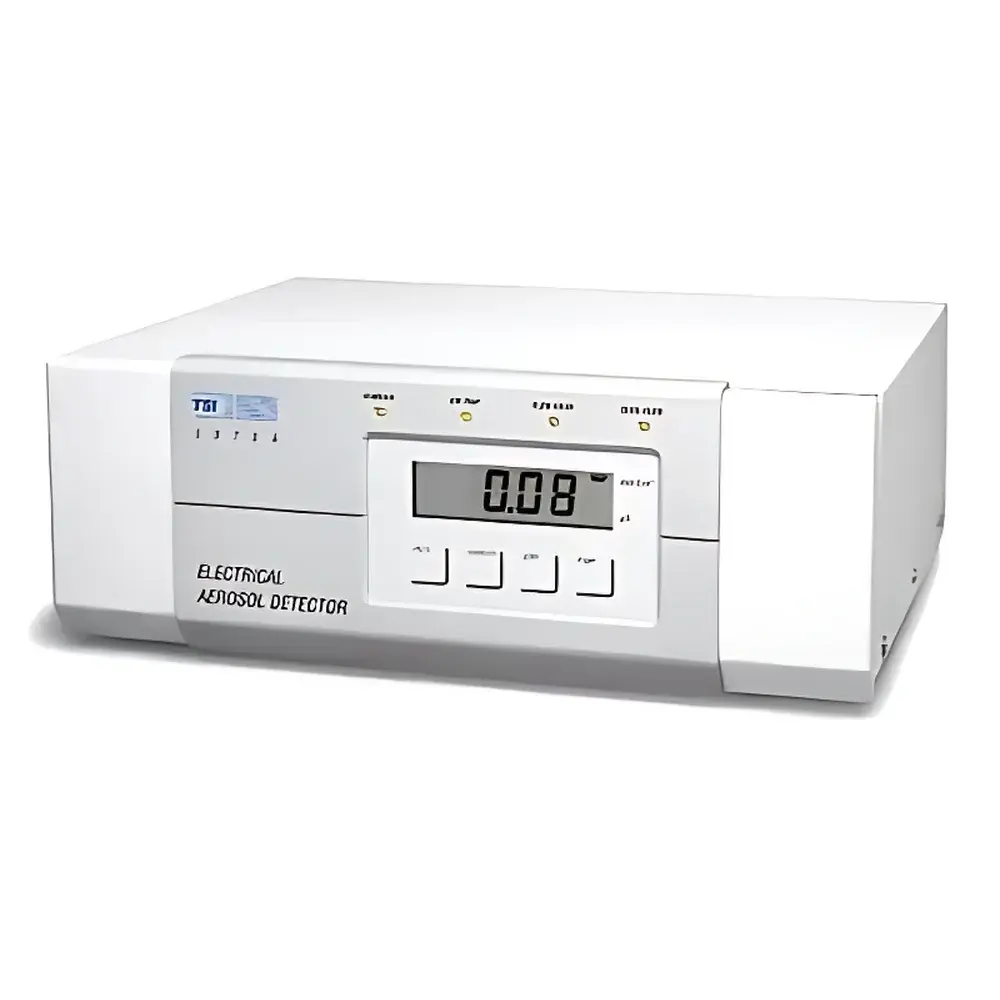
TSI 3070A-EAD Electrical Aerosol Detector
| Origin | USA |
|---|---|
| Manufacturer Type | Authorized Distributor |
| Origin Category | Imported |
| Model | 3070A |
| Pricing | Available Upon Request |
| Particle Size Range | 10 nm – 1 µm |
| Maximum Data Acquisition Rate | 3.75 readings/sec |
| Length Concentration Resolution | 0.01 mm/cm³ |
| Operating Temperature | 10–35 °C |
Overview
The TSI 3070A-EAD (Electrical Aerosol Detector) is a robust, benchtop-grade instrument engineered for real-time, quantitative measurement of aerosol length concentration — a physically meaningful metric defined as the product of particle number concentration and mean particle diameter (d1), expressed in mm/cm³. Unlike conventional optical or condensation particle counters that report number concentration (d0) or surface-area-weighted metrics (d2), the EAD provides a dimensionally consistent parameter that correlates more directly with deposition efficiency in human respiratory airways and oxidative stress potential in toxicological studies. The instrument operates on the principle of bipolar diffusion charging followed by electrometer-based current measurement: aerosol particles are charged in a controlled corona field, then passed through a precision classifier and collected on a high-sensitivity electrometer. The resulting current is linearly proportional to aerosol length concentration under steady-state laminar flow conditions. This physical basis ensures high reproducibility across varying composition, morphology, and volatility — critical for long-term environmental monitoring and combustion diagnostics where particle hygroscopicity or organic fraction may fluctuate.
Key Features
- Real-time aerosol length concentration output at up to 3.75 Hz sampling frequency, enabling dynamic process characterization in engine exhaust, indoor air quality studies, or chamber-based exposure experiments.
- Validated detection range from 10 nm to >1 µm — covering nucleation-mode ultrafines through coarse accumulation-mode particles without size-selective inlet limitations.
- Integrated temperature-controlled sheath air system ensuring stable diffusion charging efficiency across ambient operating conditions (10–35 °C).
- Low-power, solid-state electrometer architecture with <0.01 mm/cm³ resolution and drift-stabilized analog signal conditioning for multi-week unattended operation.
- Rugged aluminum chassis with IP20-rated enclosure, designed for both laboratory benchtop use and field-deployable mobile monitoring platforms.
- No consumables required beyond standard calibration aerosols (e.g., NIST-traceable PSL or DEHS); no radioactive sources, no optical components subject to fouling.
Sample Compatibility & Compliance
The 3070A-EAD accepts ambient air, diluted stack emissions, chamber effluents, and filtered laboratory-generated aerosols without preconditioning — provided sample dew point remains below 10 °C to prevent condensation-induced charging artifacts. It complies with ISO 15900:2020 (Determination of particle size distribution — Electrical low-pressure impactors and differential mobility analyzers) for charging-based aerosol metrics, and supports GLP-aligned data integrity when paired with TSI’s TrakPro™ software (see Software section). While not certified for regulatory compliance reporting per EPA Method PS-1 or EN 16842, its measurements are routinely cited in peer-reviewed health effects literature (e.g., studies referenced in IARC Monograph Vol. 100E) as a surrogate for biologically active fine particulate mass.
Software & Data Management
Data acquisition and instrument control are managed via TSI’s TrakPro™ Lite v5.x software (Windows-compatible), which logs timestamped length concentration values with metadata including internal temperature, pressure, and electrometer gain settings. Raw data exports to CSV or ASCII formats support third-party statistical analysis (e.g., Python pandas, R, MATLAB). Audit trails, user access levels, and electronic signatures are available in TrakPro™ Professional edition — compliant with FDA 21 CFR Part 11 requirements for regulated environments. All firmware updates are delivered via TSI’s secure customer portal; no field service tools required.
Applications
- Environmental health research: Correlating sub-100 nm aerosol length with inflammatory biomarkers in controlled human exposure studies.
- Combustion engineering: Quantifying nucleation-mode particle formation kinetics during diesel/gasoline engine transient cycles.
- Indoor air quality assessment: Monitoring cooking-, cleaning-, or printer-emitted aerosols in real time without size binning assumptions.
- Filter testing: Evaluating penetration efficiency of HVAC filters against polydisperse challenge aerosols using d1-weighted metrics.
- Atmospheric science: Supporting closure studies between modeled aerosol microphysics and ground-based observational constraints.
FAQ
How does aerosol length concentration differ from particle number concentration?
Aerosol length (mm/cm³) = Σ(ni × di), where ni is number concentration in size bin i and di is geometric mean diameter. It reflects total linear extent of particles per unit volume — a proxy for diffusional deposition probability in alveolar regions.
Can the 3070A-EAD measure volatile or semi-volatile aerosols accurately?
Yes, provided sampling temperature and residence time minimize evaporation prior to charging; use of heated inlets (optional accessory) is recommended for thermally labile organics.
Is calibration traceable to national standards?
Calibration is performed using NIST-traceable polystyrene latex (PSL) spheres and/or dioctyl sebacate (DOS) aerosols; TSI provides Certificate of Calibration with uncertainty budget per ISO/IEC 17025 guidelines.
Does the instrument require annual recalibration?
TSI recommends annual verification against reference aerosol; full recalibration is required only if electrometer offset drift exceeds ±2% of full scale or after major component replacement.
Can multiple 3070A units be synchronized for spatial mapping?
Yes — via external TTL trigger input and GPS-synchronized timestamps using optional TrakPro™ Network Edition, enabling coordinated multi-point aerosol length profiling.
Related Products







