
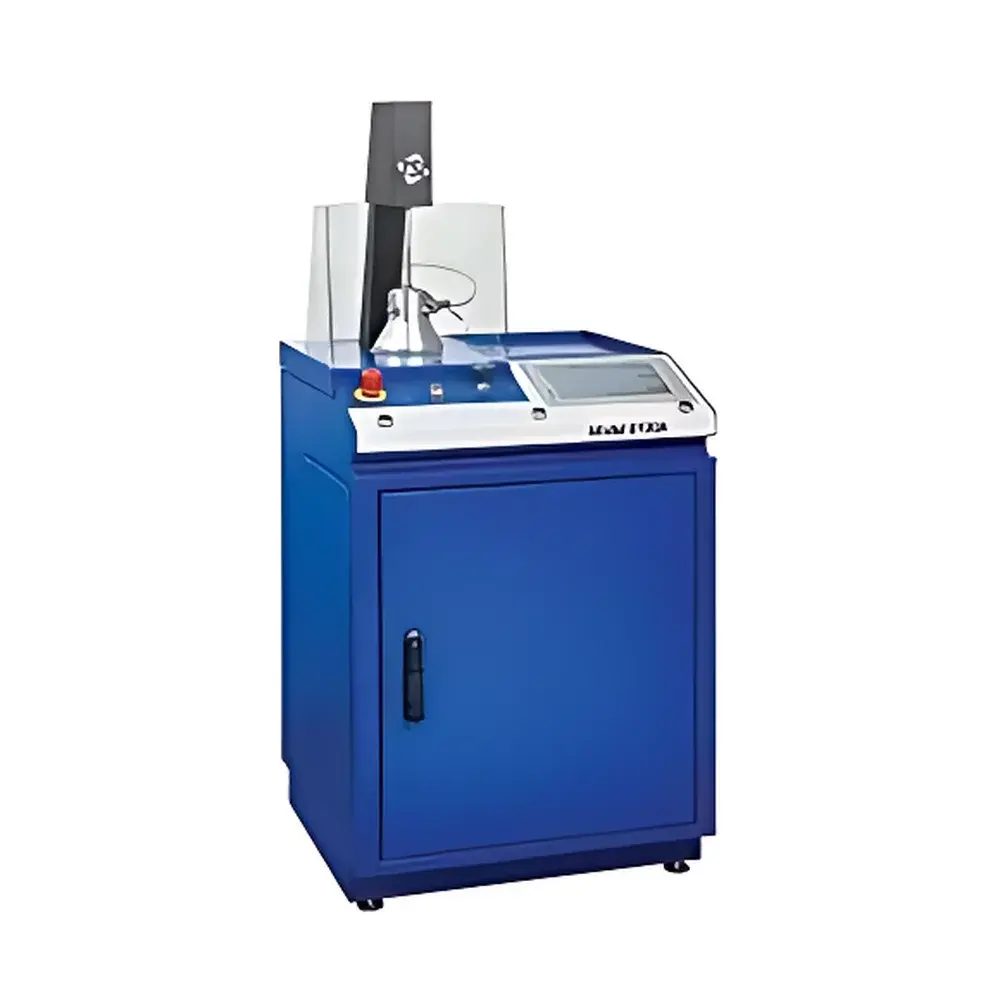
TSI Model 8130A Automatic Filter Testing System
| Brand | TSI |
|---|---|
| Origin | USA |
| Model | 8130A |
| Instrument Type | Aerosol Filter Efficiency Tester |
| Test Aerosols | NaCl (salt) and DEHS/DOP (oil-based) |
| Maximum Efficiency Measurement | 99.9999% |
| Compliance | 42 CFR Part 84, EN 143, ISO 16900-3, ISO 23328-1, GB 2626, JMOL Standards |
| Automation Level | Fully Automated with Self-Diagnostic Routines |
| Optical Detection | Integrated, Serviceable Photometer |
| User Interface | Touchscreen GUI with Audit-Trail-Capable Data Logging |
Overview
The TSI Model 8130A Automatic Filter Testing System is a precision-engineered aerosol filtration efficiency tester designed for quantitative assessment of particulate filter media used in respiratory protection devices. It operates on the principle of photometric aerosol detection—generating a stable, monodisperse or polydisperse challenge aerosol (NaCl for N-series or P-series respirator certification; DEHS or DOP for oil-based resistance testing), passing it through a conditioned filter sample under controlled face velocity and differential pressure, and measuring the downstream particle concentration via calibrated light scattering. This methodology conforms to internationally recognized test protocols including ASTM F2299 (for initial penetration), ISO 16900-3 (respiratory protective devices — test methods for filtration performance), and the U.S. Code of Federal Regulations Title 42 Part 84 (NIOSH respirator certification). The 8130A extends the legacy of the widely deployed 8130 platform with enhanced photometric sensitivity, improved signal-to-noise ratio, and a field-replaceable optical module that reduces long-term cost of ownership without compromising measurement traceability.
Key Features
- Simultaneous salt (NaCl) and oil (DEHS/DOP) aerosol testing capability within a single instrument platform—eliminating need for dual-system setups or reconfiguration downtime.
- Photometric detection system with sub-ppm resolution and linear dynamic range spanning four orders of magnitude, enabling reliable quantification of filter efficiencies up to 99.9999% (corresponding to ≤10⁻⁶ penetration).
- Fully automated test sequences—including aerosol generation, upstream/downstream sampling, pressure drop monitoring, and real-time efficiency calculation—with programmable dwell times, flow rates (typically 30–95 L/min), and challenge durations per standard requirements.
- Integrated self-diagnostic routines continuously monitor aerosol generator stability, photometer zero drift, flow sensor calibration, and pressure transducer integrity—flagging deviations before they impact data validity.
- Touchscreen human-machine interface (HMI) with intuitive workflow navigation, multilingual support (English, German, Chinese, Japanese), and configurable report templates compliant with GLP/GMP documentation practices.
- Ergonomic benchtop design with modular sample holder assembly, accommodating flat-sheet filter media (standard 100 cm² test area), pleated cartridges, and custom geometries via optional fixtures.
Sample Compatibility & Compliance
The 8130A supports testing of diverse filter substrate types—including melt-blown polypropylene, electrostatically charged nonwovens, nanofiber composites, and activated carbon laminates—under standardized conditioning (e.g., 25°C/30% RH per ISO 16900-3). Its validated test methodology satisfies regulatory acceptance criteria across major jurisdictions: NIOSH 42 CFR Part 84 (U.S.), EN 143:2000+A1:2006 and EN 149:2001+A1:2009 (Europe), GB 2626–2019 (China), JMOL Notification No. 214 (Japan), and ISO 23328-1:2021 (anesthetic gas filters). All system firmware and calibration procedures are maintained under TSI’s ISO 9001-certified quality management system, with documented metrological traceability to NIST-traceable aerosol standards.
Software & Data Management
The embedded control software includes audit-trail functionality compliant with FDA 21 CFR Part 11 requirements, recording operator ID, timestamped parameter changes, calibration events, and raw photometric voltage outputs. Data export options include CSV, PDF summary reports, and XML formats compatible with LIMS integration. Optional TSI FilterSuite™ software enables advanced statistical process control (SPC), batch trending, comparative analysis across material lots, and automated generation of EN 143 compliance declarations—including certified pass/fail status with uncertainty budgets per GUM (Guide to the Expression of Uncertainty in Measurement).
Applications
- Quality assurance and release testing of N95, KN95, FFP2, DS2, and equivalent respirator filter media during production.
- R&D evaluation of novel electret, mechanical, or hybrid filtration mechanisms under accelerated aging or humidity stress conditions.
- Validation of filter performance in medical device applications—including surgical masks, anesthesia breathing circuits, and ICU ventilator inlet filters per ISO 23328-1.
- Third-party certification laboratory testing for regulatory submissions to NIOSH, CE Notified Bodies, or China’s CNAS-accredited labs.
- Supplier qualification and incoming inspection of nonwoven raw materials used in PPE manufacturing supply chains.
FAQ
Does the 8130A meet NIOSH 42 CFR Part 84 sodium chloride (NaCl) test requirements?
Yes—the system implements the specified 85 L/min face velocity, 0.075 µm median particle size (CMD), and photometric detection sensitivity required for N-series and P-series respirator filter certification.
Can the same instrument be used for both salt and oil aerosol testing without hardware modification?
Yes—dual-aerosol capability is built-in via independent, software-selectable aerosol generators and dedicated fluid reservoirs, eliminating cross-contamination risk and manual reconfiguration.
Is calibration traceable to national standards?
All photometric and flow sensors are factory-calibrated against NIST-traceable references; annual recalibration services include full uncertainty analysis and certificate issuance.
What sample sizes does the standard fixture accommodate?
The default planar fixture accepts 100 cm² (10 cm × 10 cm) flat filter specimens; custom fixtures for cylindrical cartridges, pleated modules, or irregular geometries are available upon request.
Does the system support automated reporting for ISO 16900-3 Annex A compliance?
Yes—preconfigured report templates include mandatory parameters: test aerosol type, mass median aerodynamic diameter (MMAD), geometric standard deviation (GSD), face velocity, pressure drop, and fractional efficiency at specified particle sizes (e.g., 0.3 µm).
Related Products







