
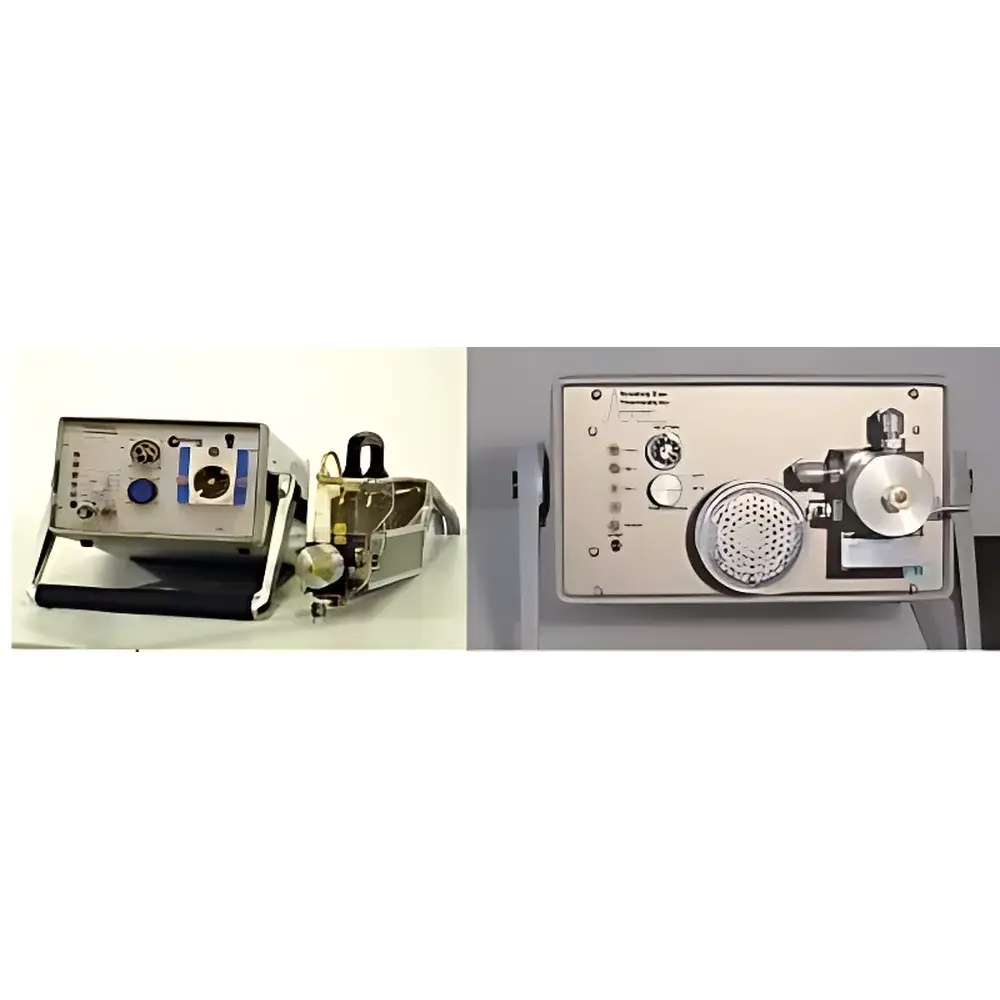
TSI Rotating Disk Aerosol Diluter (Model 379020A / 379030)
| Brand | TSI |
|---|---|
| Origin | USA |
| Model | 379020A / 379030 |
| Instrument Type | Aerosol Conditioning Diluter |
| Dilution Ratio (379020A) | 15:1 to 3000:1 (8-hole disk), 15:1 to 300:1 (10-hole disk) |
| Dilution Ratio (379021) | 12:1 to 2400:1 (8-hole disk), 12:1 to 240:1 (10-hole disk) |
| Sample Inlet Flow | ~1.0 L/min (379020A), ~1.2 L/min (379021) |
| Dilution Air Temperature Settings | Off, 40 °C, 80 °C, 120 °C, 150 °C (379020A) |
| Heating Temperature (379030/379031) | Up to 400 °C |
| Outlet Flow Range | 0.5–1.5 L/min (standard), up to 5 L/min (high-flow mode) |
| Pressure Drop Range | −100 to +150 mbar (379020A), −50 to +150 mbar (379021) |
| Secondary Dilution Flow (379030) | 0–15 L/min |
| Design Configuration | Separated sampling outlet and controller (379020A), Integrated outlet and controller (379021) |
Overview
The TSI Rotating Disk Aerosol Diluter (Model 379020A / 379030) is a precision-engineered aerosol conditioning system designed for regulatory-compliant particulate matter (PM) measurement in engine exhaust, combustion emissions, and ambient air monitoring applications. Operating on the principle of controlled turbulent mixing within a rotating disk chamber, this diluter achieves highly reproducible, isokinetic dilution while preserving the original particle size distribution (PSD) and number concentration integrity—critical for accurate downstream analysis by condensation particle counters (CPCs), scanning mobility particle sizers (SMPS), or electrical low-pressure impactors (ELPI). Its integration with TSI’s 379030/379031 heated thermal conditioner enables selective volatilization of semi-volatile organic compounds (SVOCs), ensuring that only non-volatile, solid-phase particles are quantified—a requirement specified in the Particle Measurement Programme (PMP) guidelines (UN/ECE R83, R49, and ISO 8549-2). The system is widely deployed in vehicle certification laboratories, EPA Method 202-compliant testing facilities, and research institutes conducting real-world driving emissions (RDE) studies.
Key Features
- Rotating disk-based dilution mechanism delivering stable, pulse-free flow profiles with minimal shear-induced particle coagulation or break-up
- Wide, stepwise dilution ratio range: 15:1 to 3000:1 (379020A, 8-hole disk) and 12:1 to 2400:1 (379021, 8-hole disk), enabling flexibility across low- and high-concentration aerosol sources
- Programmable dilution air heating (up to 150 °C for 379020A; up to 80 °C for 379021) to suppress vapor-phase re-condensation during dilution
- Independent sampling probe design (379020A) allows direct insertion into CVS tunnels, stack ducts, or tailpipes without upstream flow disturbance
- High-temperature thermal conditioner (379030/379031) capable of sustained operation at 400 °C, compatible with PMP-compliant volatile removal protocols
- Dual-mode outlet flow control supporting both standard (0.5–1.5 L/min) and high-flow (up to 5 L/min) configurations for integration with fast-response analyzers
- Robust pressure compensation architecture maintaining ±2% volumetric accuracy across −100 to +150 mbar differential pressure ranges
Sample Compatibility & Compliance
The 379020A/379030 system is validated for use with diesel and gasoline direct-injection (GDI) engine exhaust, biomass combustion aerosols, industrial flue gases, and laboratory-generated test aerosols (e.g., CAST soot, DEHS, NaCl). It meets critical requirements of ISO 29463-3 (high-efficiency filter testing), ASTM D6243 (diesel particulate filter evaluation), and EU Commission Regulation (EU) 2017/1151 Annex VI (RDE testing). When paired with a PMP-certified CPC (e.g., TSI 3776), the full chain satisfies UN/ECE Regulation No. 83 (light-duty vehicles) and No. 49 (heavy-duty engines) for solid particle number (SPN) measurement. All firmware and hardware configurations support audit-ready data logging aligned with GLP and ISO/IEC 17025 documentation standards.
Software & Data Management
The diluter operates via TSI’s proprietary Aerosol Instrument Manager (AIM) v6.x software suite, which provides synchronized control of dilution ratio, heater setpoints, and mass flow regulators. AIM supports automated method sequencing—including temperature ramping, multi-step dilution profiling, and time-stamped event logging—with native export to CSV, HDF5, and NetCDF formats. Full 21 CFR Part 11 compliance is available through optional AIM Secure Mode, featuring electronic signatures, role-based access control, and immutable audit trails for regulated environments. Raw sensor data (thermocouple readings, pressure transducer outputs, motor encoder positions) are streamed at 10 Hz for post-hoc diagnostics and uncertainty propagation analysis per GUM (JCGM 100:2008).
Applications
- Regulatory emissions testing for light- and heavy-duty vehicles under WLTC, FTP-75, and RDE cycles
- Development and validation of diesel particulate filters (DPFs) and gasoline particulate filters (GPFs)
- Real-time aerosol characterization in combustion research labs and engine test cells
- Calibration traceability for SMPS, EEPS, and CPC systems requiring stable, low-concentration aerosol references
- Volatility basis set (VBS) studies and thermodenuder-assisted aerosol aging experiments
- Indoor air quality (IAQ) source apportionment using controlled dilution of cooking, candle, or incense emissions
FAQ
What distinguishes the 379020A from the 379021 model?
The 379020A features higher maximum dilution temperature (150 °C vs. 80 °C), wider dilution range (up to 3000:1), and a physically separated sampling outlet for flexible field deployment.
Can the 379030 thermal conditioner be used independently of the rotating disk diluter?
Yes—the 379030 operates as a standalone heated denuder and is compatible with third-party diluters, impactors, and filter samplers via standardized 1/4″ Swagelok fittings.
Is the system suitable for measuring nanoparticles below 23 nm?
When coupled with a PMP-certified CPC (e.g., TSI 3776) and operated under ISO 27891-compliant conditions, the system supports reliable detection down to 10 nm solid particle diameter.
Does the diluter require periodic calibration?
While no routine recalibration is required, annual verification of mass flow controllers and thermocouple accuracy against NIST-traceable standards is recommended per ISO/IEC 17025 Clause 6.5.
How is volatile artifact minimization verified during operation?
TSI provides application note AN-3790-01 detailing dual-thermodenuder intercomparison protocols and volatility loss correction algorithms based on evaporation kinetics modeling.
Related Products







