
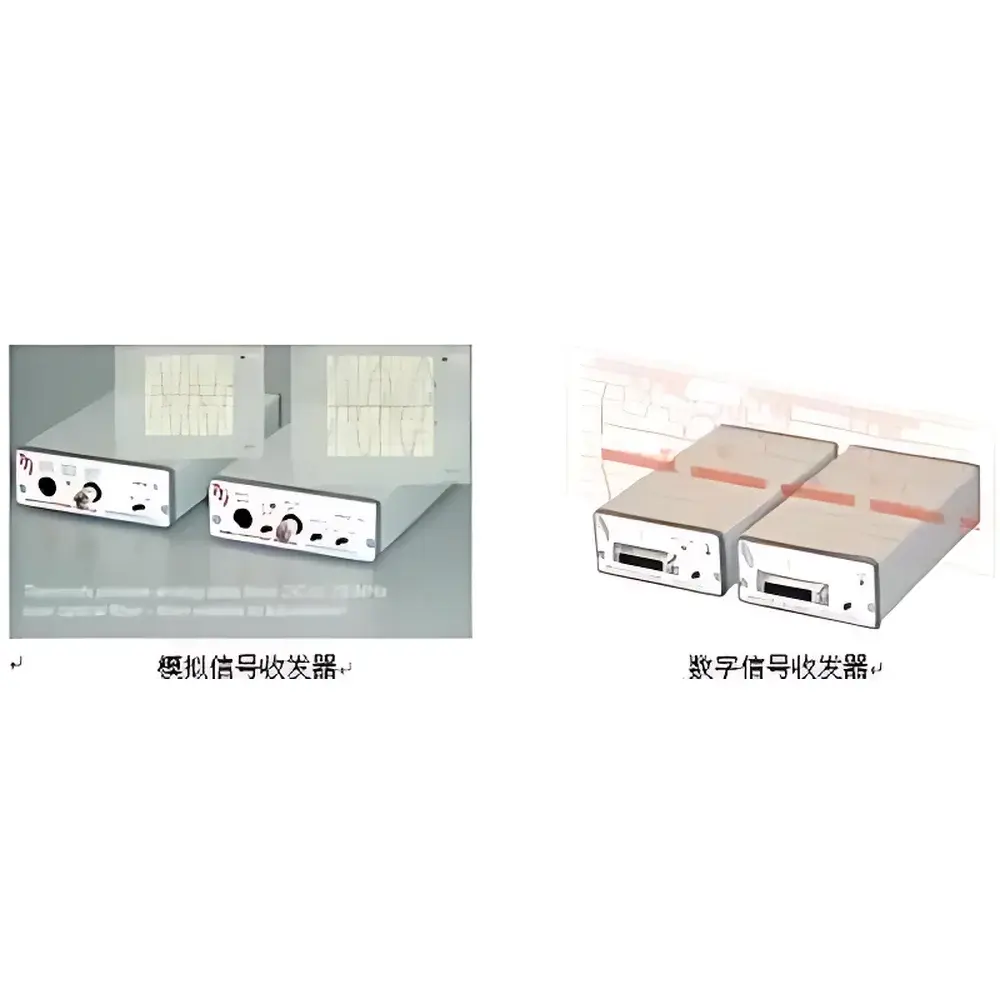
TTI LTX-5515 Analog Fiber-Optic Signal Transceiver
| Brand | TTI |
|---|---|
| Origin | USA |
| Model | LTX-5515 |
| Analog Bandwidth | DC – 12.5 MHz (-3 dB) |
| Input Voltage Range | ±1 V or ±5 V |
| Resolution | 12-bit |
| Accuracy | ±0.1% Full Scale, ±20 mV offset |
| Data Rate | 50 Mb/s |
| Switching Speed | 0 – 12 MHz |
| Laser Wavelength | 850 nm ± 20 nm, 1310 nm ± 20 nm |
Overview
The TTI LTX-5515 Analog Fiber-Optic Signal Transceiver is an engineered solution for high-fidelity, galvanically isolated transmission of analog voltage signals over optical fiber. Designed for demanding electromagnetic interference (EMI)-sensitive environments, it employs intensity-modulated laser diode transmission and photodiode-based demodulation to convert analog input voltages into optical carriers—eliminating ground loops, common-mode voltage hazards (>10 kV typical isolation), and signal degradation across long distances. Its core architecture complies with fundamental principles of optoelectronic signal conditioning: linear current-to-light conversion (via bias-controlled VCSEL or FP laser), low-noise transimpedance amplification at the receiver, and precision analog-to-digital reconstruction only where required downstream. This device is not a data logger or digitizer per se; rather, it preserves analog integrity end-to-end—making it essential in plasma diagnostics, pulsed power monitoring, RF amplifier feedback control, and high-power laser cavity sensing where real-time waveform fidelity, sub-microsecond latency, and >100 dB common-mode rejection ratio (CMRR) are non-negotiable.
Key Features
- True analog fiber-optic transmission with no on-board ADC/DAC—preserves signal phase linearity and dynamic range
- DC-coupled bandwidth of 12.5 MHz (-3 dB), supporting fast transient capture including square-wave rise times <30 ns
- Dual-wavelength operation: interoperable with both 850 nm multimode (OM1–OM4) and 1310 nm single-mode (OS1/OS2) fiber infrastructure
- Configurable input sensitivity: selectable ±1 V or ±5 V full-scale range via front-panel DIP switches or remote command interface
- 12-bit effective resolution maintained across full bandwidth, verified per IEEE Std 1057 procedures
- Galvanic isolation rated to 5 kVRMS (1 min, IEC 61000-4-5 surge withstand), enabling safe interfacing with HV test benches and tokamak diagnostics
- Four independent analog channels housed in a single 1U rack-mount chassis (optional 19″ 4-channel module variant available)
- Input impedance selection: 50 Ω or 1 MΩ per channel, switchable without hardware modification
Sample Compatibility & Compliance
The LTX-5515 interfaces directly with standard BNC-terminated analog outputs from oscilloscopes, lock-in amplifiers, function generators, and sensor signal conditioners. It requires no external power at the remote (transmit) end when used with TTI’s companion LTR-5515 receiver—only fiber patch cable and host-side 24 VDC. The system meets IEC 61326-1 (industrial EMC), UL 61010-1 (safety), and RoHS 3 directives. While not certified for SIL or DO-178C applications, its deterministic latency (<150 ns propagation + <5 ns jitter) and absence of firmware make it suitable for safety-related monitoring loops under customer-defined validation protocols aligned with ISO 13849-1 Category 3 architectures.
Software & Data Management
The LTX-5515 operates autonomously—no driver installation, OS dependency, or runtime software is required. Configuration is performed via hardware jumpers or optional RS-485 command set (Modbus RTU compliant). All calibration coefficients—including gain, offset, and wavelength-specific responsivity—are stored in non-volatile EEPROM and applied in analog domain prior to optical modulation. Audit trails are maintained externally via host DAQ systems; the transceiver itself provides no local storage or network stack. For GLP/GMP environments, users may document calibration intervals (recommended annually) and traceability to NIST-traceable voltage standards using TTI’s Certificate of Conformance (CoC), which includes as-found/as-left data per ISO/IEC 17025 requirements.
Applications
- Plasma physics experiments: real-time Langmuir probe bias voltage transmission across vacuum feedthroughs without distortion from RF noise
- High-voltage power electronics: isolated gate-drive signal relay and current-sense feedback in SiC/GaN inverter stacks
- Laser system diagnostics: analog photodetector output transmission from Q-switched Nd:YAG cavities with minimal timing skew
- EMC immunity testing: reference signal distribution within semi-anechoic chambers where copper cabling induces coupling errors
- Nuclear instrumentation: neutron detector pulse-height analysis signal transport across radiation-hardened zones
FAQ
Does the LTX-5515 include built-in analog-to-digital conversion?
No. It performs analog optical modulation only; digitization must occur at the receiving instrument or downstream DAQ system.
Can multiple LTX-5515 units share a single fiber strand?
No—each unit requires dedicated fiber (WDM multiplexing is not supported); however, four channels operate independently over one multi-fiber cable assembly.
Is recalibration required after fiber replacement?
No. Calibration is laser-diode and photodiode specific—not fiber-length dependent—as long as connector insertion loss remains within specified limits (≤3.5 dB per mated pair).
What is the maximum recommended fiber length at 1310 nm for analog mode?
For LTX-5515 analog operation, up to 10 km is supported with 9/125 µm single-mode fiber and ≤0.4 dB/km attenuation, assuming SNR > 60 dB at full scale.
Does TTI provide application-specific firmware updates?
Not applicable—the device contains no programmable logic or microcontroller; all functionality is hardwired and field-proven across >15 years of deployment.




