
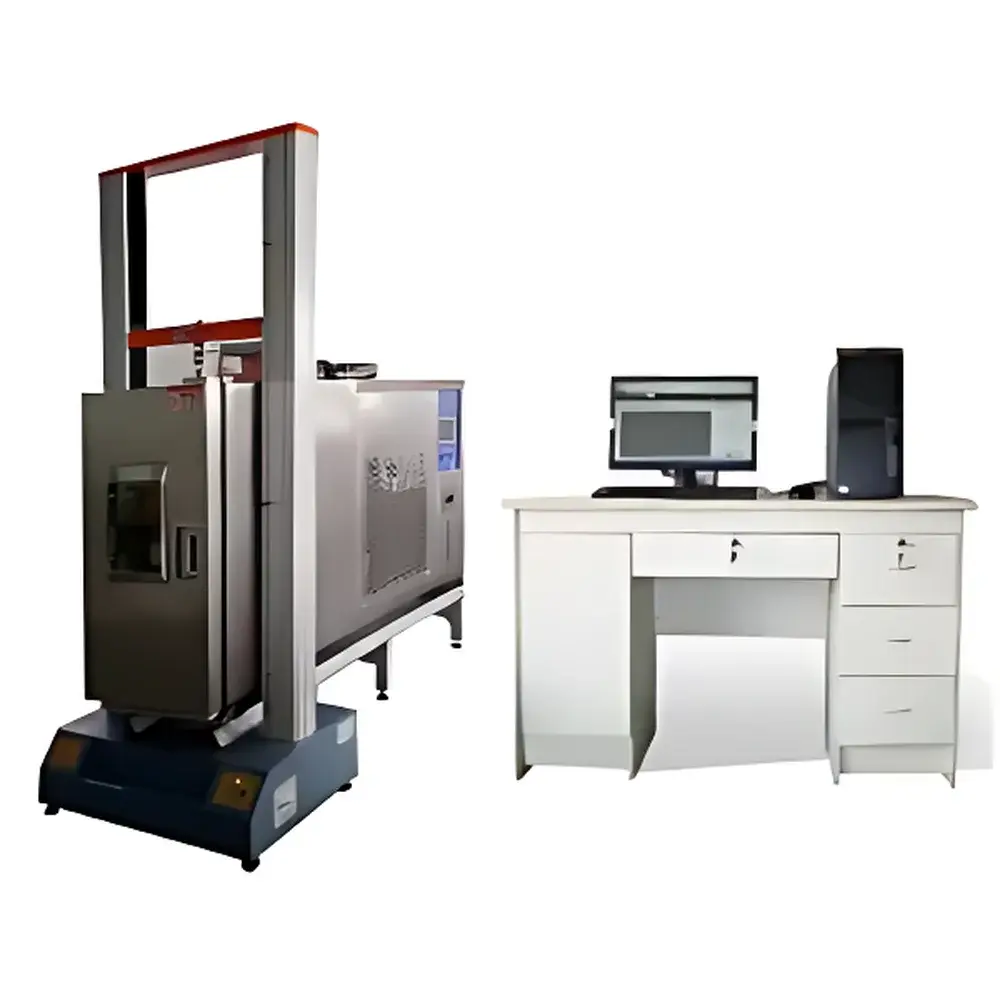
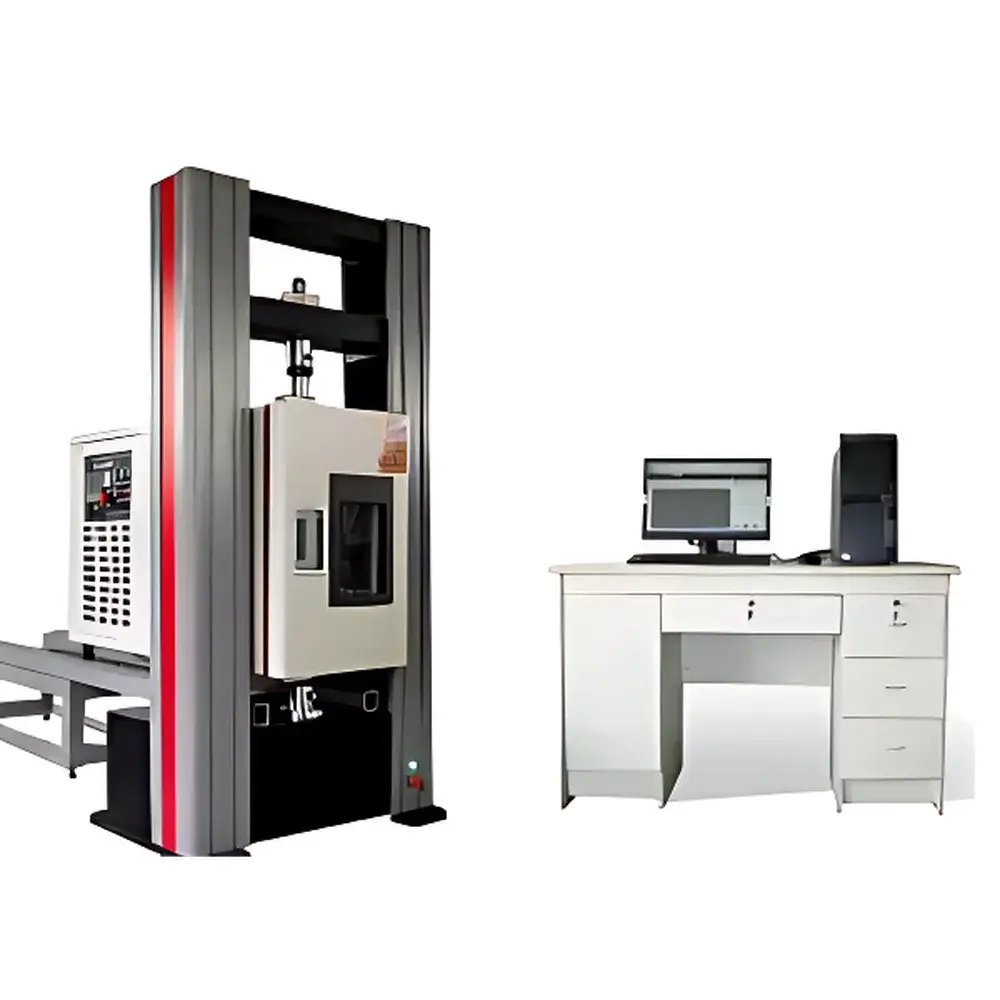
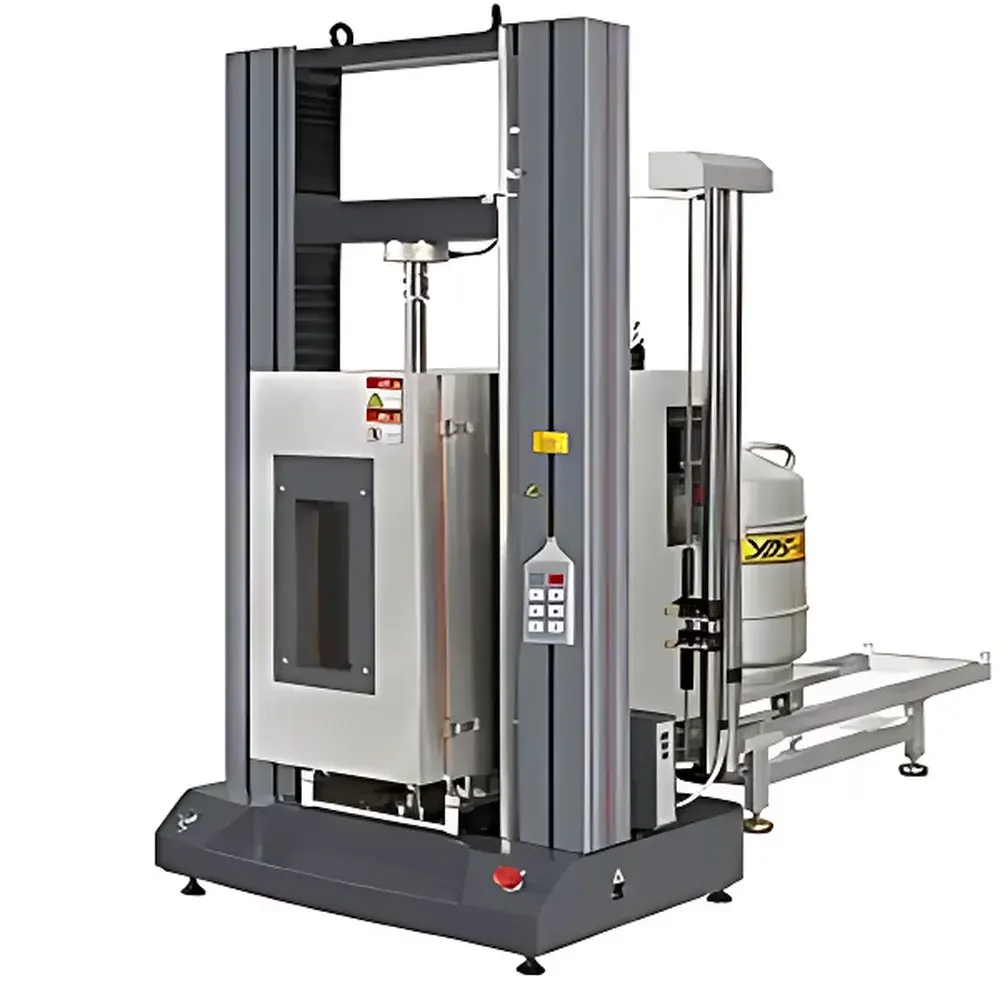
Tuofeng TFW-20G High-Temperature Microcomputer-Controlled Tensile Testing Machine
| Brand | Tuofeng |
|---|---|
| Origin | Shanghai, China |
| Manufacturer Type | Direct Manufacturer |
| Model | TFW-20G |
| Instrument Type | Electromechanical Tensile Testing Machine |
| Maximum Test Load | 200 kN |
| Force Measurement Range | 0.4–100% of Full Scale |
| Force Accuracy | ±0.5% of reading |
| Crosshead Travel | 1000 mm |
| Displacement Resolution | 0.0001 mm |
Overview
The Tuofeng TFW-20G High-Temperature Microcomputer-Controlled Tensile Testing Machine is a dual-module electromechanical system integrating a precision universal testing frame with an independently controlled high-temperature environmental chamber. Engineered for materials science laboratories and industrial R&D centers, it performs standardized uniaxial tensile, compression, bending, and shear tests on metallic alloys, polymer composites, ceramics, and advanced laminates under elevated thermal conditions—up to 300 °C. The system operates on the principle of servo-controlled displacement actuation via a high-rigidity滚珠丝杠 (ball-screw) transmission train, coupled with real-time force feedback from calibrated load cells and high-resolution position tracking via optical encoders. Its modular architecture enables seamless decoupling: the environmental chamber may be used standalone for component-level thermal aging or creep evaluation, while the base testing frame supports ambient-temperature mechanical characterization per ISO 6892-1, ASTM E8/E21, and GB/T 228.1.
Key Features
- High-stability electromechanical drive: AC servo motor paired with precision timing belt and preloaded ball-screw assembly ensures smooth, backlash-free crosshead motion across the full 1000 mm stroke range.
- Force measurement certified to ISO 7500-1 Class 0.5: Dual-range load cell with ±0.5% accuracy over 0.4–100% FS, traceable to national metrological standards.
- Sub-micron displacement resolution: 0.0001 mm encoder-based positioning enables precise strain quantification in low-deformation regimes (e.g., elastic modulus determination).
- Integrated high-temperature chamber: 304 stainless steel inner chamber (300 × 250 × 600 mm standard), PID-controlled heating with ±1 °C uniformity and 0.1 °C digital resolution; external cold-rolled steel housing with powder-coated finish.
- Modular mobility design: Chamber mounted on heavy-duty casters with integrated linear guide rails for repeatable alignment and thermal isolation during setup.
- Hardware-level safety interlocks: Automatic shutdown triggered by overload, specimen rupture, current surge, or thermal excursion beyond setpoint.
Sample Compatibility & Compliance
The TFW-20G accommodates flat, round, and notched specimens per ISO 6892-1 (tensile), ISO 14577 (instrumented indentation), ASTM D638 (plastics), and GB/T 7314 (compression of metallic materials). Specimen grips include pneumatic wedge-action clamps (standard), hydraulic self-tightening jaws (optional), and high-temperature ceramic-faced fixtures rated to 300 °C. All test protocols support audit-ready compliance with GLP and GMP requirements: raw data logging includes timestamped force-displacement traces, environmental chamber temperature profiles, and operator ID metadata. System firmware adheres to ISO/IEC 17025 documentation practices and facilitates traceability for FDA 21 CFR Part 11–aligned validation packages.
Software & Data Management
Control and analysis are executed via Windows-based proprietary software compatible with Windows 7/10/11 (64-bit). The interface provides real-time visualization of load–displacement, stress–strain, and time–temperature–deformation curves. Automated parameter extraction includes yield strength (Rp0.2), ultimate tensile strength (UTS), elongation at break (A%), Young’s modulus (E), and reduction of area (Z%). Curve overlay functionality allows side-by-side comparison of up to eight datasets using user-defined color coding and axis scaling. Raw ASCII output (.csv) and structured XML export ensure interoperability with MATLAB, Python (NumPy/Pandas), and LIMS platforms. Audit trail logs record all user actions—including method edits, calibration events, and report generation—with immutable timestamps.
Applications
- High-temperature mechanical property mapping of aerospace-grade superalloys (e.g., Inconel 718, Ti-6Al-4V) across 25–300 °C.
- Thermo-mechanical fatigue (TMF) pre-screening of polymer matrix composites (PMCs) used in automotive under-hood components.
- Creep rupture testing of refractory ceramics and fiber-reinforced concrete under sustained load at elevated temperatures.
- Validation of weld joint integrity in pressure vessel steels per ASME BPVC Section VIII Div. 2 Annex 3.A.
- Quality control of additive-manufactured metal parts, including post-heat-treated Ti-6Al-4V and AlSi10Mg specimens.
- Research into glass transition effects on thermoplastic elastomers (TPEs) and shape-memory polymers (SMPs).
FAQ
What is the maximum operating temperature of the environmental chamber?
The standard chamber achieves 250 °C continuously; optional configuration extends to 300 °C with upgraded heating elements and insulation.
Can the system perform closed-loop strain control during high-temperature tests?
Yes—when equipped with high-temperature extensometers (e.g., clip-on or non-contact laser types), the controller supports displacement- and strain-controlled ramp-hold profiles per ASTM E2309.
Is third-party calibration certification included with delivery?
Each unit ships with a factory calibration certificate traceable to CNAS-accredited standards; ISO/IEC 17025–accredited field calibration services are available upon request.
Does the software support automated report generation compliant with ISO 17025 requirements?
Yes—templates follow ISO/IEC 17025 Annex A.1 guidelines, embedding instrument IDs, calibration dates, environmental conditions, and statistical uncertainty estimates directly into PDF outputs.
What maintenance intervals are recommended for long-term reliability?
Ball-screw lubrication every 1,000 operational hours; load cell verification annually; chamber heater and sensor calibration biannually—documented in the included Maintenance Logbook.
Related Products



