
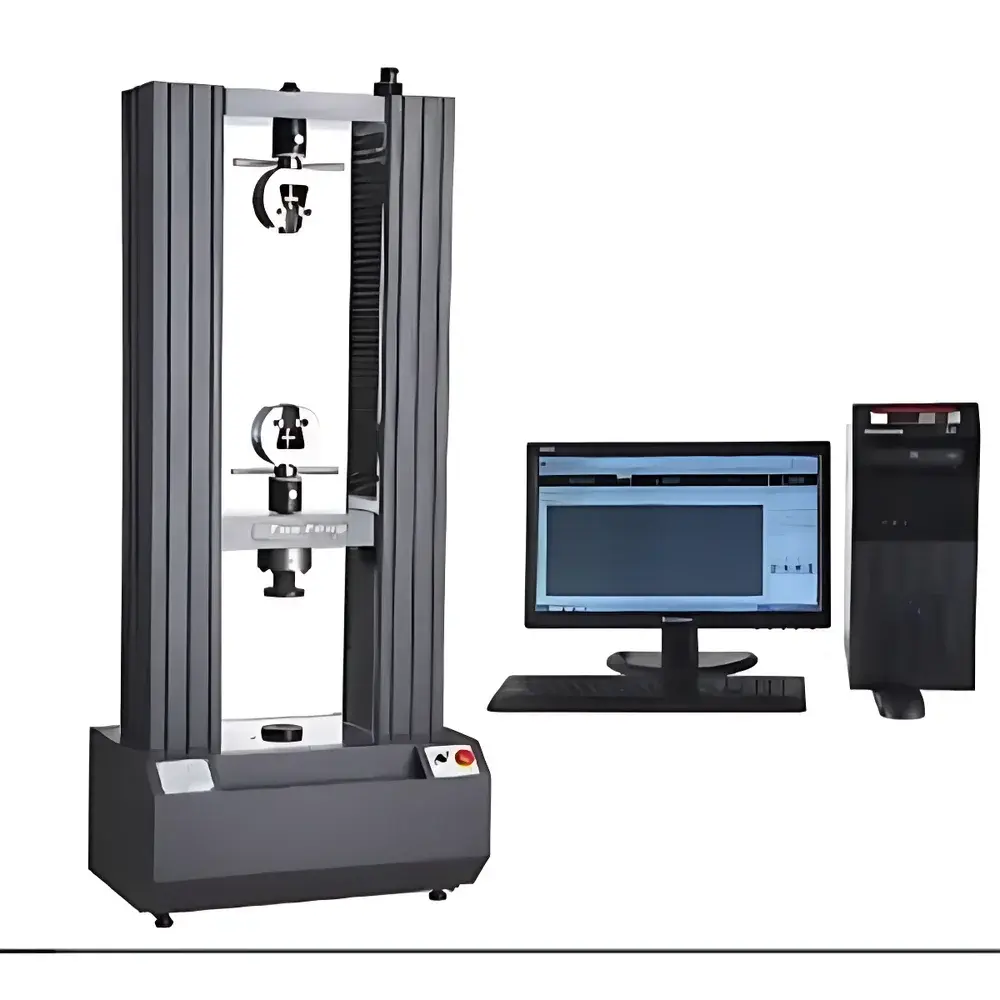
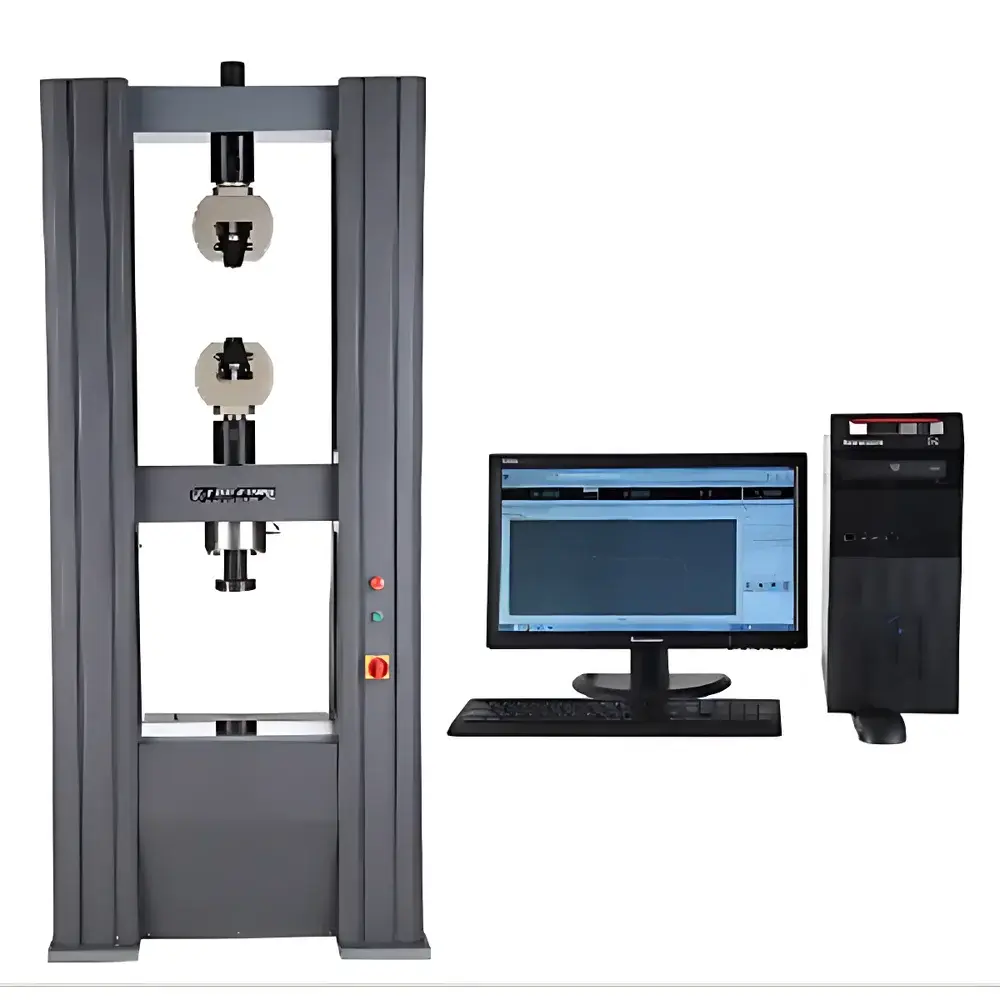
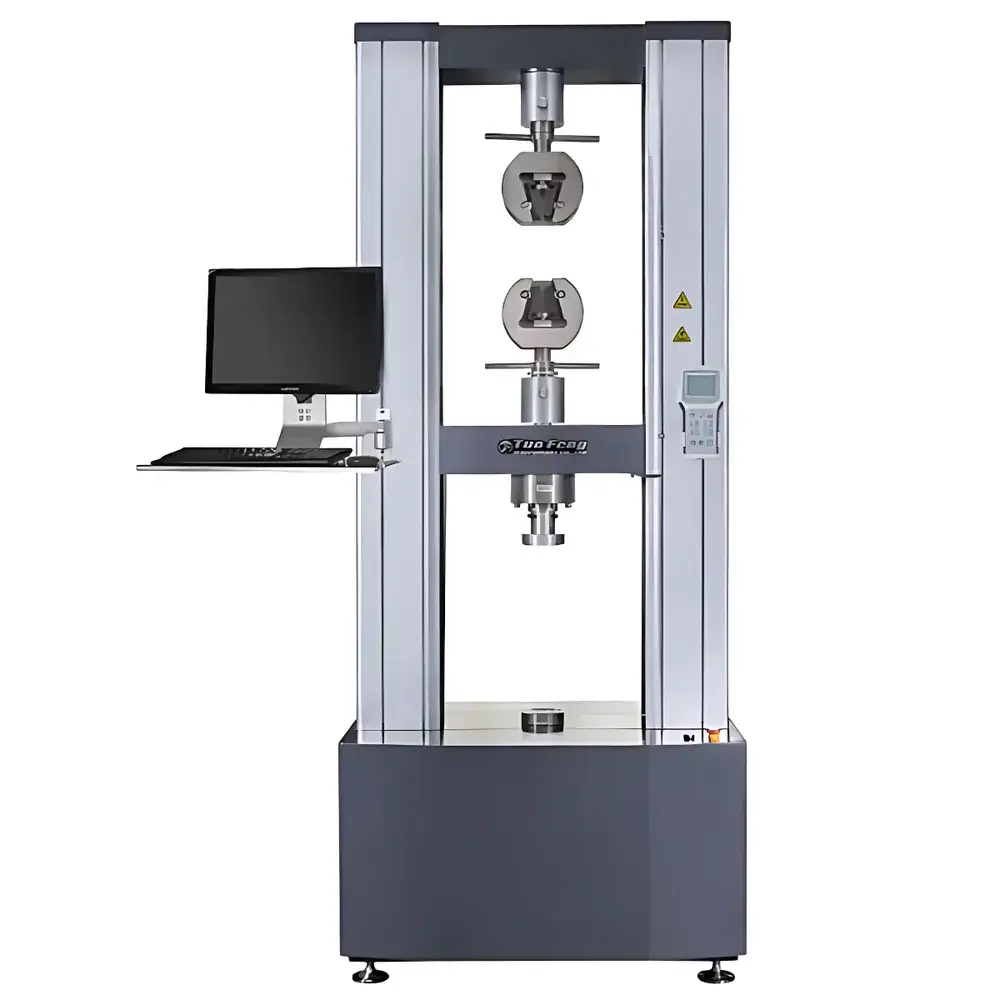
Tuofeng TFW-219 Microcomputer-Controlled Electronic Universal Testing Machine
| Brand | Tuofeng |
|---|---|
| Origin | Shanghai, China |
| Manufacturer Type | Direct Manufacturer |
| Instrument Type | Electromechanical Universal Testing Machine |
| Model | TFW-219 |
| Load Capacity | 200 kN |
| Accuracy Class | 0.5 |
| Effective Force Range | 0.2–100% of Full Scale |
| Force Measurement Accuracy | ±0.005% of Reading |
| Force Resolution | 1 part in ±500,000 full-scale codes (no range switching, constant resolution) |
| Drive System | Imported Servo Motor + Precision Worm Gear Reducer |
| Lead Screw | High-Accuracy Ball Screw |
| Effective Test Width | 600 mm (customizable) |
| Max. Stroke | 800 mm (extendable) |
| Speed Range | 0.001–500 mm/min (infinitely variable) |
| Displacement Measurement | Optical Encoder |
| Displacement Accuracy | ±0.005% of Reading |
| Strain Measurement | Optional Extensometer or Large-Deformation Sensor |
| Strain Accuracy | ±0.005% of Reading |
| Safety Protection | Electronic Limit Switches, Emergency Stop, Overload Protection (10% above capacity) |
| Crosshead Control | Dual-Speed (Fast/Slow) Automatic Adjustment with Point-to-Point Jog Function |
| Return Mode | Auto-return or Manual Fast Return to Initial Position |
| Fixture Customization | Application-specific grips (tensile, compression, bend, shear, peel, tear) |
| Compliance | GB/T 16491–2008, JJG 475–2008, ASTM E4, ASTM E8, ISO 6892-1, ISO 7500-1, DIN 51221, JIS Z2241, BS EN 10002-1 |
Overview
The Tuofeng TFW-219 Microcomputer-Controlled Electronic Universal Testing Machine is an electromechanical force-testing platform engineered for high-precision mechanical property evaluation of metallic, polymeric, composite, and ceramic materials. It operates on the principle of controlled displacement actuation via a servo-driven ball-screw system, enabling accurate application of axial tensile, compressive, flexural, shear, peel, and tear loads. Designed to meet international metrological and structural integrity requirements, the system delivers traceable force measurement with 0.5-class accuracy per GB/T 16491–2008 and ISO 7500-1, supported by a force resolution of 1 part in ±500,000 full-scale codes—maintained uniformly across the entire load range without hardware range-switching. Its modular architecture accommodates standardized test configurations as defined in ASTM E8/E8M (tensile testing of metals), ASTM D638 (plastics), ISO 6892-1 (metallic materials), and EN 10002-1 (metallic tensile testing), making it suitable for both R&D laboratories and quality control environments subject to GLP, GMP, or ISO/IEC 17025 accreditation.
Key Features
- High-fidelity force transduction with ±0.005% reading accuracy and zero drift compensation over extended test durations.
- Imported servo motor coupled with a precision worm gear reducer ensures smooth, low-noise motion control and exceptional speed stability—even at sub-millimeter-per-minute rates.
- Ball-screw-driven crosshead with 600 mm effective test width and 800 mm standard stroke (extendable upon request) provides ample workspace for reinforced bar specimens, structural profiles, and large-section composites.
- Dual-speed automatic crosshead positioning with jog functionality enables rapid setup and precise specimen alignment prior to test initiation.
- Comprehensive safety architecture including electronic limit switches, hardware-based emergency stop circuitry, and programmable overload cutoff (triggered at 110% of rated capacity).
- Modular fixture interface supporting ASTM-compliant wedge-action tensile grips, compression platens, three- and four-point bending fixtures, and custom-designed shear or peel assemblies for rebar, wire rod, and welded mesh specimens.
Sample Compatibility & Compliance
The TFW-219 is routinely deployed for mechanical characterization of reinforcing steel bars (deformed and plain), prestressed strands, cold-drawn wires, and structural hollow sections per GB/T 1499.2, ASTM A615/A615M, ISO 15630-1, and EN 10080. Its 200 kN capacity and 0.2–100% effective force range allow full-scale testing of Ø6–Ø40 mm rebar grades up to HRB600, including yield plateau detection, uniform elongation (Agt), and total elongation at maximum force (A). The system conforms to national and international calibration and verification protocols: JJG 475–2008 (verification regulation for electronic universal testing machines), GB/T 16491–2008 (manufacturing standard), and ISO/IEC 17025 Annex A.5 for uncertainty budgeting in force measurement. All hardware and firmware are designed to support audit-ready data integrity under FDA 21 CFR Part 11 when paired with optional electronic signature and audit trail modules.
Software & Data Management
The Windows-based TFW-TestSuite software provides ISO/IEC 17025-aligned data acquisition and reporting workflows. It supports multiple control modes—including constant rate of extension (CRE), constant load ramping, hold-at-load, and displacement-controlled cycling—with real-time synchronization of force, displacement, and strain (when equipped with extensometry). The interface offers on-the-fly unit conversion (N/kN/lbf, mm/in, MPa/psi), multi-language support (English, Simplified/Traditional Chinese), and customizable report templates compliant with internal QA forms or external regulatory submissions. Curve overlay functionality permits comparative analysis of batch-to-batch variability or material lot qualification. Raw data is stored in encrypted binary format with embedded metadata (operator ID, timestamp, environmental conditions, calibration certificate ID), and export options include CSV, PDF, and XML for LIMS integration. Software updates are provided free of charge for the instrument’s operational lifetime.
Applications
- Tensile testing of hot-rolled deformed steel bars (GB/T 1499.2, ASTM A615) — determination of yield strength (ReL/Rp0.2), ultimate tensile strength (Rm), total elongation (A), and bendability.
- Compression testing of concrete cylinders and grout specimens per ASTM C39 and GB/T 50081.
- Three-point flexural evaluation of fiber-reinforced polymer (FRP) rebars and hybrid composites.
- Shear strength assessment of welded wire fabric and mechanical couplers used in precast construction.
- Peel and tear resistance testing of protective coatings applied to galvanized or epoxy-coated rebar.
- Process validation of cold-drawing and heat-treatment parameters in steel mill QC labs.
FAQ
Does the TFW-219 comply with ASTM E4 calibration standards for verification of force-measuring instruments?
Yes—the machine is supplied with a certified calibration certificate traceable to NIM (National Institute of Metrology, China) and includes built-in verification routines aligned with ASTM E4 Annex A for periodic in-house verification.
Can the system perform closed-loop strain control using an extensometer?
Yes—when fitted with a calibrated clip-on or non-contact extensometer, the controller supports true strain-controlled ramp-and-hold tests per ASTM E83 and ISO 5368.
Is the test software validated for use in regulated environments (e.g., pharmaceutical or aerospace QA)?
The base software meets functional requirements for ISO/IEC 17025; optional 21 CFR Part 11 compliance packages—including electronic signatures, audit trails, and role-based access control—are available upon request.
What is the typical lead time for custom fixture design and validation?
Standard tensile grips for rebar up to Ø40 mm are included; bespoke fixtures (e.g., ribbed-bar clamping, anchor pull-out assemblies) typically require 10–15 working days from drawing approval.
How is mechanical calibration maintained over long-term operation?
The system features auto-zeroing routines, temperature-compensated load cell electronics, and scheduled calibration prompts synchronized with user-defined maintenance intervals—fully documented in the instrument logbook module.



