
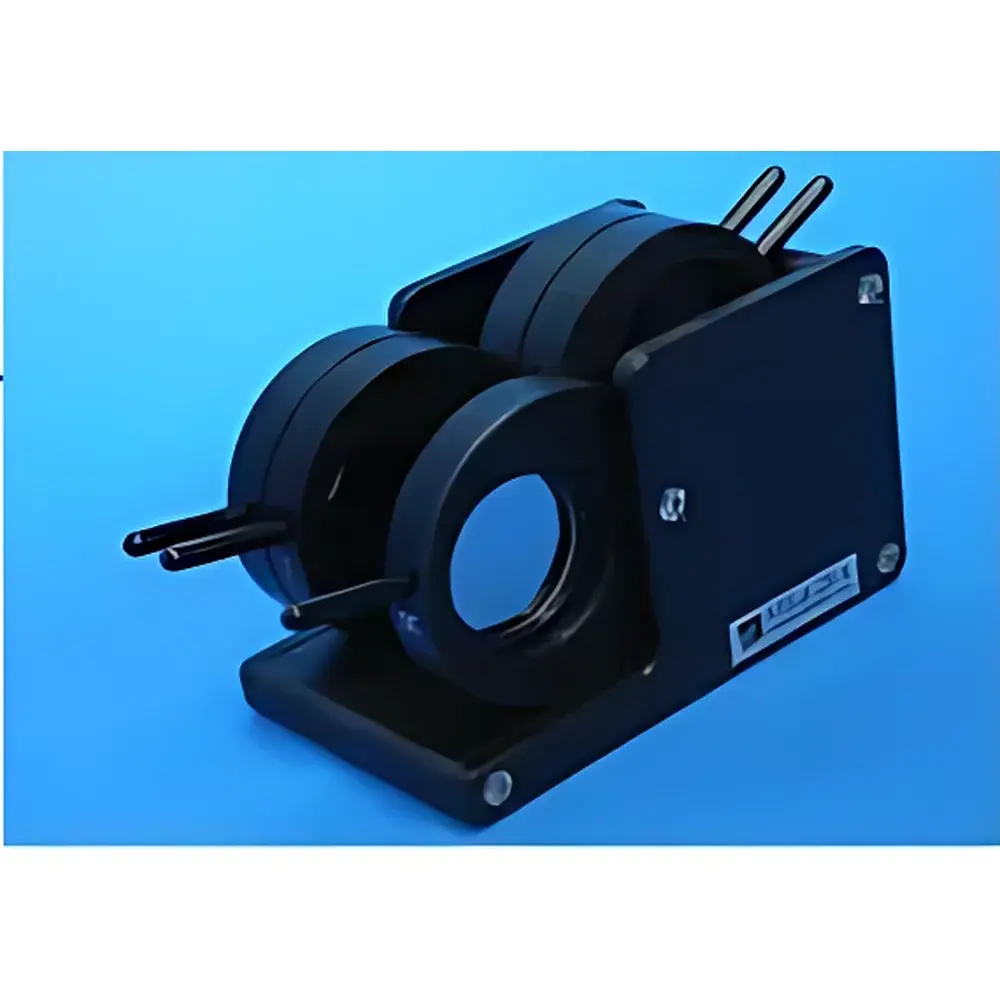
Tydex ATS THz Variable Attenuator Wheel System
| Brand | Tydex |
|---|---|
| Origin | Russia |
| Model | ATS |
| Transmission Levels | 30%, 10%, 3%, 1% (individual) |
| Max Aperture | 54.5 mm |
| Spectral Range | Up to 1000 µm (extended operational range beyond 1 mm achievable) |
| Mounting | Modular wheel-based holder (5-position turret), optional standalone use |
| Customization | Empty wheel position supports user-supplied optics (e.g., bandpass filters, polarizers, substrates) |
| Compliance | Designed for high-power THz beam conditioning in research-grade systems |
Overview
The Tydex ATS THz Variable Attenuator Wheel System is an engineered optical component designed for precise, repeatable power management of broadband terahertz radiation in laboratory and synchrotron-based experimental setups. Based on the principle of controlled transmission through calibrated silicon wedge elements with metallic coatings, the ATS system enables discrete yet highly stable attenuation without introducing significant beam distortion or polarization dependence. Unlike absorptive or thermal-based attenuators, the ATS leverages refractive index mismatch and internal reflection losses within high-resistivity silicon substrates—optimized for minimal dispersion and low absorption across the 0.1–3 THz (3 mm–100 µm) regime. Its mechanical architecture centers on a motorizable or manually indexed 5-position turret, allowing rapid switching between attenuation states while maintaining beam collimation and spatial overlap—critical for time-domain spectroscopy (TDS), heterodyne detection, and high-dynamic-range imaging applications.
Key Features
- Modular 5-position wheel turret with four calibrated silicon wedge attenuators (30%, 10%, 3%, 1% nominal transmission) and one blank slot for user-defined optics
- High-damage-threshold design compatible with pulsed and CW THz sources up to several kW peak power (depending on pulse duration and spot size)
- Low wavefront distortion (< λ/8 RMS over 50 mm aperture) ensured by precision-polished, <100 ppm thickness uniformity silicon wedges
- Interchangeable mounting: fully functional as a stand-alone optic or integrated into standard 25.4 mm or 50.8 mm kinematic mounts via optional adapter plates
- Custom aperture support up to Ø54.5 mm; substrate thickness, wedge angle, and coating reflectivity adjustable per application requirements
- No moving parts within individual attenuator elements—mechanical stability maintained over >10⁶ actuation cycles
Sample Compatibility & Compliance
The ATS attenuator is compatible with free-space THz beam paths operating under vacuum, dry nitrogen, or ambient conditions. It exhibits no measurable outgassing in UHV environments (tested to 1×10⁻⁹ mbar) and retains structural integrity at temperatures from 10 K to 350 K. All silicon substrates are fabricated from float-zone grown, high-resistivity (>10 kΩ·cm) material to minimize free-carrier absorption. The metallic coatings (typically Ti/Au or Cr/Au bilayers) are electron-beam deposited under ultra-high vacuum and qualified per MIL-C-48497A for adhesion and environmental durability. While not certified to a specific ISO or ASTM standard as a standalone device, the ATS conforms to optical interface specifications outlined in ISO 10110-7 (surface imperfections) and ISO 10110-12 (coating spectral performance), and is routinely deployed in setups compliant with GLP and ISO/IEC 17025-accredited THz metrology laboratories.
Software & Data Management
The ATS operates as a passive optical element and requires no embedded firmware or drivers. However, its integration into automated beamlines is facilitated via industry-standard mechanical interfaces: the turret hub accepts M4 or M6 threaded mounting and is compatible with common stepper-motorized rotation stages (e.g., Thorlabs K10CR1, Newport URS100CC). Position encoding is supported through external optical encoders or Hall-effect sensors. For traceable calibration, Tydex provides NIST-traceable spectral transmission data (measured via Fourier-transform THz spectrometer) for each attenuator unit, delivered in CSV and HDF5 formats—including uncertainty budgets per ISO/IEC Guide 98-3 (GUM). Raw transmission curves include smoothing-corrected noise floor characterization (RMS < 0.05% over 0.2–2.5 THz), enabling accurate photometric correction in quantitative intensity measurements.
Applications
- Dynamic range extension in THz time-domain spectroscopy (THz-TDS) systems, especially for high-brightness photoconductive antennas or optical rectification sources
- Power stabilization in feedback-controlled THz pump-probe experiments requiring sub-percent intensity repeatability
- Calibration reference for THz power meters and bolometric detectors (e.g., Golay cells, pyroelectric sensors)
- Beam conditioning in multi-spectral THz imaging platforms where variable exposure control replaces mechanical shuttering
- Integration into cryogenic THz endstations for synchrotron or FEL facilities, where vacuum compatibility and thermal cycling resilience are essential
FAQ
Is the ATS compatible with both pulsed and continuous-wave THz sources?
Yes—the silicon wedge design ensures consistent attenuation behavior across picosecond pulses and CW emission, provided average power density remains below 10 W/cm² and peak fluence stays below 10 mJ/cm² for <10 ps pulses.
Can I replace the blank wheel position with a custom filter?
Absolutely—the fifth position accepts plano-plano optics up to 5 mm thickness and Ø54.5 mm diameter; standard mounting uses 0.5 mm retaining rings with alignment fiducials.
Does Tydex provide calibration certificates with each unit?
Each ATS shipment includes a factory-measured transmission spectrum (0.1–3 THz), mechanical drawing, surface quality report, and coating reflectance data—all traceable to NIST SRM 1920a.
What is the maximum beam diameter supported without vignetting?
For full transmission uniformity, the recommended clear aperture is Ø45 mm; the physical housing limits usable diameter to Ø54.5 mm, with edge roll-off beginning at ~2% beyond that threshold.
Is vacuum baking supported?
Yes—fully assembled units have been successfully baked at 120°C for 24 h under 1×10⁻⁶ mbar without degradation to coatings or wedge adhesion.



