
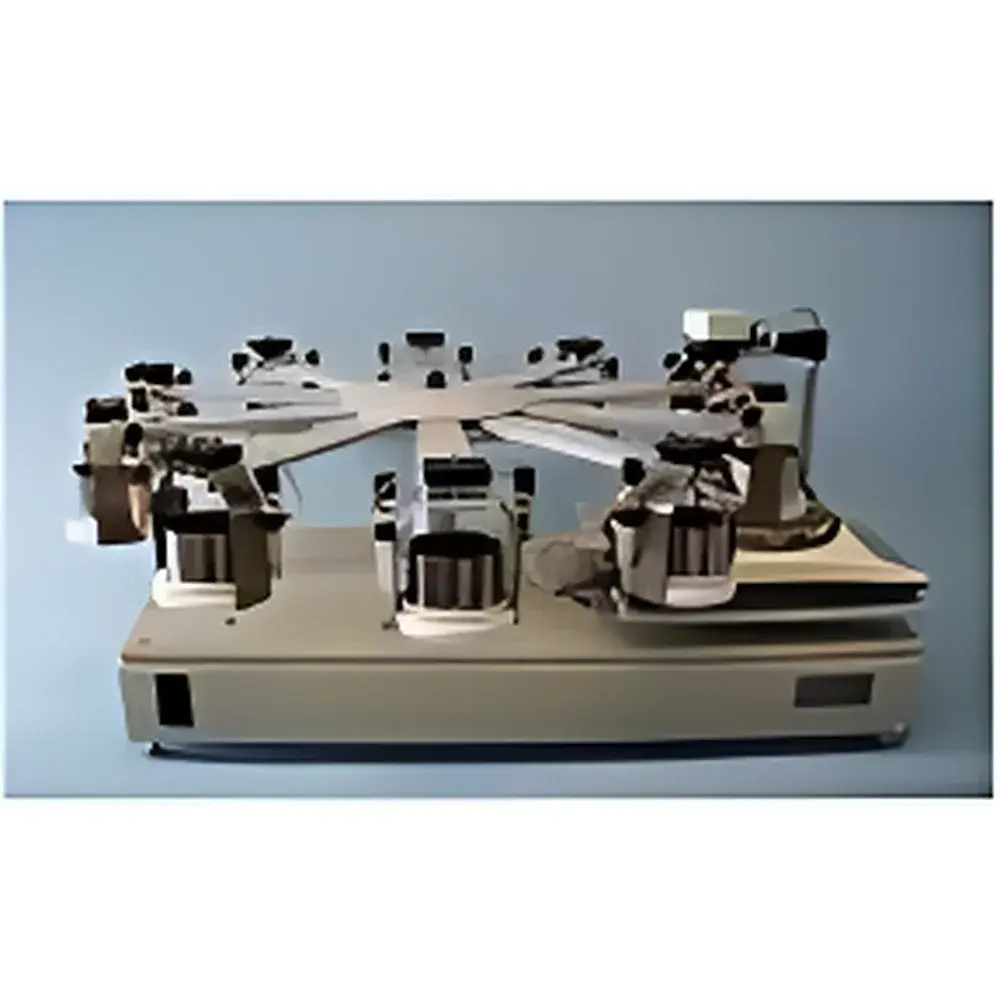
UGT Ku-pF Unsaturated Hydraulic Conductivity Measurement System
| Brand | UGT |
|---|---|
| Origin | Germany |
| Model | Ku-pF |
| Instrument Type | Soil Water Potential and Moisture Characterization System |
| Sample Capacity | 10 columns |
| Column Volume | 250 cm³ |
| Cross-sectional Area | 41 cm² |
| Weighing Resolution | 0.01 g |
| Matric Potential Range | +100 to −85 kPa (pF 2.0–2.8) |
| Hydraulic Conductivity Range | kᵤ < 10 cm/d |
| Measurement Interval | 10–40 min |
| System Dimensions | 100 × 70 × 40 cm |
| Weight | 40 kg |
| Power Supply | 220 V / 1 A |
| Interface | USB |
| Typical Test Duration | 2–10 days |
| Compliance | ASTM D6836, ISO 11274, UNSODA-compatible data export |
Overview
The UGT Ku-pF Unsaturated Hydraulic Conductivity Measurement System is a fully automated, gravimetric-evaporation-based laboratory instrument engineered for the precise determination of unsaturated hydraulic conductivity (ku) and soil water retention characteristics (i.e., the soil–water characteristic curve, SWCC). It operates on the principle of controlled evaporation from saturated soil columns under constant ambient conditions, enabling continuous, non-destructive monitoring of mass loss (via high-resolution weighing) and matric potential evolution (via dual tensiometric profiling). By integrating Darcy’s law with simultaneous measurements of volumetric water content (θ) and matric head (h), the system computes ku(θ) across the pF range of approximately 2.0–2.8 (−10 to −85 kPa), supporting rigorous hydrological modeling, vadose zone simulation, and contaminant transport analysis.
Key Features
- Simultaneous measurement of 10 independent soil columns, each housed in standardized 250 cm³ cylindrical rings with 41 cm² cross-section — ensuring statistical robustness and inter-sample comparability.
- Dual tensiometric profiling: Two Tensio 130 tensiometers per column, vertically spaced at 3 cm intervals, deliver high-fidelity matric potential gradients essential for accurate flux estimation and SWCC derivation.
- Automated star-arm weighing mechanism synchronized with programmable time intervals (10–40 min), enabling precise tracking of evaporative mass loss with ±0.01 g resolution.
- Integrated USB-connected data acquisition unit with real-time logging of weight, tensiometer voltage, temperature, and timestamp — compatible with Windows-based control software.
- Modular mechanical architecture: Stainless-steel frame, vibration-damped load cell platform, and sealed sample chamber design minimize environmental interference and ensure long-term operational stability.
Sample Compatibility & Compliance
The Ku-pF system accommodates a broad spectrum of mineral and organic soils, including sands, loams, clays, and structured aggregates, provided samples are homogenized and packed within the supplied 250 cm³ stainless-steel rings. All components—including tensiometers, load cells, and data loggers—conform to CE marking requirements and meet electromagnetic compatibility (EMC) Directive 2014/30/EU. Data output complies with ASTM D6836 (Standard Test Method for Determination of the Soil–Water Characteristic Curve for Unsaturated Soils) and ISO 11274 (Soil Quality — Determination of Field-Moist Bulk Density, Water Content and Porosity). Exported datasets follow UNSODA v2.0 metadata conventions, facilitating direct import into HYDRUS-1D, STANMOD, or RETC for inverse parameter estimation.
Software & Data Management
UGT’s proprietary Ku-pF Control & Analysis Suite provides intuitive experiment setup, real-time visualization of θ(h), ku(θ), and cumulative evaporation, plus post-processing tools for smoothing, outlier detection, and van Genuchten/Mualem parameter fitting. All raw sensor readings are stored with full audit trail: user ID, calibration timestamps, and instrument firmware version. The software supports 21 CFR Part 11–compliant electronic signatures and generates PDF reports containing metadata, raw curves, fitted parameters, and uncertainty estimates (based on propagation of weighing and tensiometric errors). Data files are saved in ASCII tab-delimited format with embedded headers for seamless integration into LIMS or institutional data repositories.
Applications
- Calibration and validation of unsaturated flow models used in landfill liner performance assessment and leachate migration studies.
- Characterization of engineered barrier systems (EBS) in nuclear waste disposal safety cases, where low-permeability clay–bentonite mixtures require high-resolution ku data below pF 2.5.
- Supporting EU Soil Thematic Strategy objectives by generating harmonized SWCC datasets for regional pedotransfer function (PTF) development.
- Research on root-zone water dynamics in agronomic trials, particularly for drought-tolerant crop cultivars requiring quantification of near-saturation ku behavior.
- Quality assurance in geotechnical laboratories accredited to ISO/IEC 17025, where traceable, repeatable ku measurements under GLP conditions are mandatory.
FAQ
What is the minimum detectable change in hydraulic conductivity using the Ku-pF system?
The system resolves ku changes down to ~0.01 cm/d within its operational range (ku < 10 cm/d), limited primarily by tensiometric sensitivity and weighing precision over defined time intervals.
Can the Ku-pF be used for swelling soils or expansive clays?
Yes — but sample preparation must include pre-consolidation and restraint to mitigate vertical displacement; optional confining rings are available upon request.
Is calibration of tensiometers performed in situ or offline?
Each Tensio 130 unit is factory-calibrated against NIST-traceable pressure standards; field verification is recommended before each test series using saturated salt solutions.
Does the system support remote monitoring during multi-day experiments?
Yes — the USB interface allows continuous connection to a dedicated PC running the control software; email/SMS alerts for anomalies (e.g., power interruption, sensor timeout) can be configured via optional network gateway module.
How is data integrity ensured during extended runs exceeding 7 days?
The data logger buffers all measurements internally (up to 30 days at 30-min intervals); power-loss recovery ensures no data gaps, and checksum-verified file writes prevent corruption.
Related Products







