
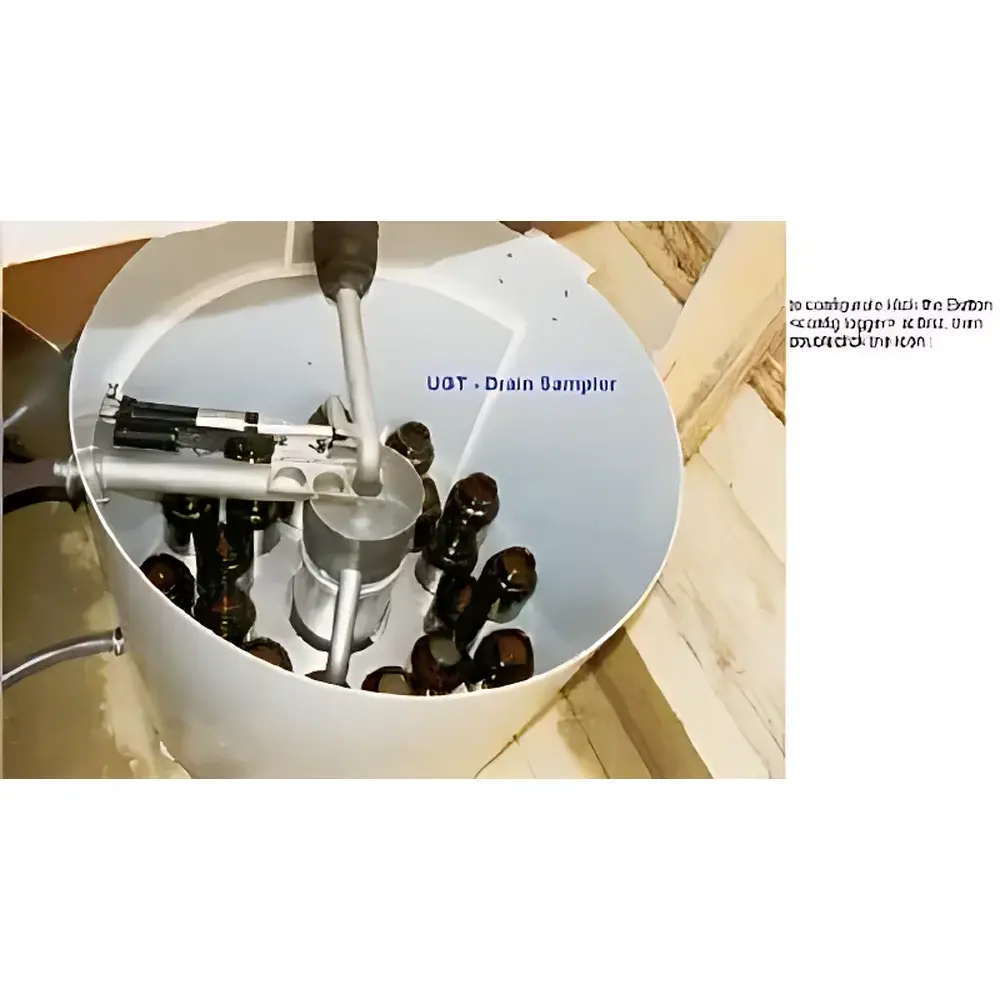
UGT Run-off Surface Runoff and Soil Erosion Monitoring System
| Brand | UGT |
|---|---|
| Origin | Germany |
| Model | Run-off |
| Instrument Type | Soil Moisture / Water Potential Analyzer |
| Key Components | V2A Diversion Unit, Dual-Bucket Flowmeters (3 L & 1 L), 24-Bottle Auto-Sampler, UMP-2 Multi-Parameter Soil Sensor (VWC/Temp/EC), Tipping-Bucket Rain Gauge (2 mL per tip, 0.1 mm resolution), Data Logger (15-bit ADC, 512 KB RAM, 8-channel, programmable sampling logic) |
| Compliance | Designed for ISO 11274 (soil water retention), ASTM D4959 (soil moisture by capacitance), and EU Water Framework Directive (WFD) monitoring protocols |
| Software | UGTLOG v5.x (Windows-based, supports audit trail, parameter scheduling, event-triggered sampling, and export to CSV/Excel) |
Overview
The UGT Run-off Surface Runoff and Soil Erosion Monitoring System is an integrated, field-deployable environmental instrumentation platform engineered for quantitative, time-resolved measurement of surface hydrological and sediment transport processes. Based on the physical principles of volumetric flow partitioning, gravimetric sediment capture, and real-time sensor-based soil–water–solute state monitoring, the system enables rigorous investigation of rainfall–runoff–erosion coupling mechanisms under natural or controlled plot-scale conditions. It operates within the conceptual framework of process-based erosion modeling—specifically supporting USLE/RUSLE parameterization, sediment yield calibration, and solute leaching quantification. The system is designed for long-term unattended operation in diverse agroecological settings, including sloping cropland, restored grassland, forest margins, and semi-arid rangelands. Its architecture conforms to international standards for environmental data integrity, including traceable time-stamping, sensor calibration logging, and deterministic sampling logic—essential for regulatory reporting and peer-reviewed research reproducibility.
Key Features
- Modular dual-stage flow partitioning: A V2A stainless-steel diversion unit filters debris and directs runoff through parallel 3 L and 1 L tipping-bucket flowmeters—enabling high-capacity bypass (36 L/min max) while reserving precise low-flow sampling (up to 8 L/min) for laboratory analysis.
- Programmable 24-bottle auto-sampler: Equipped with a V2A three-way distributor arm and position-sensing logic, it executes event-triggered, time-proportional, or volume-proportional sampling sequences defined via UGTLOG software—ensuring representative capture of suspended solids and dissolved nutrient dynamics across storm hydrographs.
- Multi-parameter in-situ soil sensing: The UMP-2 probe simultaneously measures volumetric water content (0–100%, ±2% accuracy), soil temperature (−40 to +60 °C, ±0.5 °C), and bulk electrical conductivity (0.001–5 mS/cm, ±1%), providing co-located boundary condition data critical for infiltration–exfiltration modeling.
- High-fidelity precipitation monitoring: A 200 cm² aperture rain gauge with 2 mL tipping buckets delivers 0.1 mm resolution and linear response up to 8 mm/min—calibrated per WMO Guide to Instruments and Methods of Observation (CIMO).
- Robust data acquisition architecture: The embedded 15-bit data logger features 512 KB RAM, hardware real-time clock with drift compensation, sleep-mode power management (<1 mA standby), and eight configurable analog/digital sensor inputs—supporting synchronized timestamping of rainfall onset, runoff initiation, and sediment-laden pulse events.
Sample Compatibility & Compliance
The system is validated for use with standard sediment analysis protocols, including ISO 11277 (particle-size analysis by sieving and sedimentation) and ASTM D422 (grain-size analysis of soils). Collected 1 L runoff samples are compatible with laboratory instruments such as laser diffraction particle analyzers (e.g., Malvern Mastersizer), ICP-OES for elemental quantification (N, P, K, Ca, Mg), and TOC analyzers. All wetted components comply with DIN 11864-1 (food-grade stainless steel V2A/AISI 304) and meet EU REACH SVHC screening requirements. The system design facilitates GLP-compliant deployment: raw sensor outputs are stored with metadata (sensor ID, calibration date, firmware version), and all sampling decisions are logged with UTC timestamps and trigger conditions—fully auditable for environmental impact assessments and regulatory submissions under EU Regulation (EC) No 1107/2009 or US EPA Method 1669.
Software & Data Management
UGTLOG v5.x serves as the central configuration, visualization, and export interface. It provides graphical real-time monitoring of rainfall intensity, cumulative runoff volume, soil moisture hysteresis, and sampling actuation status. Users define complex sampling rules—including minimum inter-event dry periods, antecedent moisture thresholds, and dynamic bucket-fill triggers—via intuitive logic trees. All configuration changes are versioned and time-stamped. Data exports support CSV, Excel (.xlsx), and NetCDF formats, preserving SI units and uncertainty annotations. The software maintains a full audit trail compliant with FDA 21 CFR Part 11 requirements when operated with user authentication and electronic signature modules—making it suitable for GxP-aligned environmental monitoring programs.
Applications
- Quantifying sediment yield and nutrient export (total N, total P, NO₃⁻, NH₄⁺) from agricultural plots under varying tillage, cover crop, and contour farming regimes.
- Calibrating and validating physically based erosion models (e.g., WEPP, RillGrow, LISEM) using high-temporal-resolution runoff and sediment concentration data.
- Assessing effectiveness of ecological restoration interventions—such as check dams, grassed waterways, or biochar-amended soils—on peak flow attenuation and sediment trapping efficiency.
- Supporting watershed-scale sediment budgeting in compliance with the EU Water Framework Directive (WFD) Article 5 reporting obligations.
- Long-term monitoring of soil structural degradation indicators—correlating changes in clay/silt loss ratios (measured via SEDIMAT 4–12) with declining aggregate stability and organic carbon stocks.
FAQ
Can the system operate autonomously for extended deployments (e.g., >6 months)?
Yes—the data logger’s ultra-low-power sleep mode, combined with solar-charging compatibility and industrial-grade V2A construction, enables continuous operation in remote field sites with minimal maintenance.
Is the 1 L sampling bottle capacity sufficient for high-intensity rainfall events?
The system’s adaptive sampling logic allows users to configure smaller-volume sequential fractions (e.g., 250 mL sub-samples per bottle) or trigger overflow diversion—ensuring no loss of temporal resolution during intense pulses.
How is sensor calibration traceability maintained?
Each UMP-2 probe ships with NIST-traceable calibration certificates; UGTLOG stores calibration dates, coefficients, and verification logs alongside raw data—fully supporting ISO/IEC 17025 laboratory accreditation requirements.
Does the system support integration with third-party telemetry (e.g., LoRaWAN, GSM)?
The data logger provides RS-232/RS-485 serial output and Modbus RTU protocol support—enabling seamless connection to external gateways for cloud-based data aggregation and alerting.
What is the recommended maintenance interval for the filtration and flowmeter components?
Biannual inspection of the stainless-steel sieve and flowmeter pivots is advised; cleaning with deionized water and visual verification of bucket alignment ensures sustained metrological performance per manufacturer specifications.
Related Products







