
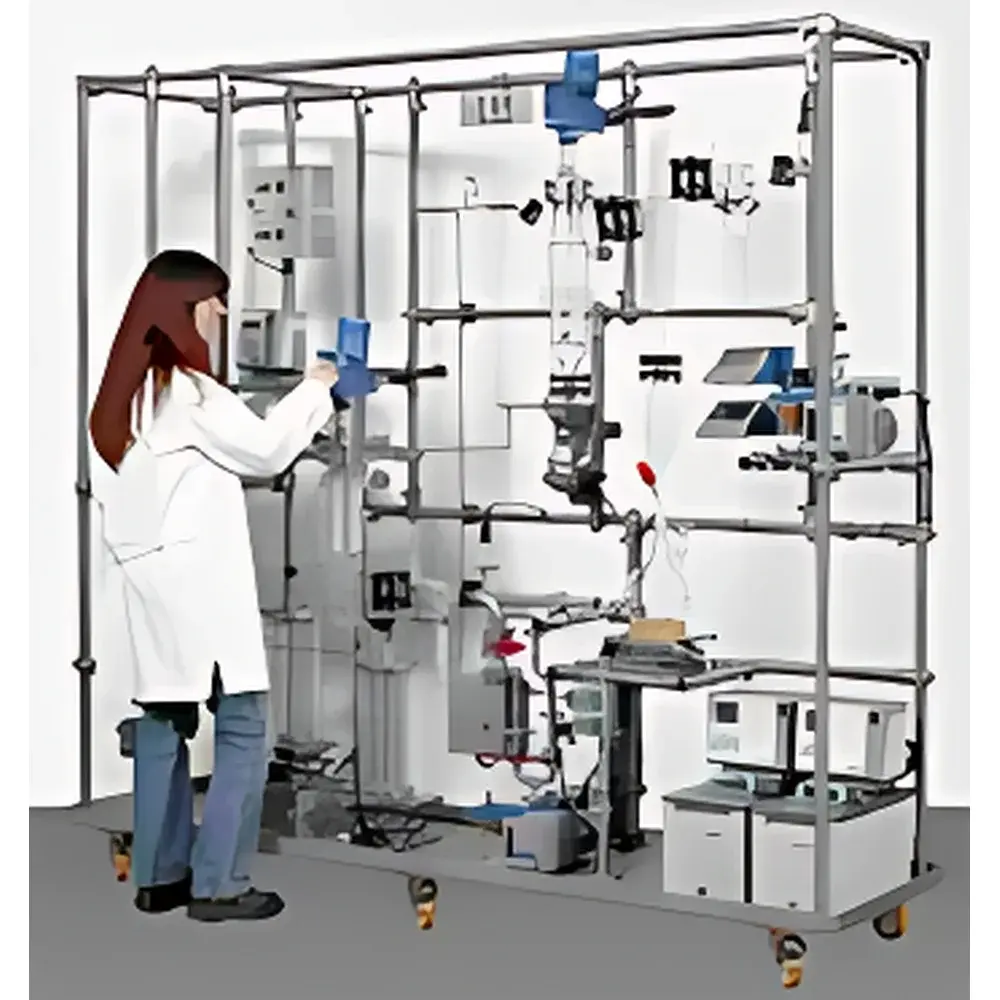
UIC DSL 5 / KDL 5 Combined Glass Short-Path and Thin-Film Molecular Distillation System
| Brand | UIC GmbH |
|---|---|
| Origin | Germany |
| Model | DSL 5 / KDL 5 |
| Feed Rate | 0.5–2.5 kg/h |
| Effective Evaporation Area | 0.05 m² |
| Evaporator Inner Diameter | 180 mm |
| Condenser Area | 0.085 m² |
| Collecting Flasks | 3 |
| Construction Material | Borosilicate Glass 3.3 |
| Max Evaporation Temp (DSL 5) | 250 °C |
| Max Evaporation Temp (KDL 5) | 350 °C |
| Min Operating Pressure (DSL 5) | 1 mbar |
| Min Operating Pressure (KDL 5) | 0.001 mbar |
| Film Formation | Self-Cleaning Roller System |
Overview
The UIC DSL 5 / KDL 5 Combined Glass Molecular Distillation System is a dual-stage, benchtop-scale purification platform engineered for high-vacuum, low-thermal-degradation separation of thermally sensitive, high-boiling-point compounds. It integrates two complementary unit operations—thin-film evaporation (DSL 5) and short-path (molecular) distillation (KDL 5)—into a single, modular glass train. The system operates on the principle that, under high vacuum (<1 mbar, down to 0.001 mbar), mean free path of vapor molecules exceeds the distance between evaporator surface and condenser, enabling molecular-level separation based on differences in vapor pressure rather than boiling point alone. This makes it especially suited for isolating polyunsaturated fatty acids (e.g., EPA/DHA from fish oil), natural antioxidants (tocopherols, carotenoids), phospholipids, and specialty fragrances where thermal stability and chemical integrity are critical. All process sections—including feed inlet, rotating wiper assembly, heated evaporator cylinder, internal condenser, and fraction collectors—are constructed from DIN ISO 3585 borosilicate glass 3.3, ensuring full visual process monitoring, chemical inertness, and compatibility with aggressive solvents or acidic feedstocks.
Key Features
- Modular dual-stage configuration: DSL 5 (thin-film evaporator) precedes KDL 5 (short-path distiller), enabling sequential removal of volatile front fractions followed by high-purity molecular distillation of target actives.
- Optically transparent borosilicate glass 3.3 construction throughout—no metal contact with process stream—facilitating real-time observation of film formation, foaming behavior, and condensate collection.
- Self-cleaning roller-type wiper system in both units ensures uniform, turbulence-free thin-film generation and minimizes residence time (<30 seconds typical), reducing thermal stress on labile compounds.
- Independent temperature control: DSL 5 heated via silicone oil bath up to 250 °C; KDL 5 features separate oil-heated jacket rated to 350 °C, allowing staged thermal optimization.
- Precision vacuum management: Integrated vacuum controller with Pirani + cold cathode gauges enables stable operation from 1 mbar (DSL 5) down to 1×10⁻³ mbar (KDL 5), with optional turbo-molecular pump upgrade for sub-10⁻⁴ mbar applications.
- Three-position fractional collector with cooled receiving flasks (−20 °C optional) permits automated, pressure-triggered or time-based fraction switching without breaking vacuum.
Sample Compatibility & Compliance
The DSL 5 / KDL 5 system accommodates viscous, heat-sensitive, and non-Newtonian feedstocks including crude fish oil, algal extracts, lanolin derivatives, polymer precursors, and botanical CO₂ extracts. Its all-glass wetted path complies with USP , ASTM E438 Type I Class A, and EU Directive 2004/22/EC for laboratory glassware. While not intrinsically GMP-certified, the system supports GLP-compliant workflows when paired with validated vacuum sensors, calibrated PT100 probes (traceable to NIST), and audit-trail-enabled data loggers. Vacuum and temperature profiles can be exported in CSV or XML for regulatory submission per FDA 21 CFR Part 11 requirements when used with compliant software.
Software & Data Management
UIC’s optional “DistriSoft” control interface (v4.2+) provides centralized supervision of heater setpoints, vacuum ramp rates, wiper speed (0–300 rpm), and collector positioning. All parameters are logged at user-defined intervals (1–60 s) with timestamp, operator ID, and system status flags. Raw data files include metadata headers referencing IUPAC nomenclature for common feedstocks (e.g., “Fish Oil, Menhaden, Crude, Batch #FISH-2024-087”) and support direct import into LIMS platforms via ODBC or REST API. The software generates ASTM D6304-compliant distillation reports, including cumulative mass balance, volatility curves, and residual solvent quantification (when coupled with optional GC-FID integration).
Applications
- Purification of omega-3 concentrates: Deacidification, deodorization, and monoglyceride removal from fish oil prior to ethyl ester synthesis.
- Isolation of natural vitamin E isomers (α-, γ-, δ-tocopherol) from soybean distillates with >92% recovery and <0.5% degradation.
- Refining of medium-chain triglycerides (MCTs) from coconut oil hydrolysates while preserving caprylic/capric acid ratio.
- Recovery of fragrance lactones (e.g., γ-undecalactone) from fermentation broths under sub-10⁻³ mbar to avoid thermal racemization.
- Preparative-scale fractionation of polymer additives (e.g., hindered phenols, phosphites) for stability testing per ISO 11346.
FAQ
What is the difference between thin-film evaporation and short-path distillation in this system?
Thin-film evaporation (DSL 5) removes volatile impurities and light ends under moderate vacuum (1–10 mbar) using high-shear film renewal; short-path distillation (KDL 5) performs final purification under ultra-high vacuum (<0.01 mbar) where molecular mean free path dominates separation mechanics.
Can the system handle feedstocks with suspended solids or high viscosity?
Yes—the self-cleaning roller wipers tolerate viscosities up to 50,000 cP at 50 °C; however, particulates >50 µm require pre-filtration to prevent wiper jamming.
Is calibration documentation provided for temperature and pressure sensors?
UIC supplies factory calibration certificates (ISO/IEC 17025-accredited) for all embedded PT100 sensors and vacuum transducers, valid for 12 months from shipment.
How is cleaning validated between batches?
The all-glass design allows full disassembly; residue verification is performed via swab testing per ASTM E1847, with rinse solvent analysis by HPLC-UV at 210 nm.
Does the system meet CE and PED directives?
Yes—the entire unit carries CE marking under Machinery Directive 2006/42/EC and Pressure Equipment Directive 2014/68/EU (Category I for vacuum components).



