
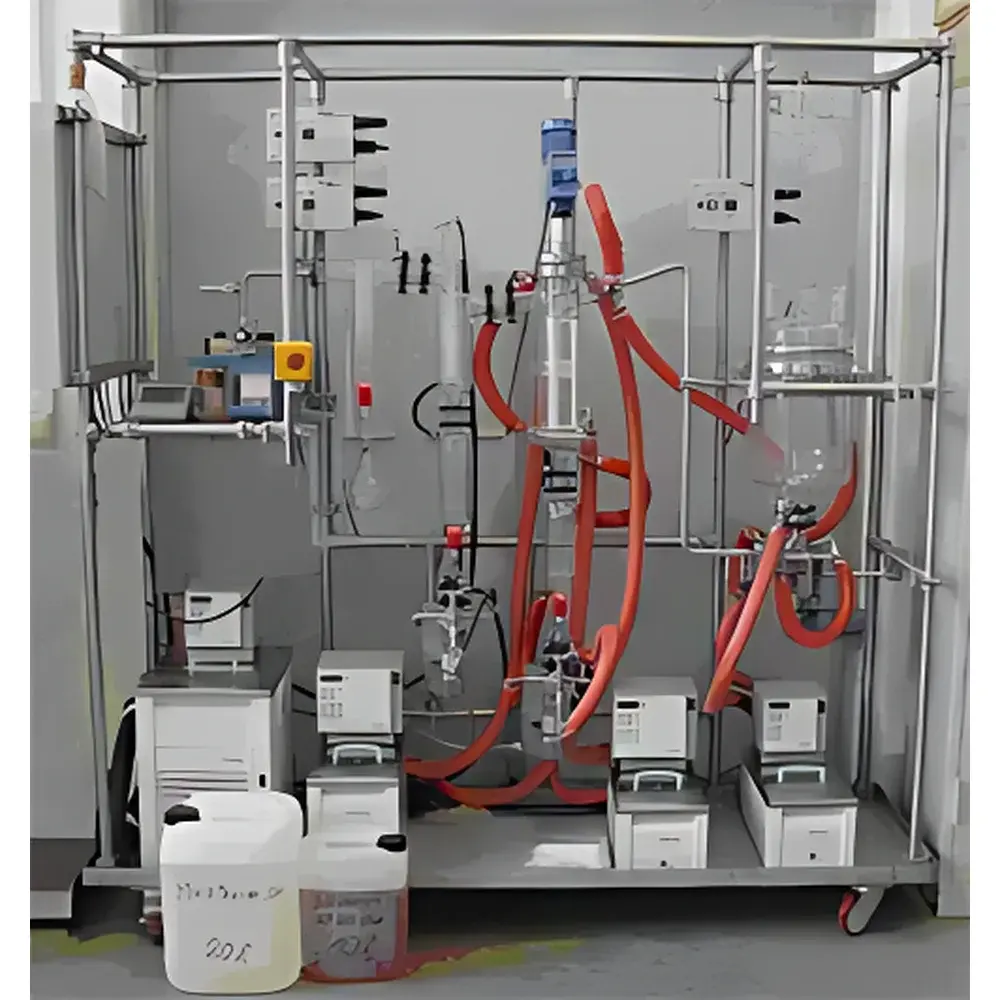
UIC DSL 5 Laboratory Glass Thin-Film Evaporator
| Brand | UIC GmbH |
|---|---|
| Origin | Germany |
| Model | DSL 5 |
| Feed Rate | 0.5–2.5 kg/h |
| Effective Evaporation Area | 0.05 m² |
| Evaporator Internal Diameter | 180 mm |
| Condenser Area | 0.085 m² |
| Number of Collecting Flasks | 3 |
| Operating Pressure | Down to 1 mbar |
| Maximum Evaporation Temperature | 250 °C |
| Construction Material | Borosilicate Glass 3.3 |
| Film Formation System | Self-Cleaning Roller-Type Wiper |
Overview
The UIC DSL 5 is a precision-engineered laboratory-scale thin-film evaporator constructed entirely from high-purity borosilicate glass 3.3, designed for gentle, high-efficiency solvent removal and thermal separation under controlled vacuum conditions. It operates on the principle of short-path molecular distillation combined with dynamic thin-film formation: feed material is introduced tangentially onto a heated vertical cylindrical evaporator surface, where a rotating roller wiper generates a uniform, continuously renewed film—minimizing residence time and thermal degradation. The evaporated vapor travels a short distance (<100 mm) to an integrated internal or external condenser (0.085 m² active area), where it is rapidly condensed under pressures as low as 1 mbar. This architecture ensures high separation selectivity, excellent reproducibility, and compatibility with heat-sensitive, high-boiling, or thermally labile compounds—making the DSL 5 particularly suitable for pharmaceutical intermediates, natural product isolates, polymer additives, and specialty chemicals.
Key Features
- Fully transparent borosilicate glass 3.3 construction enables real-time visual monitoring of film formation, foaming behavior, and condensate collection—critical for method development and process optimization.
- Self-cleaning roller-type wiper system ensures consistent film thickness and prevents fouling or buildup, even with viscous or particulate-containing feeds (up to 40% solids).
- Modular design compatible with UIC’s KDL 5 series components, allowing seamless integration of secondary short-path distillation stages for multi-step purification (e.g., primary solvent stripping followed by high-vacuum molecular fractionation).
- Heating via thermostatically controlled oil bath (not included) with PID-regulated temperature up to 250 °C; precise thermal management minimizes localized overheating and supports GLP-compliant temperature logging.
- Three independently collectable fractions via standardized ground-glass joints and PTFE stopcocks—enabling sequential cut collection based on boiling point differentials or refractive index monitoring.
- Vacuum-tight glass manifold rated for continuous operation at ≤1 mbar; includes calibrated pressure port and optional digital vacuum gauge interface for ASTM E2912-compliant pressure validation.
Sample Compatibility & Compliance
The DSL 5 accommodates feed streams ranging from low-viscosity solvents (e.g., hexane, ethanol) to highly viscous materials (e.g., silicone oils, crude terpene resins) within the specified 0.5–2.5 kg/h throughput range. Its inert glass surface eliminates catalytic side reactions and metal leaching—essential for USP compliant pharmaceutical processing and ISO 17025-accredited analytical laboratories. The system meets structural requirements for Class I vacuum equipment per EN 15649-2 and supports audit-ready documentation when paired with validated vacuum controllers and temperature recorders. All glass components comply with DIN ISO 3585 specifications for borosilicate glass 3.3.
Software & Data Management
While the base DSL 5 operates manually, it is fully compatible with UIC’s optional UIC-DataLink interface module, enabling analog/digital signal acquisition from external PT100 sensors, vacuum transducers, and flow meters. When connected to UIC ControlSuite software (v4.2+), users can generate 21 CFR Part 11–compliant electronic records—including timestamped temperature/pressure profiles, operator ID, and batch metadata—with configurable audit trails and electronic signatures. Data export adheres to ASTM E1469 standards for scientific instrument data interchange.
Applications
- Pretreatment of crude extracts prior to preparative HPLC or supercritical fluid extraction—removing bulk solvents without degrading labile phytochemicals.
- Devolatilization of polymeric melts (e.g., polylactic acid, polyurethane prepolymers) to reduce residual monomer content below ISO 10993-18 thresholds.
- Concentration and purification of omega-3 fatty acid ethyl esters from fish oil hydrolysates under oxygen-free nitrogen sweep.
- Recovery of high-value catalysts (e.g., Rh- or Pd-based complexes) from homogeneous reaction mixtures after cross-coupling synthesis.
- Process development for continuous thin-film evaporation in QbD (Quality by Design) frameworks, supporting DOE-based parameter optimization per ICH Q5A and Q8(R2).
FAQ
What vacuum level is required for optimal performance?
The DSL 5 achieves maximum separation efficiency at operating pressures between 0.5 and 5 mbar; stable operation down to 0.1 mbar is possible with high-capacity dual-stage vacuum pumps meeting ISO 8573-1 Class 2 purity requirements.
Can the DSL 5 be used for fractional distillation?
Yes—when coupled with UIC’s KDL 5 short-path head and fraction collector, the DSL 5 forms a two-stage system capable of sequential boiling-point-based fractionation with theoretical plate equivalents exceeding 3.5 per stage.
Is the roller wiper speed adjustable?
The wiper motor operates at fixed 300 rpm for standard configurations; variable-speed drive options (100–600 rpm) are available under UIC Option Code DSL-WV for rheologically heterogeneous feeds.
What maintenance is required for long-term reliability?
Annual calibration of temperature sensors per ISO/IEC 17025, biannual inspection of ground-glass joints for microfractures, and quarterly replacement of Viton O-rings in vacuum seals—documented in accordance with GMP Annex 15 verification protocols.



