
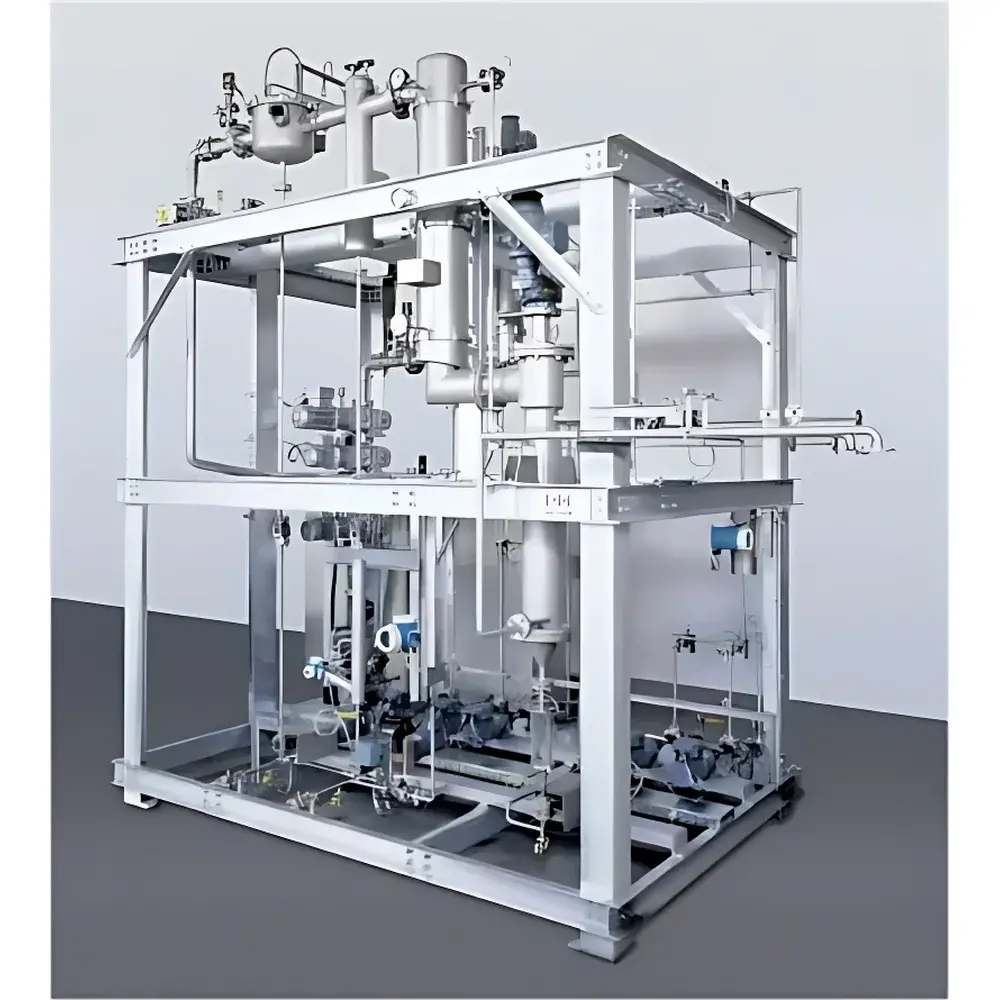
UIC Molecular Distillation System (Short-Path Distillation) – Industrial Scale
| Brand | UIC GmbH |
|---|---|
| Origin | Germany |
| Manufacturer Type | Authorized Distributor |
| Origin Category | Imported |
| Model | Custom-Engineered per Application |
| Price | €500,000 |
| Feed Rate | 50–20,000 kg/h |
| Effective Evaporation Area | 3–100 m² |
| Evaporator Internal Diameter | 300–800 mm |
| Condenser Area | 3–100 m² |
| Collecting Vessels | 3 |
Overview
The UIC Molecular Distillation System (Short-Path Distillation) – Industrial Scale is a high-vacuum, continuous thermal separation platform engineered for the gentle, high-selectivity purification of thermally sensitive, high-boiling, or non-volatile compounds. Operating under ultra-high vacuum conditions (typically <0.001 mbar), it exploits the mean free path principle: molecules evaporated from a heated feed surface travel directly to a cooled condensing surface located at a short, precisely controlled distance—minimizing residence time and thermal degradation. Unlike conventional distillation, molecular distillation separates components based on differences in vapor pressure at the molecular level rather than boiling point alone, making it indispensable for isolating bioactive lipids (e.g., fish oil omega-3 concentrates), natural antioxidants (e.g., tocopherols, astaxanthin), pharmaceutical intermediates, and specialty polymers. This industrial-scale system is not a catalog product; each unit is fully custom-engineered by UIC’s application engineers following detailed process characterization—including feed composition, thermal stability profile, target purity, throughput requirements, and integration constraints—ensuring optimal mass transfer efficiency, scalability, and long-term operational reliability.
Key Features
- Modular, client-specific engineering: Every system undergoes a rigorous pre-design phase involving thermal modeling, material compatibility assessment (e.g., Hastelloy C-276 or electropolished SS316L wetted parts), and vacuum integrity validation.
- High-precision thin-film evaporation: Rotating wiper systems (PTFE or metal alloy blades) ensure uniform, controllable film thickness and consistent heat transfer across the entire evaporation surface (3–100 m²).
- Dual-stage high-vacuum architecture: Integrated primary and secondary vacuum systems maintain stable sub-10⁻³ mbar operating pressure, supported by cryogenic or liquid nitrogen-cooled condensers for maximum condensation efficiency.
- Multi-collection capability: Three independently temperature-controlled receiving flasks allow sequential fractionation of distillate streams—critical for multi-component separations such as phospholipid enrichment followed by free fatty acid removal.
- Robust mechanical design: Evaporator internal diameters range from 300 mm to 800 mm, accommodating diverse scale-up paths while maintaining laminar flow dynamics and minimizing backstreaming.
- Process-integrated instrumentation: Real-time monitoring of feed temperature, evaporator wall temperature, condenser surface temperature, vacuum level, and mass flow rate via calibrated, traceable sensors compliant with ISO/IEC 17025 calibration protocols.
Sample Compatibility & Compliance
The UIC industrial molecular distillation system accommodates viscous, heat-labile, and high-molecular-weight feedstocks—including crude fish oil, lanolin derivatives, polymer precursors, and botanical extracts—with minimal thermal stress. All wetted materials meet FDA 21 CFR §177.2600 (food-contact plastics) and EU Regulation (EC) No. 1935/2004 compliance standards where applicable. The system supports GLP- and GMP-aligned operation through configurable audit trails, user access levels, and electronic signature capability (aligned with FDA 21 CFR Part 11 requirements when paired with UIC’s optional ProcessControl™ software suite). Design documentation conforms to PED 2014/68/EU (Pressure Equipment Directive) and ATEX 2014/34/EU for hazardous area classification where required.
Software & Data Management
UIC’s ProcessControl™ software (optional) provides full HMI-based supervision, including recipe management, automated start-up/shutdown sequences, real-time trend logging, and deviation alerting. All process data—including vacuum profiles, temperature gradients, and feed/distillate mass balances—are timestamped, encrypted, and exportable in CSV or ASTM E2500-compliant formats. Historical data archives support root-cause analysis during regulatory audits and facilitate continuous process verification (CPV) per ICH Q8(R2) and Q9 guidelines. Remote diagnostics and firmware updates are supported via secure TLS 1.3 connections, ensuring cybersecurity alignment with IEC 62443-3-3.
Applications
- Concentration of polyunsaturated fatty acids (PUFA) from marine oils while preserving cis-configuration integrity
- Purification of vitamin E isomers (d-α-tocopherol) from deodorizer distillates
- Deacidification and decolorization of biodiesel feedstocks without catalyst use
- Recovery and refinement of silicone monomers and oligomers from reaction mixtures
- Isolation of phytosterols and squalene from vegetable oil refining by-products
- Preparative-scale separation of fragrance compounds with low volatility and high thermal sensitivity
FAQ
Is this system suitable for pilot-scale development before full industrial deployment?
Yes—UIC offers scalable design continuity: laboratory (0.01–0.1 m²), pilot (0.5–5 m²), and industrial (3–100 m²) units share identical core geometry, wiper dynamics, and vacuum architecture to ensure direct scale-up predictability.
What level of vacuum performance is guaranteed across the full operating range?
Each system undergoes helium leak testing to ≤1×10⁻⁹ mbar·L/s and achieves sustained operating pressure ≤5×10⁻⁴ mbar at full load, verified per ISO 20487:2020 Annex B.
Can the system be integrated into an existing plant automation infrastructure?
Yes—it supports Modbus TCP, Profibus DP, and OPC UA communication protocols, enabling seamless integration with DCS or MES platforms for centralized batch record generation and S88/S95 compliance.
What maintenance intervals are recommended for rotating wiper assemblies and vacuum pumps?
Wiper blade replacement is scheduled every 6–12 months depending on feed viscosity and particulate load; primary vacuum pump oil changes follow ISO 8573-1 Class 2 particle/contamination thresholds, typically every 3,000 operating hours.
Does UIC provide process validation support for regulated industries?
Yes—UIC Application Engineers collaborate on IQ/OQ/PQ protocol development, including installation qualification (IQ) checklists aligned with ASME BPE-2022, operational qualification (OQ) test scripts, and performance qualification (PQ) acceptance criteria per USP and ICH Q5E.



