
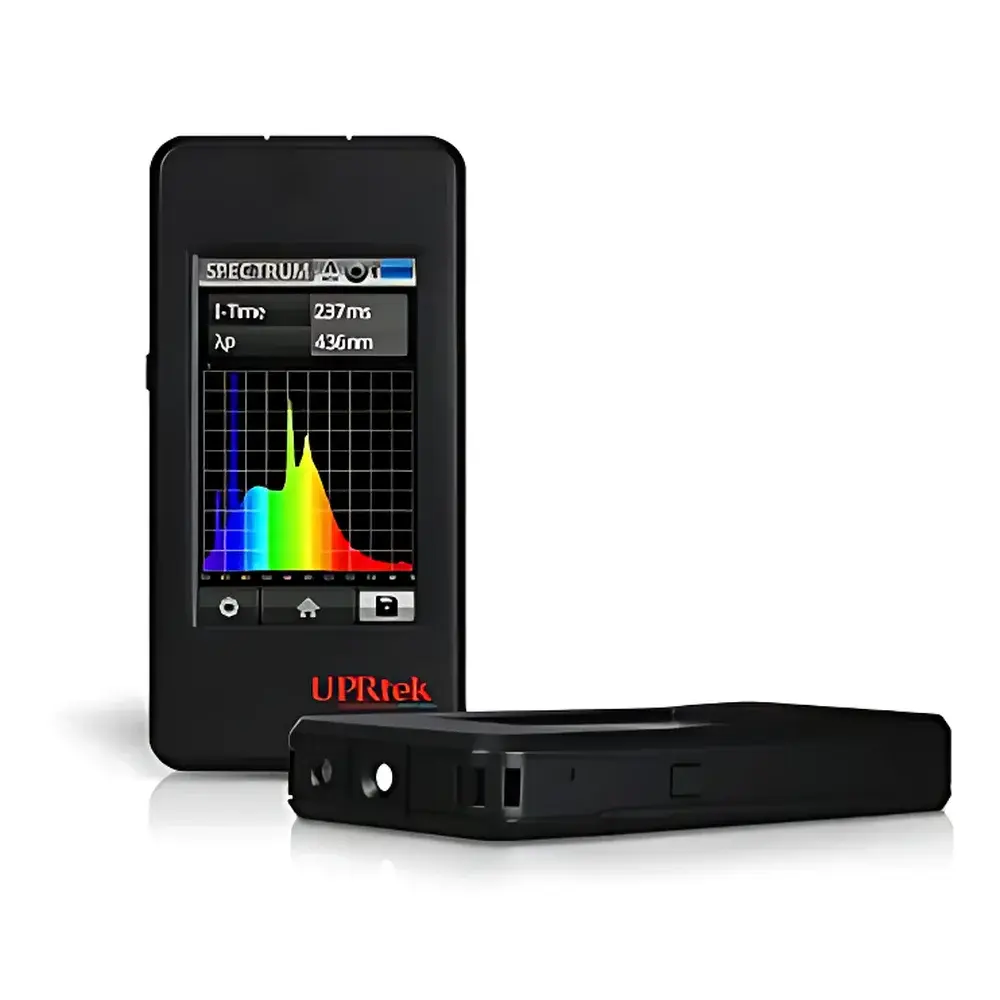

UPRtek MK350S Portable Spectroradiometer
| Origin | Taiwan |
|---|---|
| Manufacturer Type | Authorized Distributor |
| Regional Origin | Domestic (Taiwan) |
| Model | MK350S Spectrometer |
| Price Range | USD 1,400–2,800 |
| Instrument Architecture | Dual-Wavelength Detection |
| Detector Type | Photodiode Array (CMOS Linear Sensor) |
| Wavelength Range | 380–780 nm |
| Automation Level | Auto-Wavelength Scanning |
| Spectral Bandwidth (FWHM) | 12 nm |
| Wavelength Accuracy | ±1 nm |
| Stray Light | ≤0.01%T (–25 dB at 550 nm, ±40 nm window) |
Overview
The UPRtek MK350S Portable Spectroradiometer is a handheld, field-deployable instrument engineered for precise spectral radiometric and photometric characterization of visible-light sources—particularly LED-based lighting systems. Operating on the principle of linear-array CMOS-based spectroradiometry, the MK350S captures full spectral power distribution (SPD) across the photobiologically relevant 380–780 nm range with 1 nm data interval resolution. Its optical design incorporates a cosine-corrected input optic (Ø6.6 mm aperture) to ensure compliant irradiance and illuminance measurements per CIE S 023/E:2013 and IES LM-79-19 guidelines. Unlike benchtop spectrophotometers, the MK350S integrates real-time spectral analysis, colorimetric computation, and quality control logic into a single autonomous unit—eliminating dependency on external PCs while maintaining traceable metrological performance suitable for in-line production verification, lighting design validation, and energy-efficiency compliance testing (e.g., ENERGY STAR® SSL Program C78.377, DLC QPL, and IEC TR 62778).
Key Features
- Self-contained operation with 4.3″ capacitive touch LCD (800 × 480), enabling full spectral and colorimetric analysis without PC tethering
- 16-bit ADC resolution and auto-exposure control (6–5000 ms) for high dynamic range measurement across 20–70,000 lux
- Dual-wavelength detection architecture optimized for simultaneous evaluation of peak wavelength, dominant wavelength, and spectral centroid
- Real-time CIE 1931 (x,y) and CIE 1976 (u′,v′) chromaticity mapping with Δx, Δy, Δu′, Δv′, and duv deviation reporting
- Comprehensive color fidelity analysis: CRI (Ra, R1–R15), TM-30-15 (Rf, Rg), and spectral purity metrics
- Illuminance distribution imaging mode—visual heatmap overlay for spatial uniformity assessment in architectural lighting applications
- Continuous auto-sampling mode with SD card logging (up to ~2000 records on 2 GB card); supports timestamped, GPS-tagged (via optional WiFi SD card) measurement series
- On-device quality gate checking: user-definable upper/lower limits for CCT, CRI, illuminance, and spectral band ratios (e.g., R/G/B, cyan gap, deep red)
- Integrated firmware-level calibration traceability; factory-calibrated against NIST-traceable standards under ISO/IEC 17025-accredited conditions
- WiFi-enabled remote control and data streaming via optional 802.11 b/g/n SD card module—compatible with iOS and Android companion apps
Sample Compatibility & Compliance
The MK350S is validated for quantitative analysis of steady-state, non-pulsed visible-light emitters including white LEDs, RGB LED arrays, OLED panels, fluorescent tubes, and halogen lamps. It complies with photometric geometry requirements for Type A (cosine-corrected) detectors per CIE Publication 69 and IES RP-27.1-15. All colorimetric outputs—including correlated color temperature (CCT), Duv, CRI, and spectral power distribution—are computed in accordance with CIE 15:2018, CIE 13.3-1995, and ANSI C78.377-2017. The instrument’s stray light performance (≤0.01%T) satisfies Class L requirements for general-purpose spectroradiometry as defined in EN 13032-1:2012. Data export formats (CSV, Excel-compatible .xls, JPEG spectra plots) support audit-ready documentation for GLP and ISO 9001 quality management systems.
Software & Data Management
Data acquisition, visualization, and reporting are fully embedded within the device firmware—no proprietary desktop software installation required. Measurement files are stored natively in UTF-8 CSV format with metadata headers (timestamp, integration time, detector temperature, calibration ID). The built-in file browser enables rapid recall and side-by-side comparison of up to two datasets (live vs. reference or historical). Optional WiFi SD card enables over-the-air firmware updates, remote trigger commands, and direct cloud upload to secure enterprise servers. Exported spectral data is compatible with third-party analysis platforms including MATLAB, Python (NumPy/Pandas), and lighting simulation tools (DIALux, AGi32) via standardized .csv ingestion. Audit trail functionality—including operator ID, measurement mode, and calibration validity status—is retained in each exported record to satisfy FDA 21 CFR Part 11 and ISO/IEC 17025 data integrity requirements.
Applications
- LED manufacturing QC: binning verification, CCT drift monitoring, phosphor degradation tracking
- Architectural lighting design: illuminance uniformity mapping, glare index estimation, circadian stimulus (CS) calculation
- Photobiology research: photosynthetic photon flux (PPF, 400–700 nm) and phytochrome photoequilibrium (PPE) modeling
- Regulatory compliance testing: ENERGY STAR, DesignLights Consortium (DLC), California Title 24, and EU Ecodesign Lot 9
- Museum and archival lighting: spectral hazard assessment (blue-light hazard ratio per IEC 62471), UV/IR leakage screening
- Educational laboratories: hands-on spectroscopy pedagogy with real-world SPD interpretation and color science fundamentals
FAQ
Is the MK350S calibrated to NIST-traceable standards?
Yes—the instrument ships with a factory calibration certificate referencing NIST SRM 2035 and 2036, performed under ISO/IEC 17025-accredited conditions. Calibration validity is tracked in firmware and displayed on-screen.
Can the MK350S measure pulsed or modulated LED sources?
No—it is designed exclusively for DC-stable or slowly varying light sources. For PWM-driven or high-frequency modulated LEDs, use the MK350N model with synchronized gating capability.
Does the device support spectral irradiance (W/m²·nm) units?
Yes—when used with an optional calibrated irradiance adapter (sold separately), the MK350S reports absolute spectral irradiance alongside photometric quantities.
What is the recommended recalibration interval?
UPRtek recommends annual recalibration or after any physical shock exceeding 5 g; users may perform zero-point correction in-field using the integrated dark-current compensation routine.
Is the SD card data format compatible with LMS or ERP systems?
Yes—CSV exports include machine-readable headers and SI-compliant units; custom field mapping can be implemented via Python or Excel Power Query for direct ingestion into LabVantage, SAP QM, or TrackWise.
Related Products




