
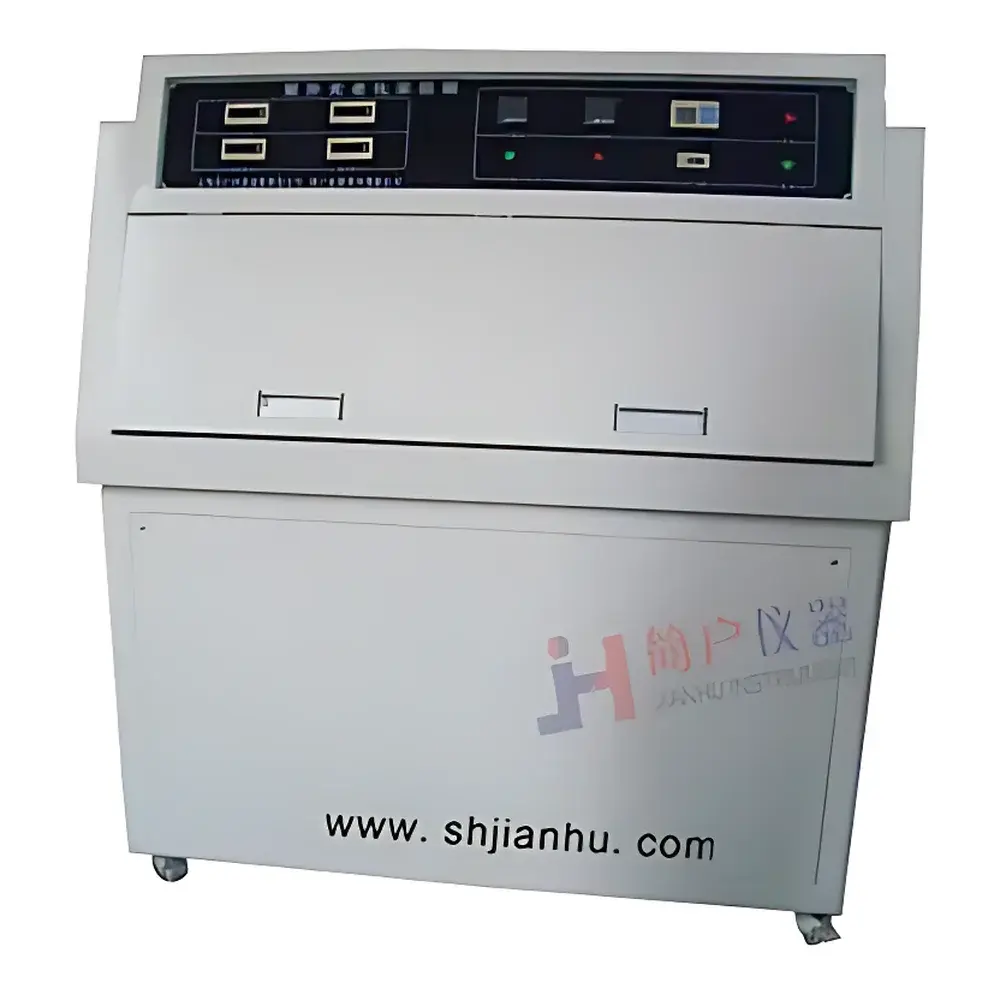
UV Weathering Test Chamber – JH-P Model by Shanghai Jianhu Instrument Co., Ltd.
| Brand | Jianhu |
|---|---|
| Origin | Guangdong, China |
| Manufacturer Type | Authorized Distributor |
| Origin Category | Domestic (China) |
| Model | JH-P |
| Pricing | Available Upon Request |
Overview
The JH-P UV Weathering Test Chamber is an engineered environmental simulation system designed to accelerate the evaluation of material degradation under controlled ultraviolet (UV) radiation, temperature, and humidity cycling. It operates on the principle of fluorescent UV lamp irradiation—specifically UVA-340 or UVB-313 lamps—to replicate critical portions of the solar spectrum responsible for photochemical damage in polymers, coatings, textiles, automotive finishes, and architectural materials. Unlike broad-spectrum xenon arc testers, this chamber emphasizes spectral fidelity in the 295–400 nm range, enabling reproducible assessment of surface chalking, gloss loss, color shift, cracking, and embrittlement per internationally recognized exposure protocols. Its architecture supports both steady-state and cyclic test regimes, with precise decoupling of irradiance, condensation, and thermal phases to isolate photodegradation mechanisms from purely thermal or hydrolytic effects.
Key Features
- Structural integrity: CNC-machined stainless steel inner chamber (SUS304) paired with A3 carbon steel outer cabinet with electrostatic powder coating for corrosion resistance and cleanroom-compatible surface finish.
- Thermal management: Immersed water-jacket heating system within the chamber base ensures rapid, uniform temperature ramping and stability across the test area (±0.5 °C typical).
- Irradiance control: Fixed-position UV sensor calibrated against NIST-traceable standards; digital UV radiometer with real-time display and data logging capability (range: 0–50 W/m², resolution: 0.1 W/m²).
- Cycle flexibility: Independent programmable timing for UV exposure (0–1000 h), condensation (0–1000 h), and dark/cool-down periods; user-defined sequence logic supports up to 99 cycles per test program.
- Ergonomic design: Dual-hinged front-access lid with gas-assisted lift mechanism; integrated vortex-type drainage with U-shaped sediment trap for efficient removal of condensed water and particulate residue.
- Black panel temperature monitoring: High-emissivity black aluminum sensor plate directly coupled to chamber wall, providing representative surface temperature measurement per ASTM G151 and ISO 4892-3 requirements.
Sample Compatibility & Compliance
The JH-P accommodates flat-panel specimens up to 150 mm × 75 mm × 25 mm (W × H × D) per rack position, with standard capacity for 48 samples (24 per shelf, two-tier configuration). Specimen holders are non-reflective, thermally stable, and compliant with ISO 11507 mounting geometry. The system meets full conformance with GB/T 14522–1993, GB/T 16422.3–1997, GB/T 16585–1996, ASTM D4329, D4587, D499, D5208, G154, G53, ISO 4892-3, ISO 11507, EN 534, PREN 1062-4, BS 2782, JIS D 0205, and SAE J2020. All calibration procedures adhere to traceable metrology practices aligned with ILAC-MRA guidelines. Documentation packages include factory calibration certificates, installation qualification (IQ), and operational qualification (OQ) support files for GLP/GMP-regulated environments.
Software & Data Management
The embedded controller features a 7-inch TFT-LCD touchscreen interface with multi-language support (English, Chinese, Spanish), password-protected parameter locking, and audit trail functionality compliant with FDA 21 CFR Part 11 Annex 11 principles. Real-time data—including irradiance (W/m²), black panel temperature (°C), chamber air temperature (°C), and elapsed cycle time—is logged at user-selectable intervals (1 s to 60 min) and exportable via USB 2.0 to CSV or Excel-compatible formats. Optional Ethernet connectivity enables remote monitoring, alarm notification via SMTP, and integration into centralized LIMS or MES platforms using Modbus TCP protocol.
Applications
- Accelerated aging of automotive interior and exterior trim components (PP, TPO, PU, PVC)
- UV stability validation of architectural sealants, elastomeric coatings, and façade systems
- Photostability screening of pharmaceutical packaging films (e.g., blister lidding, HDPE bottles)
- Quality assurance testing for outdoor signage, agricultural films, and geotextiles
- R&D correlation studies between laboratory UV exposure and natural weathering in subtropical, desert, or coastal climates
- Compliance verification for OEM material specifications (e.g., Ford WSB-M4D293-A, GMW14124, VW TL226)
FAQ
What UV lamp types are supported?
The JH-P chamber accepts standard 40 W UVA-340 (315–400 nm, peak 340 nm) and UVB-313 (280–360 nm, peak 313 nm) fluorescent tubes, compliant with ASTM G154 spectral requirements.
Is the irradiance level adjustable during a test?
No—the system maintains fixed irradiance output per lamp type; however, users select lamp type and exposure duration to achieve target radiant exposure (J/m²) as defined in test standards.
Does the chamber support humidity control?
Humidity is induced exclusively via condensation (water vapor saturation at elevated temperature); active RH control is not implemented, consistent with ASTM G154 Cycle 1–4 protocols.
Can test data be exported for regulatory submission?
Yes—raw time-series logs include timestamped metadata (operator ID, test ID, calibration status) and meet ALCOA+ data integrity criteria for inclusion in regulatory dossiers.
What maintenance is required for long-term reliability?
Lamp replacement every 1600–2000 hours, quarterly verification of black panel sensor calibration, and biannual cleaning of condensate traps and chamber seals per manufacturer’s SOP.



