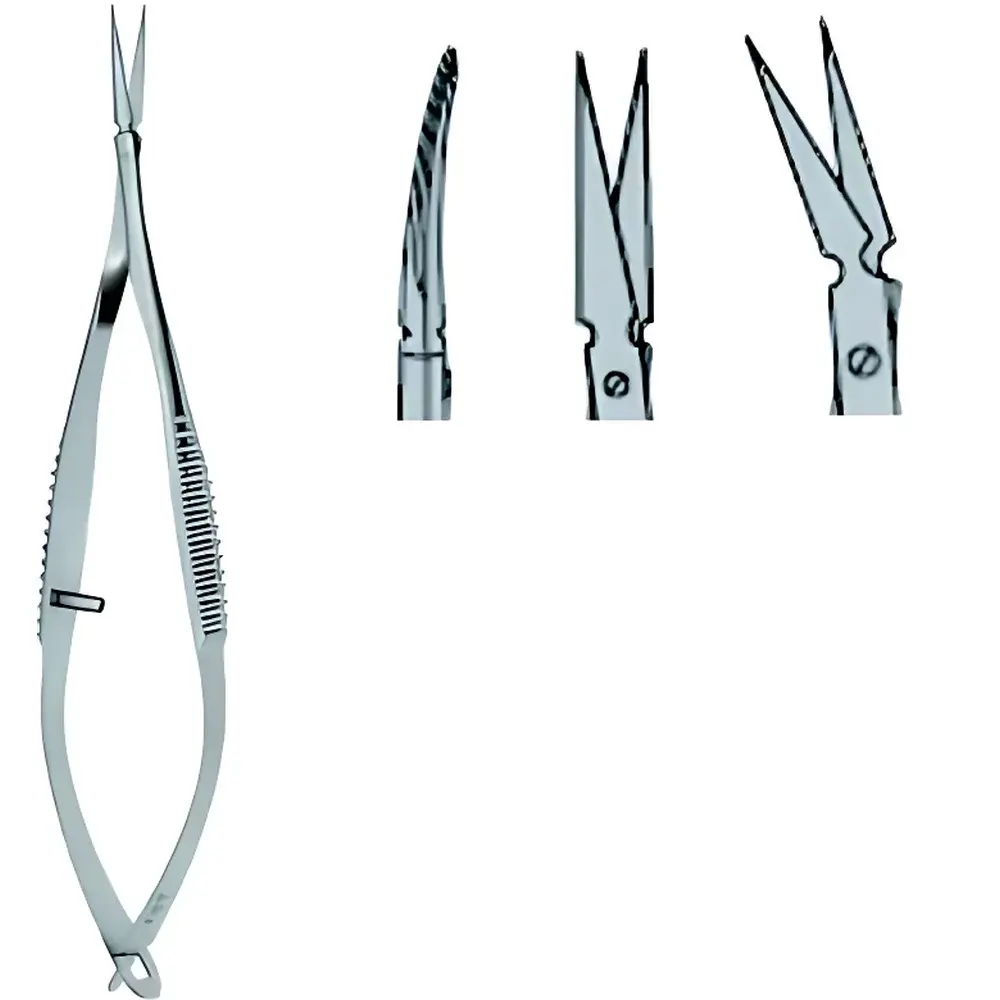
VANNAS S11001-08 Micro Spring-Loaded Scissors
| Brand | RWD |
|---|---|
| Origin | Shenzhen, China |
| Manufacturer Type | Direct Manufacturer |
| Country of Origin | China |
| Model | S11001-08 |
| Price | USD 79 (approx.) |
Overview
The VANNAS S11001-08 Micro Spring-Loaded Scissors are precision hand-held microsurgical instruments engineered for controlled, low-force cutting in delicate biological and laboratory applications. Designed with a built-in stainless steel torsion spring mechanism, these scissors deliver consistent opening force recovery after each cut—reducing operator fatigue during extended procedures and improving tactile feedback. The instrument operates on a simple mechanical principle: the spring stores elastic energy during blade closure and releases it to reopen the blades automatically, eliminating the need for manual finger retraction between cuts. This feature is particularly advantageous in stereotactic surgery, neural tissue dissection, embryonic manipulation, and in vitro cell culture workflows where fine motor control and repetitive precision are critical.
Key Features
- Spring-assisted reopening mechanism ensures rapid, repeatable blade separation without finger fatigue.
- Hardened stainless steel construction (AISI 420 or equivalent) provides corrosion resistance, edge retention, and compatibility with standard autoclaving protocols (134 °C, saturated steam).
- Blade geometry: straight configuration with double-beveled, sharp-pointed tips; 8 mm active cutting length and 1.5 mm maximum blade width at the cutting edge.
- Total instrument length: 80 mm (8 cm), optimized for ergonomic handling under microscope magnification (×10–×40) and within confined workspaces such as laminar flow hoods or stereotaxic rigs.
- Micro-polished surface finish minimizes tissue adhesion and facilitates thorough cleaning and decontamination.
- Manufactured under ISO 13485-aligned quality management systems; each batch undergoes dimensional verification and functional testing prior to release.
Sample Compatibility & Compliance
These microscissors are routinely employed in ex vivo and in vitro settings involving soft biological specimens—including brain slices, retinal explants, dorsal root ganglia, organoids, and early-stage embryos (e.g., mouse E10.5–E14.5). They are compatible with standard histological processing workflows (fixation in 4% PFA, cryosectioning, paraffin embedding) and do not introduce metallic artifacts in SEM/EDS analysis when used appropriately. The device complies with general requirements for non-active surgical instruments per ISO 13485:2016 and meets RoHS Directive 2011/65/EU restrictions on hazardous substances. While not classified as a medical device requiring CE marking under MDR 2017/745 for research-only use, documentation supports GLP-compliant recordkeeping for preclinical study reporting.
Software & Data Management
As a manually operated mechanical instrument, the S11001-08 does not incorporate electronic components, firmware, or data output interfaces. Consequently, no software integration, calibration logs, or digital audit trails are associated with its operation. However, its design supports traceability in regulated environments: each unit is laser-engraved with a unique serial number (format: S11001-08-XXXXX), enabling linkage to manufacturing batch records, sterilization logs, and instrument maintenance history in LIMS or ELN platforms. For laboratories operating under FDA 21 CFR Part 11 requirements, usage can be documented via electronic signatures in validated procedural SOPs describing instrument selection, sterilization cycle parameters, and post-use inspection criteria.
Applications
- Dissection of fine neural structures (e.g., optic nerve fascicles, commissural fibers) in rodent brain slices.
- Trimming and shaping of primary neuronal cultures during plating or subculturing.
- Microdissection of zebrafish or Xenopus embryos for fate-mapping studies.
- Cutting polymer-based hydrogel scaffolds (e.g., collagen I, Matrigel™) during 3D tissue construct preparation.
- Preparation of explant cultures from avian or mammalian embryonic tissues.
- Supporting electrophysiology experiments requiring precise isolation of recording sites without mechanical trauma.
FAQ
What is the recommended sterilization method for these scissors?
Autoclaving at 134 °C for 5 minutes under saturated steam pressure (2.1 bar) is validated and recommended. Do not use chemical sterilants containing chlorine or strong oxidizers, as they may degrade the spring temper.
Can the blades be resharpened?
Resharpening is technically possible but not advised by the manufacturer due to risk of altering blade geometry, compromising spring alignment, or reducing hardness below 52–54 HRC. Replacement instruments are supplied to maintain consistent performance.
Is this model suitable for use inside a CO₂ incubator?
No—while the material is corrosion-resistant, prolonged exposure to humid, 5% CO₂ environments may accelerate surface oxidation over time. Instruments should be removed, cleaned, and stored dry after each use.
Does RWD provide certification of conformance for export?
Yes—upon request, RWD issues a Certificate of Conformance (CoC) stating compliance with specified material grade, dimensional tolerances, and packaging standards, aligned with ISO 9001:2015 documentation practices.