
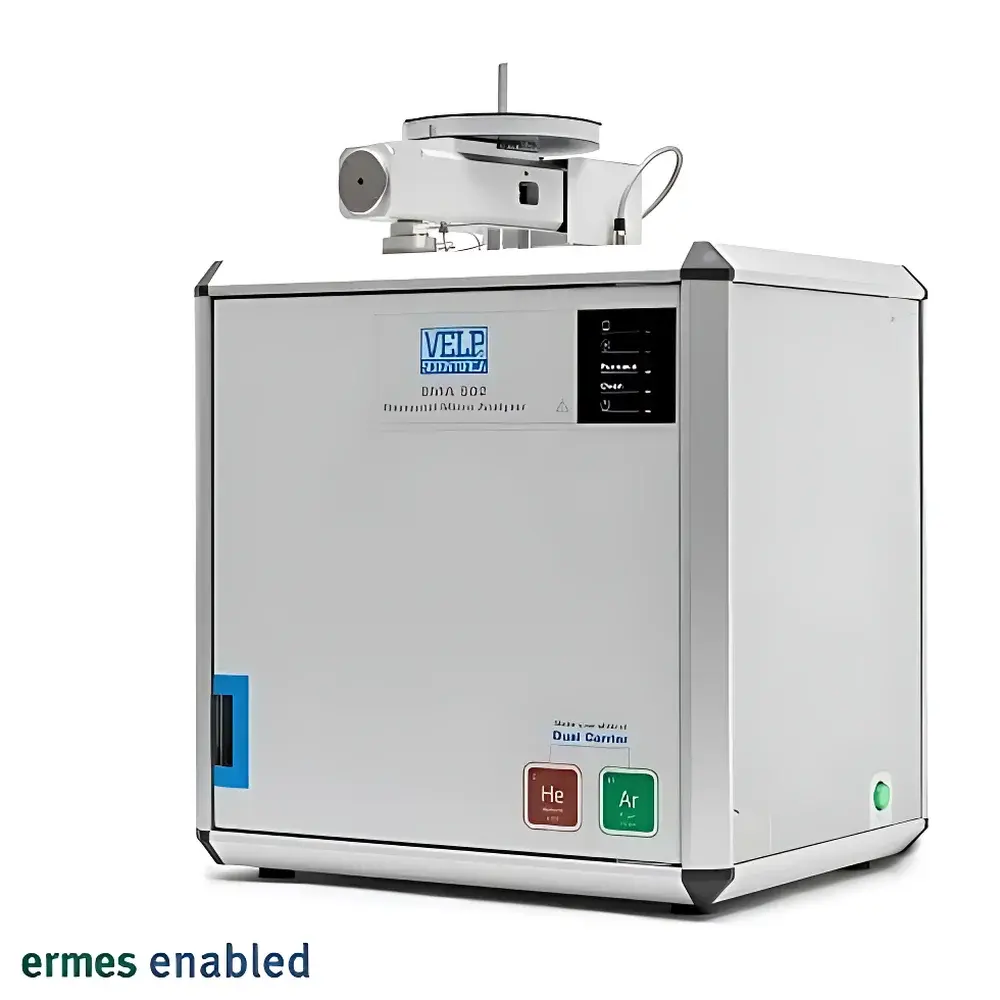
VELP EMA 502 CHNS-O Organic Elemental Analyzer
| Brand | VELP |
|---|---|
| Origin | Italy |
| Model | EMA 502 CHNS-O |
| Measurement Principle | High-Temperature Combustion (CHNS) and Pyrolysis (O) with Gas Chromatography–Thermal Conductivity Detection (GC-TCD) |
| Sample Throughput | Up to 117 samples per run |
| Analysis Time | ≥12 min (CHNS), ≥6 min (O) |
| Detection Method | TCD (no reference gas required) |
| Sample Form | Solid, semi-solid, liquid |
| Max Sample Mass | 100 mg (C-dependent) |
| Calibration Range (He carrier) | C 0.001–20 mg, H 0.001–5 mg, N 0.001–20 mg, S 0.01–6 mg, O 0.005–6 mg |
| Precision (RSD) | ≤0.2% (sulfanilic acid) |
| Operating Temperatures | 1030 °C (CHNS combustion), 1060 °C (O pyrolysis) |
| Carrier Gases | Helium or Argon (Ar for CHN only) |
| Compliance | AOAC, AACC, ASBC, ISO, DIN, IFFO, OIV, ASTM, EPA, FDA 21 CFR Part 11 (optional) |
| Software | EMASoft™ with LIMS export, Ermes Cloud integration |
| Connectivity | USB, RS232, Wi-Fi/LAN |
| Power | 570 W |
| Dimensions (W×H×D) | 500 × 510 × 410 mm (680 mm H with autosampler) |
| Weight | 45 kg |
Overview
The VELP EMA 502 CHNS-O Organic Elemental Analyzer is a fully integrated, high-precision combustion and pyrolysis-based system engineered for quantitative determination of carbon (C), hydrogen (H), nitrogen (N), sulfur (S), and oxygen (O) in organic matrices. It operates on two distinct thermochemical principles: high-temperature catalytic combustion at 1030 °C for CHNS analysis, and controlled pyrolysis at 1060 °C followed by chemical scrubbing for oxygen quantification. Both pathways utilize gas chromatographic separation coupled with a robust thermal conductivity detector (TCD), eliminating the need for reference gas streams and ensuring long-term baseline stability. Designed for laboratories requiring regulatory-grade data integrity, the EMA 502 meets methodological requirements across AOAC, ASTM, ISO, EPA, and pharmacopeial standards—including USP , , and . Its architecture supports GLP/GMP workflows through audit-trail-enabled software, electronic signatures, and 21 CFR Part 11 compliance (optional configuration).
Key Features
- Simultaneous five-element (CHNS-O) capability without hardware reconfiguration—switch between CHNS and O modes via software-driven panel activation.
- High-efficiency combustion furnace with Vcopper™ high-activity copper catalyst for complete NOx reduction to N2, ensuring stoichiometric nitrogen recovery.
- Integrated GC column oven with precise temperature control for full separation of CO2, H2O, N2, SO2, and CO prior to TCD detection.
- Automated sample handling system supporting up to four 30-position trays (117 total samples), with direct interfacing to microbalances for mass auto-import into EMASoft™.
- Low-sample-consumption design: as little as 20 mg carbon equivalent required—reducing consumable usage and extending service intervals for combustion tubes and reagents.
- Zero-maintenance TCD detector with drift-free operation over extended analytical campaigns; no periodic recalibration or gas purging needed.
- Energy-optimized standby and sleep modes reduce helium/argon consumption during idle periods, lowering operational cost per analysis.
Sample Compatibility & Compliance
The EMA 502 accommodates diverse physical forms—including powders, pellets, films, gels, oils, and aqueous solutions—without derivatization or pre-treatment. Its wide dynamic range (e.g., C: 0.001–20 mg under He carrier) enables accurate quantification from trace-level contaminants to concentrated pharmaceutical intermediates. All measurement protocols are validated against certified reference materials (CRMs) such as sulfanilic acid (RSD ≤0.2%) and benzoic acid. The instrument satisfies international regulatory frameworks: ISO 16948 (solid biofuels), ASTM D5373 (coal and coke), EPA Method 429 (petroleum products), and AOAC 993.13 (food proteins). Optional 21 CFR Part 11 configuration provides electronic record security, role-based access control, and immutable audit trails for regulated environments.
Software & Data Management
EMASoft™ serves as the central control and data processing interface, offering intuitive workflow navigation across three operational phases: method setup, real-time monitoring, and post-run evaluation. Users define calibration curves, assign sample IDs, and select analytical methods prior to injection. During analysis, live chromatograms display individual element peaks alongside retention time markers and baseline diagnostics. Post-acquisition, results are automatically reported in both absolute mass (mg) and percentage (%), with configurable units and significant figures. Data export supports .xls, .csv, and .txt formats compatible with LIMS, ERP, and statistical packages. Batch comparison tools enable overlay of multiple chromatograms or tabular summaries with one-click calculation of mean, SD, and RSD. Remote management is enabled via Ermes Cloud—accessible from desktop, tablet, or mobile browser using secure Wi-Fi or LAN authentication.
Applications
The EMA 502 delivers mission-critical elemental composition data across research and quality control settings. In pharmaceutical development, it verifies molecular stoichiometry of active pharmaceutical ingredients (APIs), confirms batch-to-batch consistency, and supports impurity profiling per ICH Q5E guidelines. In petrochemical labs, it determines heteroatom content in fuels and lubricants for refining optimization and emissions compliance. Environmental testing laboratories apply it to soil organic carbon (SOC) assessment, sludge characterization, and waste incineration residue analysis. Food and feed producers use it for protein content validation (via nitrogen-to-protein conversion), adulterant screening, and nutritional labeling compliance. Academic and synthetic chemistry groups rely on its reproducibility for structural elucidation of novel compounds and reaction yield verification.
FAQ
What carrier gases are compatible with the EMA 502, and when is argon appropriate?
Helium is recommended for all five elements (CHNS-O). Argon may be used exclusively for CHN analysis but is incompatible with sulfur and oxygen determinations due to interference in GC separation and TCD response.
Can the EMA 502 analyze volatile or thermally labile samples?
Yes—samples are sealed in quartz or tin capsules prior to insertion, preventing loss during transfer. The system’s rapid heating profile and inert atmosphere minimize decomposition artifacts.
Is method validation support available from VELP?
VELP provides IQ/OQ documentation templates, CRM application notes, and on-site qualification assistance aligned with ISO/IEC 17025 and GxP expectations.
How does the EMA 502 ensure data integrity for FDA submissions?
With optional 21 CFR Part 11 configuration, EMASoft™ enforces user authentication, electronic signatures, change history logging, and encrypted database storage—all auditable during regulatory inspections.
What maintenance intervals are recommended for routine operation?
Daily checks include carrier gas pressure and trap saturation status; quarterly replacement of combustion tube and reduction column is typical under standard throughput (≤50 samples/day).




