
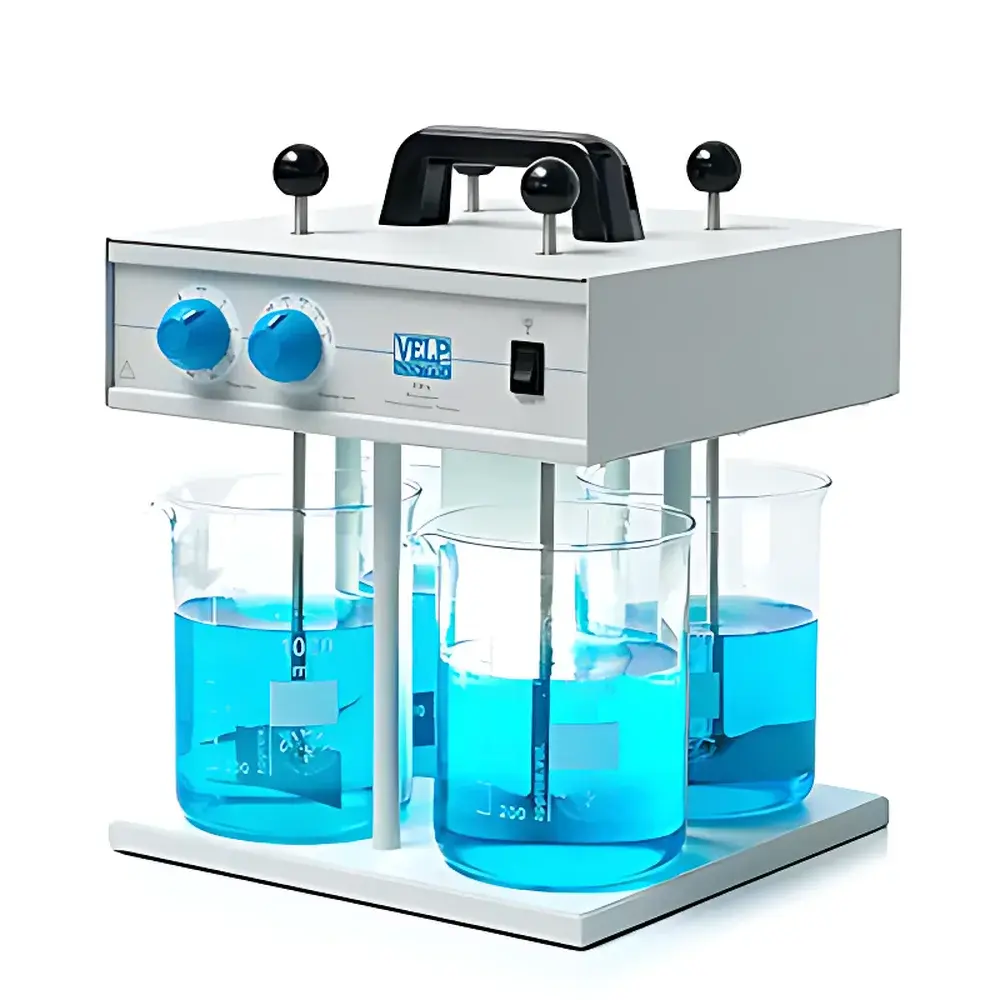
VELP FP4 Portable Jar Test Flocculator
| Brand | VELP |
|---|---|
| Origin | Italy |
| Model | FP4 |
| Instrument Type | Portable Electric Stirrer for Jar Testing |
| Max. Sample Volume | 500 mL |
| Speed Settings | 20, 40, 50, 100, and 200 rpm |
| Operating Temperature Range | Ambient |
| Power Supply | 100–240 V AC, 50–60 Hz |
| Power Consumption | 6 W |
| Dimensions (W×H×D) | 250 × 320 × 250 mm |
| Weight | 4.8 kg |
| Enclosure Material | Epoxy-coated metal |
| Stirring Shaft | Adjustable-height stainless steel rod with auto-locking chuck |
| Timer Range | 0–30 min |
| Display | Backlit LCD |
| Portability | Battery-operable (optional) and 12 V DC car adapter compatible |
| Compliance | CE-marked, RoHS-compliant |
Overview
The VELP FP4 Portable Jar Test Flocculator is an engineered solution for rapid, field-deployable coagulation and flocculation assessment in water and wastewater treatment process optimization. Designed around the standardized jar test methodology—defined by ASTM D2035 and ISO 5815-1—the FP4 enables precise, reproducible simulation of mixing dynamics during coagulant dosing, rapid mix (flash mixing), and slow mix (flocculation) phases. Its compact, battery-capable architecture supports on-site operation at treatment plants, reservoirs, or remote sampling locations without reliance on fixed laboratory infrastructure. Unlike benchtop stirrers, the FP4 integrates purpose-built mechanical stability (non-slip base), height-adjustable stainless-steel stirring rods with positive-lock chucks, and discrete speed selection calibrated to common hydraulic shear rate profiles used in full-scale clarifier design.
Key Features
- Portable dual-power operation: Operates from universal AC input (100–240 V, 50–60 Hz) or optional 12 V DC vehicle supply; battery-powered configuration available for true off-grid deployment.
- Five discrete, pre-calibrated rotational speeds (20, 40, 50, 100, and 200 rpm) aligned with standard jar test protocols—enabling accurate replication of G-values (velocity gradient) across rapid mix (G = 500–1000 s⁻¹) and flocculation (G = 20–70 s⁻¹) stages.
- Ergonomic, epoxy-coated metal housing with anti-slip rubberized base ensures mechanical stability during extended operation—even on uneven or vibrating surfaces.
- Stainless steel stirring rod with telescopic height adjustment and auto-locking chuck allows precise immersion depth control (critical for consistent shear distribution and avoiding vortex formation in 500 mL samples).
- Backlit LCD timer (0–30 min) with audible end-of-cycle alert supports unattended operation and GLP-compliant time-stamped testing.
- Low power consumption (6 W) minimizes thermal load and eliminates sample heating artifacts during prolonged tests—essential for temperature-sensitive coagulant systems (e.g., polyaluminum chloride hydrolysis kinetics).
Sample Compatibility & Compliance
The FP4 is validated for use with standard 500 mL glass or plastic beakers (e.g., VELP A00001000/A00001001). Its optimized impeller geometry and shaft alignment ensure uniform radial flow and minimal wall interference, delivering high inter-test reproducibility (CV < 3% per ASTM D3694). The device conforms to CE marking requirements under the EU Machinery Directive 2006/42/EC and Electromagnetic Compatibility Directive 2014/30/EU. While not intrinsically rated for hazardous environments, its non-sparking construction and low-voltage DC option support safe operation in municipal water facilities subject to OSHA 1910.120 and EN 60079-0 compliance frameworks. Documentation includes traceable calibration certificates for speed and timer accuracy.
Software & Data Management
The FP4 operates as a standalone instrument with no embedded firmware or proprietary software dependency. All operational parameters—including selected speed, elapsed time, and cycle count—are retained in non-volatile memory. For audit trail integrity in regulated environments (e.g., drinking water utilities under EPA 40 CFR Part 141 or ISO/IEC 17025-accredited labs), users may integrate FP4-generated test logs manually into LIMS or ELN platforms via timestamped entry. Optional accessories—including the dedicated carrying case (A00001005)—support secure transport and field documentation consistency. No data export interface is provided, aligning with the device’s role as a deterministic, operator-controlled physical testing tool rather than a connected IoT endpoint.
Applications
- Optimization of coagulant type and dosage (e.g., FeCl₃, Al₂(SO₄)₃, PACl) in surface water and wastewater influent characterization.
- Performance evaluation of flocculant polymers (anionic, cationic, non-ionic) under variable shear histories.
- Rapid screening of pH and alkalinity effects on floc formation and settleability (SVI correlation).
- Validation of full-scale clarifier hydraulic performance using scaled Gt (velocity gradient × time) equivalence.
- Training and certification of plant operators in jar test methodology per AWWA Manual M20 and WHO Water Safety Plan guidelines.
FAQ
Is the FP4 suitable for regulatory compliance testing?
Yes—when operated within defined SOPs aligned with ASTM D2035, ISO 5815-1, or national standards (e.g., China’s CJ/T 3021), the FP4 delivers data admissible for internal process validation and third-party audits.
Can the stirring speed be continuously adjusted?
No—the FP4 offers five fixed, factory-calibrated speeds to ensure repeatability and eliminate operator-induced variability inherent in analog rheostat-based systems.
What is the recommended maintenance schedule?
Inspect the chuck mechanism and shaft threads monthly; clean the base and housing with isopropyl alcohol after exposure to corrosive reagents; verify timer accuracy annually using a certified stopwatch.
Does the FP4 support multi-vessel parallel testing?
No—FP4 is a single-position unit. For simultaneous multi-jar experiments, consider VELP’s FC4S or FC6S corrosion-resistant flocculators or JLT 4/JLT 6 multi-position systems.
Is the device compatible with GLP/GMP documentation requirements?
Yes—its deterministic controls, non-volatile parameter logging, and CE/ROHS certification support inclusion in GLP study plans and FDA 21 CFR Part 11–aligned workflows when paired with appropriate procedural controls and record-keeping practices.



