
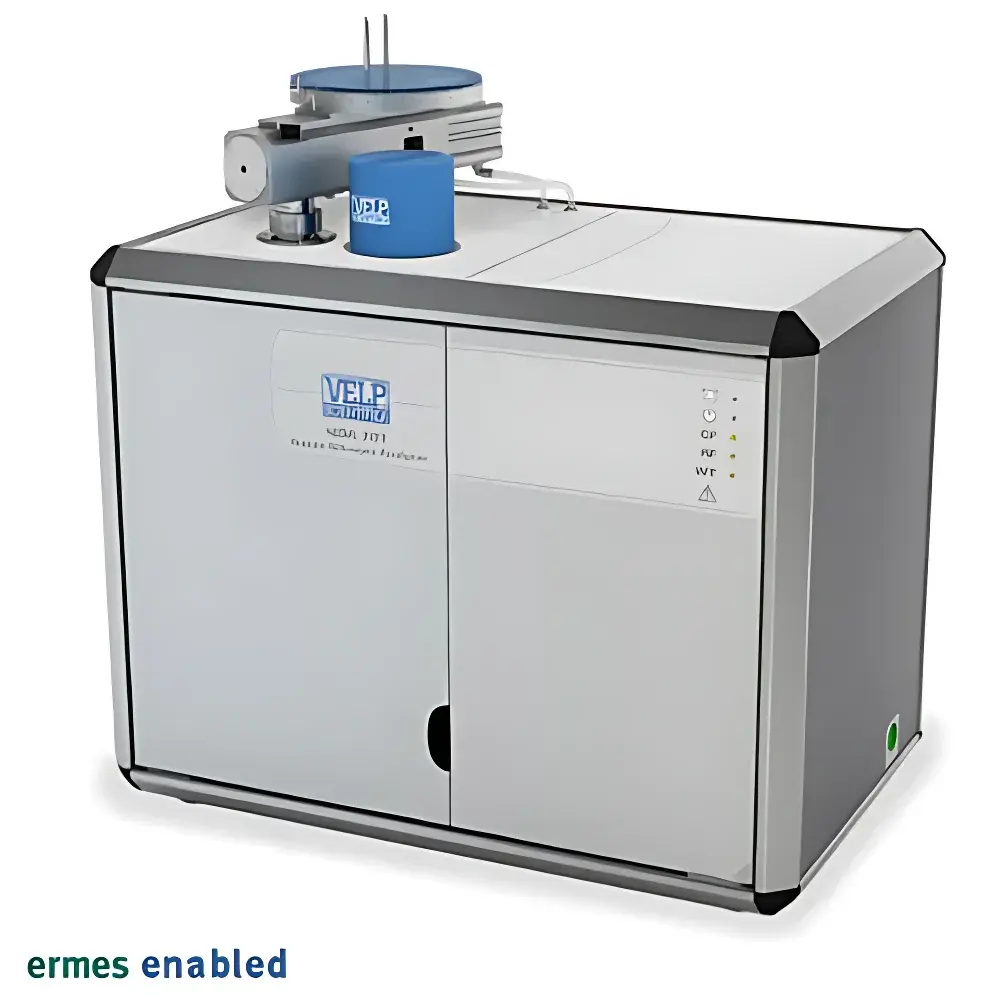
VELP NDA 701/702 Dumas Nitrogen Determinator
| Brand | VELP |
|---|---|
| Origin | Italy |
| Model | NDA 701/702 |
| Principle | Dumas Combustion Method |
| Detection Limit | NDA 701: 0.003 mg N (He) |
| NDA 702 | 0.001 mg N (He) or 0.01 mg N (Ar) |
| Analysis Time | 3–4 min per sample |
| Repeatability (RSD) | <0.5% using EDTA standard (9.57% N) |
| Sample Weight | 1 g |
| Recovery Rate | >99.5% |
| Power Consumption | 1400 W |
| Dimensions (W×D×H) | 655 × 510 × 410 mm |
| Weight | 54 kg |
| Carrier Gas | He (≥99.999%) or Ar (≥99.999%) |
| Oxygen Supply | O₂ (≥99.999%, 2 bar) |
| Combustion Temperature | 1030 °C |
| Detector | Auto-calibrating Thermal Conductivity Detector (TCD) |
| Throughput | Up to 117 samples (4 × 30-position auto-samplers) |
| Compliance | ASTM D515, ISO 13878, AOAC 992.15, EN ISO 16634-1/-2, USP <285>, FDA 21 CFR Part 11 ready (with Ermes software license) |
Overview
The VELP NDA 701/702 Dumas Nitrogen Determinator is a fully automated elemental analyzer engineered for high-precision, high-throughput total nitrogen and protein quantification in solid, semi-solid, and liquid matrices. Based on the classical Dumas combustion principle—first described by Jean-Baptiste Dumas in 1831—the instrument modernizes this foundational method through rigorous thermal control, dual-stage moisture removal (DriStep™), catalytic reduction (Vcopper™), and selective CO₂ scrubbing. Samples are combusted quantitatively at 1030 °C in an oxygen-rich environment, converting organic nitrogen into molecular nitrogen (N₂). Water vapor is removed first via cryogenic condensation (DriStep™), followed by chemical absorption after reduction; residual CO₂ is eliminated using a regenerable sorbent cartridge. The purified N₂ stream is then carried by ultra-pure helium or argon to an auto-calibrating Thermal Conductivity Detector (TCD), enabling absolute quantification without reference gas calibration. Designed for compliance with international standards—including ASTM D515, ISO 13878, AOAC 992.15, EN ISO 16634-1/-2, and USP —the NDA series delivers trace-level sensitivity (down to 0.001 mg N), sub-0.5% RSD reproducibility, and >99.5% nitrogen recovery across diverse sample types.
Key Features
- Two-model platform: NDA 701 optimized for He carrier gas; NDA 702 supports dual-gas operation (He or Ar), offering flexibility in laboratory gas infrastructure.
- Dual-stage moisture management: Physical condensation (DriStep™) post-combustion + chemical absorption post-reduction ensures complete water elimination—critical for TCD stability and baseline integrity.
- Vcopper™ high-efficiency copper catalyst: Engineered for extended service life and consistent stoichiometric reduction of NOₓ and residual O₂ to N₂, minimizing interferences and drift.
- TEMSTM (Time, Energy, Material, Space Optimization) architecture: Reduces analysis time to 3–4 minutes/sample, cuts He consumption by up to 40% vs. legacy systems, and occupies only 0.13 m³ footprint.
- Auto-sampling capacity: Supports up to four 30-position sample discs (117 total), enabling unattended overnight runs with full audit-trail logging.
- Integrated leak diagnostics: Automated, segmented tightness testing (Test 1–3 + full-system) identifies leak location—e.g., autosampler seal, combustion tube, or CO₂ trap—after consumable replacement.
- Auto-calibrating TCD: Eliminates need for external calibration gases; maintains long-term detector response stability via internal reference compensation.
Sample Compatibility & Compliance
The NDA 701/702 accommodates 1 g samples of foodstuffs (cereals, dairy, meat), animal feed, soil, sludge, botanicals, and pharmaceutical excipients. Liquid samples (e.g., milk, digestates) are encapsulated in Sn capsules; heterogeneous solids are homogenized prior to weighing. All analyses comply with GLP/GMP data integrity requirements when paired with optional Ermes software (1- or 3-year license), which provides electronic signatures, user access control, and 21 CFR Part 11–compliant audit trails. Validation documentation (IQ/OQ/PQ) is available as part of the A00000192 package. Instrument performance meets acceptance criteria defined in ISO/IEC 17025 for accredited testing laboratories, and method validation aligns with ICH Q2(R2) guidelines for quantitative analytical procedures.
Software & Data Management
DUMASoft™ v4.x provides unified control, real-time monitoring, and regulatory-grade data handling. The interface supports method creation, multi-point calibration curve generation (5–6 standards recommended), and automatic parameter optimization (gas flow, temperature ramping) based on sample type and weight. Sample metadata—including name, matrix, weight (auto-imported via RS232/USB from analytical balances), and assigned method—is stored in an embedded SQL database. Results are displayed as chromatographic peaks, numerical tables (N mg, N %, protein %), and trend graphs. Export formats include .csv, .xls, and .txt for LIMS integration; PDF reports are customizable and support digital signing. Data reprocessing is permitted using alternative calibration curves without raw signal reacquisition—essential for retrospective method verification.
Applications
Primary use cases include protein content determination in nutritional labeling (AOAC 992.15), crude protein analysis in animal feed (EN ISO 16634-1), total Kjeldahl nitrogen (TKN) equivalence in environmental samples (ASTM D515), and nitrogen balance studies in clinical nutrition research. The system is validated for low-nitrogen matrices (e.g., purified excipients, ultrapure water blanks) and high-fat samples (e.g., oils, butter) due to robust combustion efficiency and ash-handling capability (ceramic/metal/quartz receiver tubes). Regulatory submissions to EFSA, FDA, and Health Canada routinely cite NDA-series data where Dumas methodology is specified.
FAQ
What carrier gases are compatible with the NDA 702?
Helium (≥99.999% purity, 2 bar) or argon (≥99.999% purity, 2 bar) may be used. Helium yields lower detection limits (0.001 mg N); argon is suitable for cost-sensitive labs but increases LOD to 0.01 mg N.
How frequently must the Vcopper™ catalyst be replaced?
Under typical usage (≤1000 analyses/year), Vcopper™ lasts ≥2 years. Replacement interval is tracked in DUMASoft™ and triggered by cumulative run time and temperature exposure logs.
Is manual sample weighing required?
No—RS232 or USB connectivity enables direct weight transfer from METTLER TOLEDO, SARTORIUS, or OHAUS analytical balances. Manual entry remains available for legacy hardware.
Can the instrument be integrated into a centralized LIMS?
Yes—via configurable .csv/.xls export, ODBC drivers, or optional API extension. All exported files retain unique run IDs, timestamps, operator IDs, and instrument serial numbers for full traceability.
What validation support is provided for regulated environments?
VELP supplies IQ/OQ/PQ documentation (A00000192), GxP-compliant Ermes software licensing (E00010012/E00010013), and certified reference materials (EDTA, milk powder, wheat gluten) with CoA.
Related Products





