
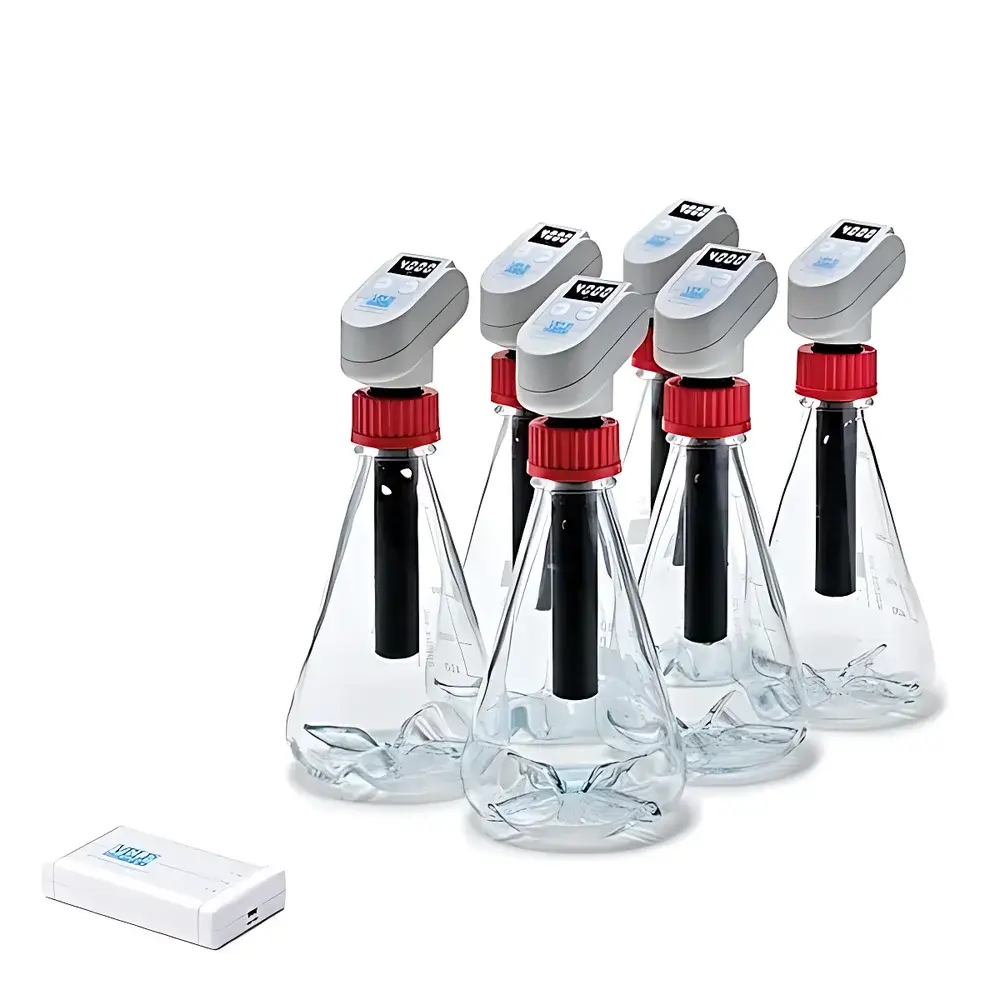
VELP RESPIROMETRIC Soil Respiration and Compost Aerobic Degradation System Model 6
| Brand | VELP |
|---|---|
| Origin | Italy |
| Model | RESPIROMETRIC System 6 |
| Sensor Type | Electronic pressure sensor (mercury-free) |
| Pressure Range | 500–2000 hPa |
| Display | 4-digit LED |
| Stirring Control | 6-digit programmable stirrer with speed lock |
| Power | 2 W |
| Sensor Dimensions | 50 × 70 × 70 mm |
| Battery | CR2430 |
| Ingress Protection | IP54 per EN 60529 |
| Safety Compliance | IEC/EN 61010-1 |
| Test Vessel Capacity | 1000 mL |
| Data Acquisition Interval | 10 min – 48 h |
| Test Duration | 1–180 days |
| Databox™ Capacity | up to 48 sensors (8 systems × 6 sensors) |
| Connectivity | USB (RESPIROSoft™) or optional Wi-Fi (Ermes™ Cloud Platform) |
| Data Storage | Local (sensor), PC (RESPIROSoft™), or cloud (Ermes™) |
| Optional Module | Ermes™ Cloud Platform for remote monitoring, multi-device access (PC/tablet/smartphone), real-time alerts (in-app/email), and collaborative reporting |
Overview
The VELP RESPIROMETRIC Soil Respiration and Compost Aerobic Degradation System Model 6 is a dedicated, non-invasive manometric measurement platform engineered for precise quantification of oxygen consumption and carbon dioxide evolution during aerobic biological processes in soil and compost matrices. Based on the classical respirometric principle—where microbial activity in a sealed reaction vessel consumes O₂ and produces CO₂, which is chemically trapped by a strong alkaline absorbent (e.g., NaOH or KOH)—the system detects minute changes in internal headspace pressure as a direct proxy for respiratory activity. This pressure differential, measured in hectopascals (hPa), is captured continuously by high-stability electronic pressure transducers integrated into each sensor unit. Unlike optical or IR-based CO₂ analyzers, this manometric approach eliminates cross-sensitivity to humidity, temperature drift, or gas matrix interference, delivering high reproducibility across long-term incubations (up to 180 days) under controlled environmental conditions (e.g., climate chambers or incubators). The system is calibrated traceably to international pressure standards and validated for compliance with ISO 17556 (soil respiration), ISO 20200 (compost biodegradability), and ASTM D5338 (aerobic biodegradation of plastic materials in soil).
Key Features
- Modular architecture supporting up to six independent respirometric sensors per system, each equipped with a mercury-free electronic pressure transducer (500–2000 hPa range) and embedded 4-digit LED display for local status verification.
- Intuitive two-button interface enabling rapid method selection, start/stop control, and real-time pressure readout—designed for routine operation without software dependency.
- Programmable 6-digit magnetic stirrer with mechanical speed lock, ensuring consistent mixing intensity across replicates and minimizing sedimentation-induced measurement artifacts.
- Databox™ wireless hub: supports simultaneous connection of up to 48 sensors (8 × Model 6 systems), eliminating cable clutter and enabling non-intrusive data retrieval from inside incubators or growth chambers.
- Low-power design (2 W nominal) with CR2430 coin-cell battery providing >12 months of continuous operation under standard acquisition intervals (e.g., 30-min sampling), reducing maintenance frequency.
- Robust mechanical construction using high-performance polymer housing (IP54-rated per EN 60529) and full electrical safety certification (IEC/EN 61010-1 Class II).
Sample Compatibility & Compliance
The system accommodates standard 1000 mL borosilicate glass test vessels with gas-tight septum caps, compatible with heterogeneous solid-phase samples including mineral soils, organic amendments, compost feedstocks, biochar blends, and biodegradable polymer composites. Sample preparation follows standardized protocols outlined in ISO 17556 (determination of soil respiration), ISO 20200 (evaluation of ultimate aerobic biodegradability of plastics in aqueous medium), and OECD 301 series (ready biodegradability testing). All sensor units are factory-calibrated against NIST-traceable pressure references and undergo post-calibration verification per ISO/IEC 17025 requirements when deployed in GLP-compliant laboratories. Data integrity is maintained through timestamped, audit-trail-enabled logging—fully aligned with FDA 21 CFR Part 11 electronic record requirements when used with RESPIROSoft™ configured for user authentication and electronic signatures.
Software & Data Management
RESPIROSoft™ is a Windows-based desktop application supporting concurrent monitoring of all connected sensors, automated curve fitting (first-order kinetics, lag-phase detection), and customizable report generation compliant with ISO/IEC 17025 documentation standards. It enables pre-defined method templates (e.g., “ISO 17556 Soil Test”, “ASTM D5338 Compost Assay”), configurable data export (CSV, PDF, XLSX), and comparative analysis across multiple sample batches. For distributed or multi-site studies, the optional Ermes™ Cloud Platform provides secure, role-based web access via TLS 1.2 encryption. Users can configure real-time email/SMS alerts for threshold breaches (e.g., pressure drift >5 hPa/h), initiate remote sensor diagnostics, and share time-synchronized datasets with collaborators—all accessible from PC, tablet, or smartphone without local installation.
Applications
- Quantitative assessment of soil microbial activity and carbon mineralization rates under varying moisture, temperature, and nutrient regimes.
- Standardized evaluation of compost stability and maturity via oxygen uptake rate (OUR) and cumulative CO₂ evolution metrics.
- Regulatory testing of biodegradable packaging materials according to ISO 14855, ASTM D5338, and EN 13432.
- Long-term incubation studies on carbon sequestration potential of soil amendments (e.g., biochar, green manures, digestates).
- Method development and validation for anaerobic digestion feedstock characterization and co-digestion compatibility screening.
- Academic and industrial R&D in environmental microbiology, waste valorization, and circular economy material assessment.
FAQ
How does the system ensure measurement accuracy over extended incubation periods?
The pressure transducers are temperature-compensated and zero-drift stabilized via internal reference cavities; calibration stability is verified at 30-day intervals using a certified dead-weight tester per ISO 6789-2.
Can the system be used for anaerobic respiration studies?
No—the RESPIROMETRIC Model 6 is explicitly designed for aerobic processes requiring O₂ consumption measurement; anaerobic assays require redox potential or CH₄/H₂S-specific detection methods.
Is validation documentation available for regulatory submissions?
Yes—VELP provides instrument qualification packages (IQ/OQ/PQ), traceable calibration certificates, and software validation reports (including 21 CFR Part 11 compliance evidence) upon request.
What happens if power to the Databox™ is interrupted?
All sensors retain locally stored data (up to 30 days at 30-min intervals); synchronization resumes automatically upon reconnection without data loss.
Are replacement parts and service support available outside Italy?
VELP maintains an authorized global service network with regional technical centers offering sensor recalibration, firmware updates, and hardware repair under warranty or extended service contracts.
Related Products







