
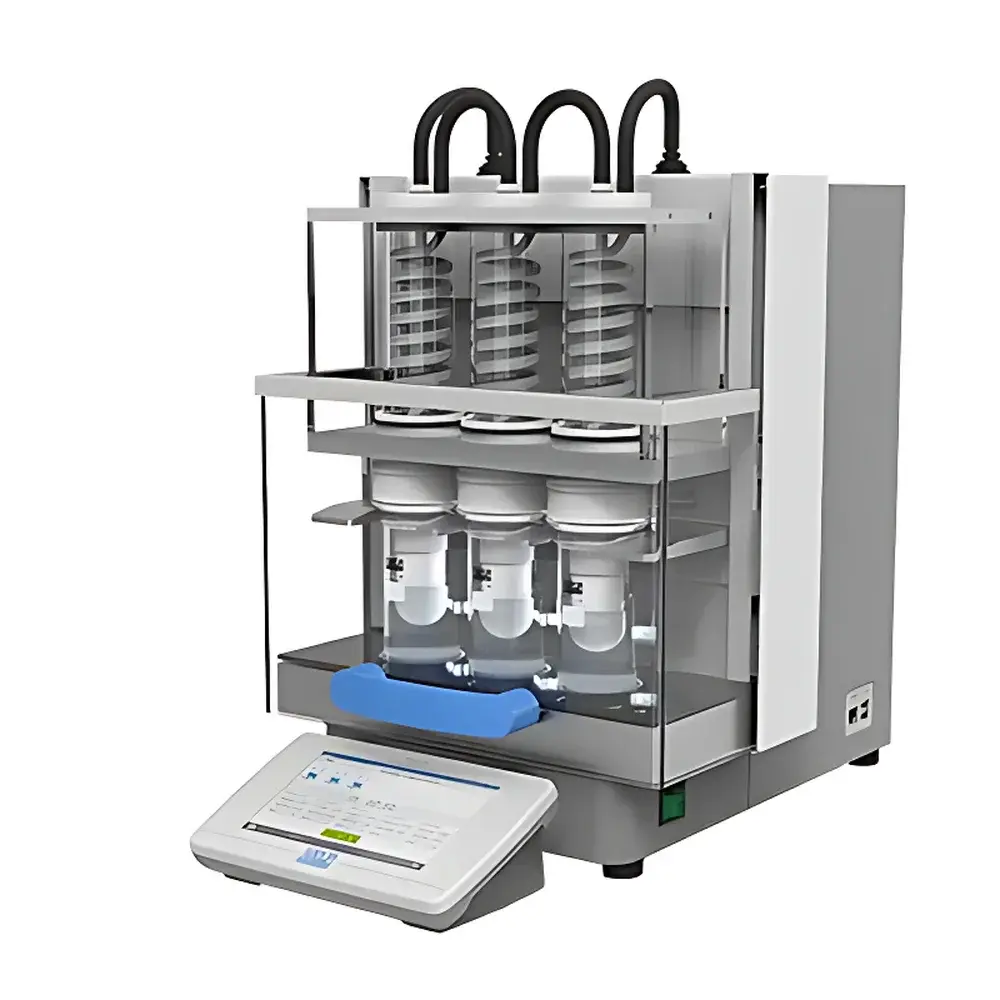
VELP SER 158 Automated Solvent Extractor (Fat Analyzer)
| Brand | VELP |
|---|---|
| Origin | Italy |
| Model | SER 158 |
| Extraction Type | Solid-Liquid |
| Max Temperature | 380 °C |
| Operating Pressure | Ambient |
| Extraction Cell Volume | 250 mL |
| Cycle Time | 130 min |
| Dimensions (W×H×D) | 358×546×450 mm (SER 158/3) / 546×546×450 mm (SER 158/6) |
| Sample Positions | 3 or 6 |
| Solvent Recovery Rate | >90% |
| RSD | ≤1% |
| Measurement Range | 0.1–100% |
| Power Supply | 115/230 V, 50/60 Hz |
| Power Consumption | 630/850 W |
| Cooling Water Flow | ≥1 L/min |
| Display | 7-inch color touchscreen |
| Connectivity | 3×USB, Ethernet, Ermes Cloud Platform |
| Compliance | ASTM D2231, ISO 14465, AOAC 920.39, USP <467>, EN 14082, NF T90-107 |
Overview
The VELP SER 158 Automated Solvent Extractor is an advanced solid-liquid extraction system engineered for precise, reproducible quantification of extractable analytes—including total and crude fat—in diverse matrices such as foodstuffs, animal feed, environmental sediments, plastics, petrochemicals, and pulp & paper products. Based on the Randall hot-solvent extraction principle—distinct from classical Soxhlet cold-solvent reflux—the SER 158 accelerates extraction kinetics through controlled thermal activation while maintaining thermally labile compound integrity. The method comprises five sequential, programmable phases: immersion, solvent removal, rinsing, solvent recovery, and post-extraction cooling—each executed with independent temperature regulation and real-time pressure monitoring. Unlike conventional systems, the SER 158 integrates TEMS™ (Thermal Efficiency Management System), which dynamically modulates heating power across zones to minimize energy consumption without compromising extraction completeness. Its glass-ceramic heating elements operate up to 380 °C with ±1 °C stability, enabling high-boiling-point solvent applications (e.g., chlorobenzene, xylene) required for hydrocarbon or polymer-bound contaminant release.
Key Features
- Automated five-step Randall protocol (immersion → removal → rinse → recovery → cooling) with full parameter independence per phase
- Titanium condenser assembly ensuring corrosion resistance, long-term thermal stability, and >90% solvent recovery into integrated reservoirs
- TEMSTM technology reducing energy use by up to 35% versus legacy hot-solvent systems, validated under ISO 50001-aligned operational profiles
- SafeEnd™ thermal protection logic preventing over-heating of extracts during final drying; automatically terminates heating when mass loss rate falls below user-defined thresholds
- SolventXpress™ sealed fluid pathway design eliminating operator exposure to volatile organic compounds (VOCs) during loading, operation, and waste handling
- Modular architecture supporting 3-position (SER 158/3) or 6-position (SER 158/6) configurations—with scalability to 12 or 24 positions via synchronized multi-unit networks
- 7-inch capacitive touchscreen interface with multilingual support (EN, DE, FR, ES, IT, CN), GLP-compliant audit trail, and timestamped method archiving
- Embedded LED status indicators showing active extraction position, thermal stage, and solvent flow condition in real time
Sample Compatibility & Compliance
The SER 158 accommodates sample masses from 0.5 g to 15 g within standardized cellulose or glass fiber extraction thimbles (Φ25–Φ65 mm × 80 mm), compatible with ASTM D3273 (soil hydrocarbons), AOAC 920.39 (crude fat in feed), EN 14082 (total fat in meat), and ISO 14465 (fatty acid methyl esters). All wetted components—including Viton®, Butyl, and PTFE (Vaflon®) seals, titanium condensers, and borosilicate glass solvent paths—meet USP and FDA 21 CFR Part 11 material compatibility requirements. The system supports IQ/OQ documentation packages (A00000306) and integrates seamlessly into GMP/GLP workflows via Ermes Cloud Platform synchronization, enabling remote validation, electronic signatures, and 21 CFR Part 11-compliant data integrity controls.
Software & Data Management
ControlPad™ software—deployable locally or via cloud—enables centralized management of up to four SER 158 units from a single interface. It provides real-time graphical monitoring of temperature gradients, solvent flow rates, condensation efficiency, and mass stabilization curves. All analytical runs are stored with embedded metadata (user ID, method version, calibration log, ambient conditions) and exportable in CSV, PDF, or XML formats compliant with LIMS integration standards (ASTM E1467, ISO/IEC 17025 Annex A.3). The system logs every parameter change, alarm event, and hardware status transition with cryptographic hashing to ensure non-repudiation. Optional Ermes subscription services deliver automated firmware updates, predictive maintenance alerts, and cross-laboratory method harmonization tools.
Applications
The SER 158 serves as a primary sample preparation platform for regulatory and research laboratories performing: fat quantification in dairy, cereals, and infant formula per Codex Alimentarius STAN 206; total petroleum hydrocarbons (TPH) recovery from contaminated soils per EPA Method 3540C; plasticizer leaching studies in PVC and polyurethane using dichloromethane or THF; lipid profiling in microalgae biomass for biofuel development; and residual oil analysis in recycled paper fibers per TAPPI T 204 cm-17. Its ability to process heterogeneous particulates—including fibrous feeds, sludge aggregates, and composite polymers—without pre-grinding makes it particularly suited for industrial QC environments where throughput and method robustness are critical.
FAQ
What extraction standards does the SER 158 support?
It complies with AOAC 920.39, ASTM D2231, ISO 14465, EN 14082, NF T90-107, and USP , with method templates preloaded for immediate deployment.
Can the SER 158 handle hazardous solvents like benzene or carbon tetrachloride?
Yes—provided appropriate containment, ventilation, and local safety protocols are in place; all wetted materials are chemically inert to halogenated and aromatic solvents.
Is method transfer from Soxhlet to SER 158 validated?
VELP provides application notes demonstrating equivalence studies per ICH Q5B guidelines, including recovery, precision, and ruggedness data across 12 matrix types.
How is solvent recovery verified and documented?
Integrated gravimetric feedback from the solvent reservoir, coupled with flowmeter calibration logs and batch-level reconciliation reports, ensures traceable mass balance reporting per ISO/IEC 17025 clause 7.7.
Does the system support unattended overnight operation?
Yes—equipped with automatic shutdown on completion, thermal fault interlocks, solvent level sensors, and remote alarm notification via Ermes Cloud or SMTP email.



