
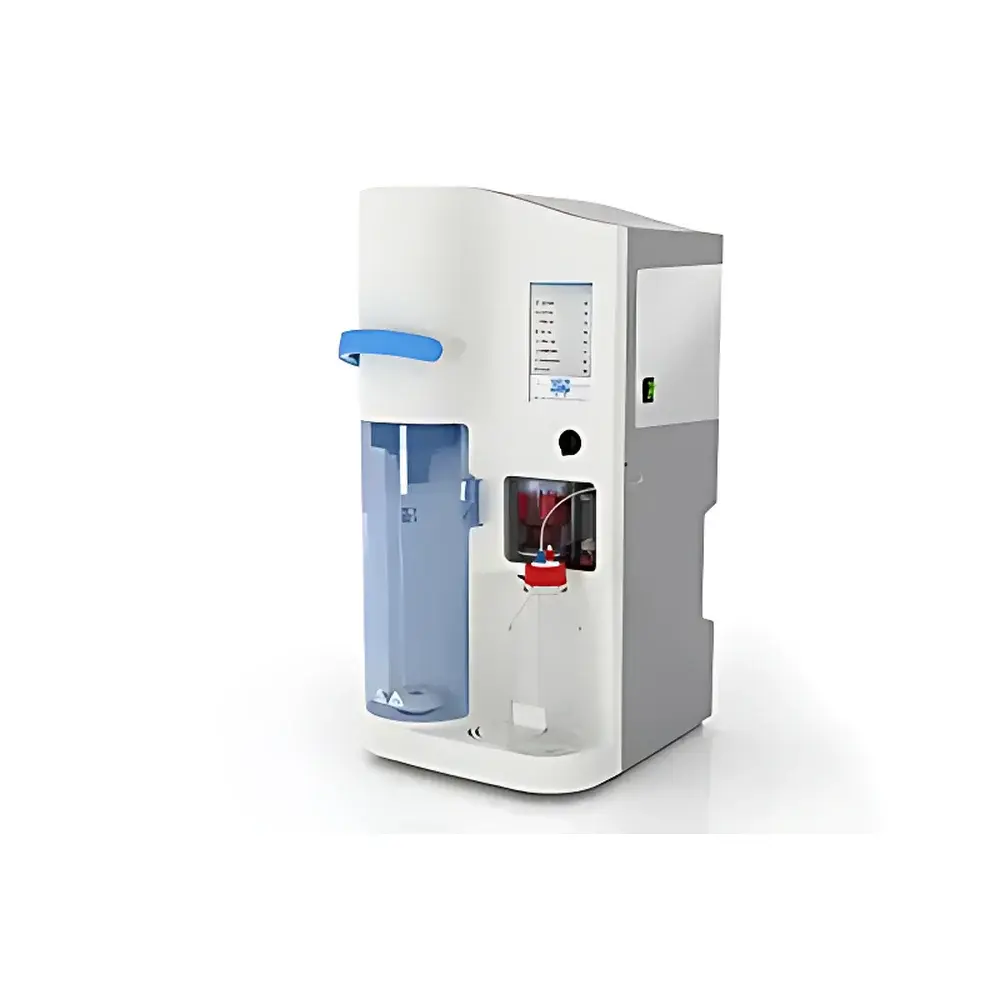
VELP UDK 159 Automated Kjeldahl Distillation and Colorimetric Titration System
| Brand | VELP |
|---|---|
| Origin | Italy |
| Model | UDK 159 |
| Instrument Type | Kjeldahl Nitrogen Determinator |
| Nitrogen Detection Range | ≥ 0.1 mg N |
| Distillation Time | 0–99 min |
| Repeatability | ≤ 1 % |
| Sample Weight Capacity | 10 g |
| Nitrogen Recovery Rate | ≥ 99.5 % |
| Power Consumption | 2200 W |
| Dimensions (L×W×H) | 416 mm × 385 mm × 780 mm |
Overview
The VELP UDK 159 is a fully automated Kjeldahl distillation and colorimetric titration system engineered for precise, reproducible total nitrogen determination in accordance with AOAC Official Method 981.10, ISO 8968-1, ISO 1871, and ASTM D1122. It integrates steam distillation, automatic reagent dosing (NaOH, boric acid, and distilled water), and integrated photometric titration into a single platform—eliminating manual intervention from digestion to quantification. The system operates on the classical Kjeldahl principle: organic nitrogen is converted to ammonium sulfate via acid digestion, liberated as ammonia under alkaline conditions during steam distillation, captured in boric acid solution, and quantified via standardized colorimetric titration using bromocresol green–methyl red indicator. Designed for routine QC/QA laboratories in food, feed, agricultural, environmental, and pharmaceutical sectors, the UDK 159 delivers regulatory-compliant nitrogen data with traceable audit trails and GLP-aligned workflow integrity.
Key Features
- 6-inch full-color capacitive touchscreen interface enabling intuitive configuration of distillation time (0–99 min), steam intensity (10–100%), and precise volumetric delivery of NaOH, boric acid, and condensate water
- Integrated AOAC-recommended colorimetric titration module with photometric endpoint detection—no electrode calibration or maintenance required
- Automatic titration cell rinsing between samples to prevent carryover and ensure cross-contamination-free analysis
- Preloaded library of 55 validated methods: 31 standardized protocols (e.g., dairy, cereals, meat) + 24 user-definable programs supporting custom reaction kinetics and reagent sequences
- Robust thermal management and optimized steam generator design delivering consistent distillation efficiency across sample matrices (solid, liquid, semi-solid)
- Comprehensive hardware-level safety: overtemperature cutoff, pressure relief valve, leak detection, and real-time steam flow monitoring
Sample Compatibility & Compliance
The UDK 159 accommodates up to 10 g sample weight per run and is validated for heterogeneous matrices including milk powder, soy flour, soil extracts, wastewater digests, and pharmaceutical excipients. All operational parameters—including reagent volumes, distillation duration, and steam ramp profiles—are fully programmable to match matrix-specific volatility and ammonia release kinetics. The system complies with Good Laboratory Practice (GLP) requirements through mandatory electronic signature support, timestamped method execution logs, and immutable result archiving. Data integrity meets FDA 21 CFR Part 11 criteria when deployed with validated networked PC environments, supporting audit-ready reporting for ISO/IEC 17025-accredited laboratories.
Software & Data Management
VELP’s proprietary KjelSoft™ v4.x software enables multi-user role-based access control (administrator, analyst, reviewer), password-protected method editing, and full audit trail generation—including operator ID, parameter changes, and result modifications. Raw and processed data export is supported in .csv, .txt, and Excel-compatible .xls formats, directly compatible with LIMS integration via configurable ODBC drivers. Results are stored locally on internal flash memory (≥10,000 analyses) and can be transferred via USB 2.0 port to external drives or network servers. Optional Ethernet connectivity allows remote monitoring, firmware updates, and centralized instrument fleet management.
Applications
- Crude protein quantification in food and feedstuffs (AOAC 981.10, ISO 8968-1)
- Soil and fertilizer nitrogen content assessment per ISO 11261 and EPA Method 350.1
- Wastewater total Kjeldahl nitrogen (TKN) analysis compliant with APHA Standard Methods 4500-Norg B
- Pharmaceutical raw material verification per USP <467> residual nitrogen limits
- Research-scale nitrogen balance studies requiring high-throughput, low-variability replicate analysis
FAQ
What standards does the UDK 159 comply with for nitrogen determination?
It supports AOAC 981.10, ISO 8968-1 (milk), ISO 1871 (cereals), ISO 11261 (soil), ASTM D1122 (petroleum products), and APHA 4500-Norg B (wastewater).
Is the titration module truly maintenance-free?
Yes—the photometric sensor requires no electrode recalibration, electrolyte refills, or membrane replacements; only periodic optical path cleaning is recommended.
Can the system interface with a laboratory information management system (LIMS)?
Yes, via standardized .csv/.xls export or ODBC-enabled direct database ingestion when connected to a validated Windows-based host PC.
How is data integrity ensured for regulatory submissions?
All analytical sessions generate immutable, time-stamped logs with operator credentials, method version, raw absorbance curves, and final calculations—fully traceable under GLP and 21 CFR Part 11.
What is the minimum detectable nitrogen mass?
The system achieves a lower limit of quantification (LLOQ) of ≥0.1 mg N per sample, verified across matrix-matched calibration curves per ICH Q2(R2) guidelines.





