
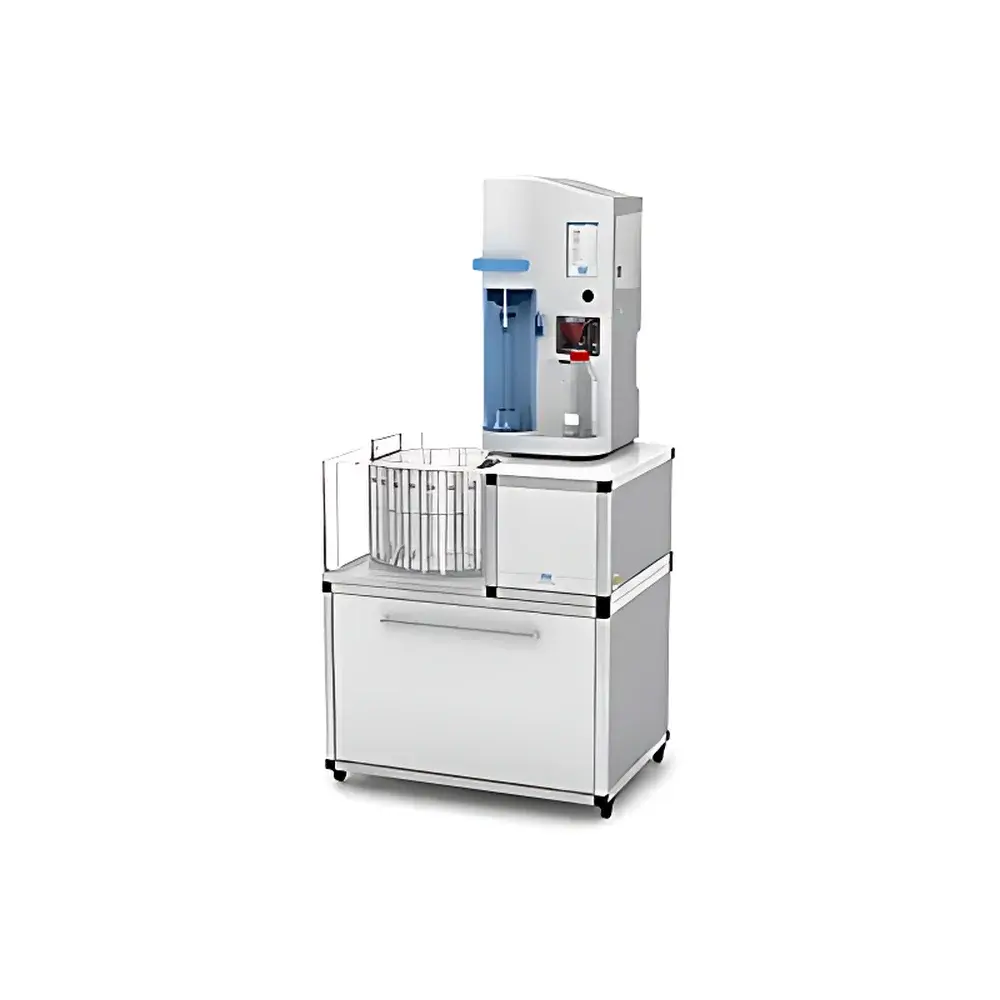
VELP UDK 169 & AutoKJEL Fully Automated High-Throughput Kjeldahl Distillation and Titration System
| Brand | VELP |
|---|---|
| Origin | Italy |
| Model | UDK 169 & AutoKJEL |
| Instrument Type | Kjeldahl Nitrogen Determinator |
| Nitrogen Detection Range | ≥0.1 mg N |
| Distillation Time | 1–99 min |
| Repeatability | ≤1% |
| Sample Weight Capacity | 10 g |
| Nitrogen Recovery Rate | >99.5% |
| Power Consumption | 2200 W |
| Dimensions (W×D×H) | 385 mm × 416 mm × 780 mm |
Overview
The VELP UDK 169, when integrated with the AutoKJEL automated sample introduction module, constitutes a fully automated Kjeldahl nitrogen analysis platform engineered for high-throughput, unattended operation in regulated laboratory environments. Based on classical Kjeldahl digestion–distillation–titration methodology, this system quantifies total nitrogen content—subsequently converted to protein concentration using standardized conversion factors (e.g., 6.25 for cereals, 5.70 for dairy)—in accordance with internationally recognized standards including ISO 8968-1, AOAC 981.10, AOAC 984.13, and ASTM D1122. The UDK 169 represents the latest evolution in VELP’s UDK series, delivering enhanced thermal efficiency, improved reagent dosing precision, and expanded programmability over its predecessor (UDK 159), while maintaining full backward compatibility with existing method libraries and consumables.
Key Features
- Fully automated distillation and titration sequence—including NaOH addition, dilution water delivery, boric acid dosing, steam generation, condensate collection, and endpoint detection via potentiometric titration—executed without manual intervention.
- AutoKJEL robotic autosampler supports two interchangeable sample rack configurations: standard 24-position (250 mL tubes) or optional 21-position (400 mL tubes), enabling flexible throughput scaling from routine QC batches to large-scale feed or food testing laboratories.
- Adjustable steam flow control (10–100% range) ensures optimal vapor delivery across diverse sample matrices—from low-fat dairy powders to high-fiber cereal grains—minimizing carryover and maximizing recovery reproducibility.
- Integrated 6-inch capacitive touchscreen interface with multilingual support (English, German, French, Spanish, Italian, Chinese), password-protected user access levels, and on-device storage of up to 55 customizable methods.
- Automatic post-run cleaning cycle for titration vessel and condenser tubing; residual distillate removal function prevents cross-contamination between sequential analyses.
- Compliance-ready architecture: audit trail logging, electronic signature support, and data export in CSV/Excel formats facilitate adherence to GLP, GMP, and FDA 21 CFR Part 11 requirements when paired with validated LIMS integration.
Sample Compatibility & Compliance
The UDK 169 & AutoKJEL system accommodates solid, semi-solid, and liquid samples within a maximum loading mass of 10 g per digestion tube. It is routinely deployed for nitrogen determination in agricultural commodities (grains, oilseeds), food products (meat, dairy, plant-based proteins), environmental samples (soil, sludge), and pharmaceutical excipients. All operational parameters—including digestion time (pre-determined off-instrument), distillation duration (programmable 1–99 min), and titrant concentration—are configurable to meet matrix-specific validation criteria defined under ISO 5983-1, AOAC Official Methods of Analysis, and USP . The system achieves ≥99.5% nitrogen recovery across the 1–200 mg N range and demonstrates ≤1% RSD for replicate analyses, satisfying repeatability thresholds specified in ISO/IEC 17025:2017 Clause 7.7.
Software & Data Management
Method programming and real-time monitoring are performed via the embedded VELP KjelSoft™ v4.2 firmware. Each analysis generates a timestamped report containing sample ID, operator ID, distillation time, titrant volume consumed, calculated %N, %protein, and system diagnostic flags (e.g., steam pressure deviation, electrode drift). Raw data and metadata are stored locally with automatic backup to USB drive. Optional Ethernet/Wi-Fi connectivity enables remote status checks and scheduled report exports to network folders or cloud repositories. When deployed in regulated environments, the system supports 21 CFR Part 11-compliant electronic records through third-party validation packages that include role-based permissions, audit trail review tools, and electronic signature workflows.
Applications
- Quality control of raw materials and finished goods in food and feed manufacturing (e.g., compliance with EU Regulation No. 1169/2011 labeling requirements).
- Research-grade nitrogen balance studies in nutritional science and animal husbandry laboratories.
- Environmental monitoring of organic nitrogen load in wastewater treatment plants and soil fertility assessment programs.
- Pharmaceutical raw material verification per ICH Q5D and compendial monographs requiring nitrogen content confirmation.
- Contract testing laboratories serving ISO/IEC 17025-accredited accreditation scopes where traceability, reproducibility, and documentation integrity are mandatory.
FAQ
What is the minimum detectable nitrogen mass for this system?
The instrument has a detection limit of ≥0.1 mg N per sample, consistent with AOAC guidelines for macro-Kjeldahl applications.
Can the system be operated without the AutoKJEL autosampler?
Yes—the UDK 169 functions as a standalone distillation-titrator; the AutoKJEL module is an optional, field-upgradable add-on for unattended batch processing.
Is method validation support available from VELP?
VELP provides IQ/OQ documentation templates and application notes aligned with ISO 8655, ISO 17025, and USP analytical instrument qualification frameworks.
What maintenance intervals are recommended for routine operation?
Daily: electrode calibration and condenser rinse; quarterly: steam generator descaling and pump tubing replacement; annually: full performance verification against certified reference materials (e.g., NIST SRM 84g).
Does the system comply with green chemistry principles?
Yes—optimized steam generation and programmable reagent dosing reduce average water consumption by 30% and NaOH usage by 22% compared to legacy Kjeldahl systems, supporting ISO 14040 life-cycle assessment objectives.




