
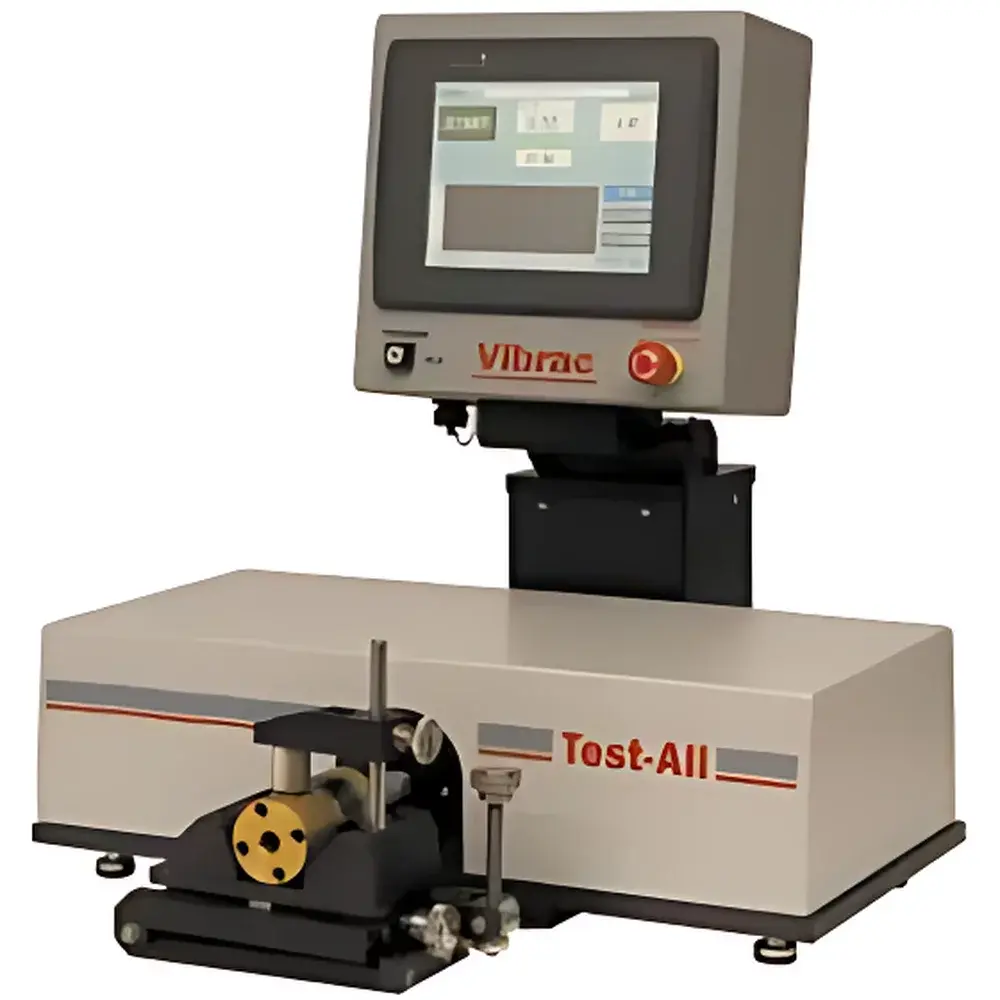
Vibrac Test-All II Multifunction Torque Tester
| Brand | Vibrac |
|---|---|
| Origin | USA |
| Model | Test-All II |
| Torque Range | 10 oz·in to 50 lb·in (0.07–5.65 N·m) |
| Accuracy | ±0.5% FS |
| Display | Touchscreen Interface |
| Control Software | Windows-based |
| Output Interfaces | RS-232, USB |
| Operating Temperature Range | Wide Ambient |
Overview
The Vibrac Test-All II Multifunction Torque Tester is a precision-engineered electromechanical instrument designed for quantitative rotational force measurement across industrial manufacturing, quality assurance, and R&D environments. Built upon over five decades of torque metrology expertise, the system implements a patented digital transduction architecture that converts mechanical torsional input into high-fidelity electrical signals via strain-gauge-based torque sensors. Its core measurement principle relies on direct coupling between the test specimen and a calibrated rotary sensor, enabling real-time acquisition of torque vs. angular displacement or time profiles. Unlike analog or spring-based testers, the Test-All II employs closed-loop feedback control during dynamic testing, ensuring consistent rotational velocity and minimizing inertial artifacts—critical for evaluating breakaway torque, prevailing torque, and dynamic friction characteristics in fasteners, valves, bearings, and actuated mechanisms.
Key Features
- Touchscreen-driven Windows-based control interface with intuitive graphical workflow navigation and on-device test configuration
- Bidirectional torque measurement capability: simultaneous acquisition and display of clockwise and counterclockwise peak torque values, each independently storable and exportable
- Three programmable test modes: (1) Fixed-torque termination, (2) Torque-drop detection (e.g., for thread engagement failure or clutch disengagement), and (3) Multi-cycle endurance testing with user-defined inter-test dwell periods
- NIST-traceable calibration certificate supplied with each unit; field recalibration supported without disassembly or external tools
- Integrated mechanical overload protection safeguarding sensor integrity up to 150% of full-scale range
- Wide operational temperature tolerance (10–40 °C) suitable for integration into production-floor environments without climate control
- Dual communication interfaces: RS-232 for legacy SCADA integration and USB 2.0 for rapid data transfer to host PCs running Windows 10/11
- No warm-up period required—stable metrological performance achieved immediately upon power-on
Sample Compatibility & Compliance
The Test-All II accommodates a broad spectrum of mechanically coupled components, including but not limited to hex-head and Torx fasteners (M2–M12), ball and needle roller bearings (ID 3–25 mm), quarter-turn and multi-turn isolation valves, solenoid-actuated shut-off assemblies, and miniature gearmotor output shafts. Fixturing is modular and tool-free, supporting both axial clamping and radial chucking configurations. From a regulatory standpoint, the system complies with ISO 9001:2015 requirements for measurement equipment control and supports GLP/GMP-aligned documentation workflows. Data logging includes timestamped audit trails, operator ID fields, and version-stamped firmware identifiers—facilitating compliance with FDA 21 CFR Part 11 when deployed within validated quality systems. All torque values are reported in SI units (N·m) with optional dual-unit display (oz·in, lb·in).
Software & Data Management
The embedded Windows application provides full test method definition, real-time waveform visualization (torque vs. angle/time), and post-acquisition statistical analysis (mean, SD, min/max, Cp/Cpk). Raw data exports as CSV or Excel-compatible XLSX files; graphical reports include annotated torque curves with pass/fail thresholds overlaid. The software supports method locking via password-protected administrator mode and maintains a local database of historical test records with search-by-part-number, date-range, or operator filter. Audit logs record all parameter changes, calibration events, and export actions—meeting traceability requirements for ISO/IEC 17025 accredited laboratories. USB mass-storage mode enables direct firmware updates and backup of configuration templates across multiple instruments.
Applications
- Fastener validation: verification of assembly torque specifications, thread stripping limits, and lubricity effects on prevailing torque
- Valve actuation characterization: quantification of stem breakaway torque, seat sealing torque, and hysteresis across service life cycles
- Bearing preload assessment: measurement of rotational drag torque under controlled axial load conditions
- Consumer product QA: functional testing of rotating dials, knobs, hinges, and latching mechanisms per ASTM F1817 (Torque Testing of Medical Devices)
- Automotive component qualification: evaluation of throttle body actuators, HVAC blend door linkages, and electric parking brake caliper rotation resistance
- Electromechanical device burn-in: automated multi-cycle torque profiling to detect wear-induced drift or seizure onset
FAQ
What is the maximum allowable input torque before sensor damage occurs?
The integrated mechanical stop mechanism engages at 150% of full scale (i.e., up to 75 lb·in / 8.48 N·m), preventing permanent deformation of the sensing element.
Can test methods be exported and shared between multiple Test-All II units?
Yes—method definitions, including speed profiles, trigger conditions, and pass/fail criteria, are saved as portable .TAM files and can be loaded across any instrument running firmware v3.2 or later.
Is third-party software integration supported?
The RS-232 port implements ASCII command protocol documented in the OEM Technical Reference Manual, enabling native integration with LabVIEW, Python (pySerial), and MATLAB environments.
How frequently must the system be recalibrated to maintain specification accuracy?
Annual recalibration is recommended per ISO/IEC 17025 guidance; however, the built-in self-diagnostic routine verifies zero stability and linearity prior to each test session.
Does the system support custom fixture design for non-standard parts?
Yes—Vibrac provides mechanical interface drawings (STEP format) and torque coupling dimensions to facilitate OEM-designed fixturing compliant with DIN 332 and ISO 7388 standards.



