
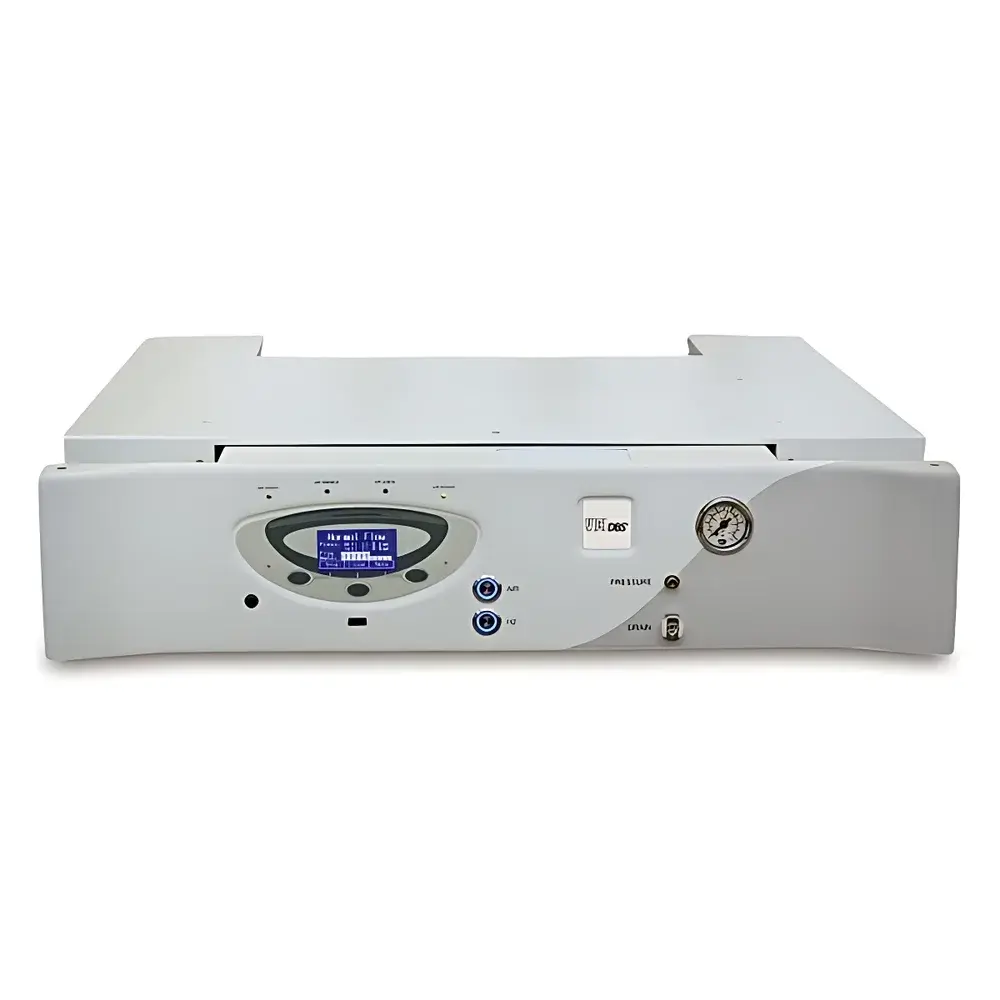
VICI FID Gas Station Hydrogen & Zero-Air Generator
| Brand | VICI |
|---|---|
| Origin | USA |
| Model | FID Gas Station |
| Hydrogen Flow Rate | 100–1000 mL/min |
| Hydrogen Purity | 99.9996% or 99.99996% |
| Hydrogen Output Pressure | up to 11 barg (160 psig) |
| Zero Air Flow Rate | 1.8–5 L/min |
| Zero Air Hydrocarbon Content | < 0.1 ppm |
| Configuration Options | Horizontal (GC-under bench) or Vertical (space-saving rack-mount) |
| Rack Compatibility | 19-inch standard enclosure (Hydrogen 19” Rack Plus variant) |
| Compliance | Designed for continuous operation in GLP/GMP and ISO/IEC 17025-accredited laboratories |
Overview
The VICI FID Gas Station is an integrated, laboratory-grade hydrogen and zero-air generator engineered specifically to supply combustion gas and carrier gas for flame ionization detectors (FIDs) in gas chromatography (GC) systems. Unlike conventional cylinder-based gas delivery, this instrument employs proprietary proton exchange membrane (PEM) electrolysis for hydrogen generation and catalytic hydrocarbon removal coupled with high-efficiency filtration for zero-air production. The dual-output architecture eliminates cross-contamination risks while maintaining strict gas purity specifications required for low-detection-limit FID operation. Its design adheres to fundamental GC detector gas requirements defined in ASTM D3612 and ISO 10101-2, ensuring stable baseline performance, reproducible peak integration, and long-term detector filament integrity. The system operates continuously without manual intervention, supporting unattended overnight runs and routine QC workflows in regulated environments.
Key Features
- Integrated PEM-based hydrogen generation and catalytic zero-air synthesis in a single compact chassis
- Selectable hydrogen purity options: 99.9996% (4.6 grade) or ultra-high-purity 99.99996% (6.6 grade), verified via onboard electrochemical oxygen sensor and residual hydrocarbon analyzer
- Hydrogen output pressure regulated to 11 barg (160 psig) with integrated safety relief valves and real-time pressure monitoring
- Zero-air stream delivers ≤ 0.1 ppm total hydrocarbons (as methane equivalent), meeting ASTM D1946 and USP specifications for GC detector air
- Dual mechanical configurations: horizontal layout for under-GC installation or vertical 19-inch rack-mount (Hydrogen 19” Rack Plus variant) compliant with EIA-310-D standards
- Self-diagnostic firmware with LED status indicators for electrolyte level, membrane health, catalyst saturation, and filter service intervals
- No consumables beyond deionized water feed; maintenance limited to annual catalyst cartridge replacement and quarterly particulate filter inspection
Sample Compatibility & Compliance
The FID Gas Station is compatible with all major GC platforms utilizing FID detection—including Agilent, Thermo Fisher Scientific, Shimadzu, and PerkinElmer systems—without modification to existing pneumatic interfaces. It satisfies gas quality prerequisites outlined in FDA 21 CFR Part 11 for electronic record integrity when paired with validated LIMS data capture. All internal wetted materials (316L stainless steel, EPDM-free fluorosilicone seals, and glass-reinforced PEEK manifolds) comply with USP Class VI biocompatibility testing. The unit is CE-marked per EN 61000-6-2 (EMC immunity) and EN 61000-6-4 (EMC emissions), and meets UL 61010-1 requirements for laboratory electrical safety. Optional audit-trail-enabled firmware supports ALCOA+ data governance principles in pharmaceutical QC labs operating under ICH GCP and EU Annex 11.
Software & Data Management
While the base FID Gas Station operates as a stand-alone analog device, optional digital interface modules support RS-232/RS-485 serial communication or Modbus TCP/IP protocol for integration into centralized facility monitoring systems. Logged parameters—including H₂ flow rate, outlet pressure, zero-air THC concentration, electrolyzer cell voltage, and runtime hours—are timestamped and exportable as CSV files. Firmware versioning, calibration history, and alarm event logs are retained for ≥12 months, enabling traceability during regulatory inspections. No cloud connectivity or proprietary software installation is required; configuration remains accessible via front-panel membrane keypad with password-protected engineering mode.
Applications
- Routine hydrocarbon analysis in environmental testing labs (EPA Method 8260, ASTM D5504)
- Residual solvent quantification in pharmaceutical manufacturing (ICH Q2(R2), USP )
- Fuel composition profiling in petrochemical QA/QC (ASTM D1319, D6379)
- Flavor and fragrance compound identification in food safety laboratories
- Continuous emissions monitoring (CEM) support for stack gas analyzers requiring certified zero-air references
- Research-scale GC×GC-FID method development where gas stability directly impacts modulation fidelity
FAQ
Does the FID Gas Station require external cooling or ventilation?
No. The unit is convection-cooled and designed for ambient lab operation (15–30 °C, <80% RH non-condensing). No dedicated exhaust ducting is needed.
Can it replace both hydrogen and compressed air cylinders simultaneously?
Yes. It fully substitutes standard H₂ (Grade 5.0) and zero-air (≤0.1 ppm THC) cylinders, eliminating cylinder handling, rental fees, and hydrostatic test logistics.
What water quality is required for electrolysis?
Deionized water with resistivity ≥ 1 MΩ·cm (ASTM D1193 Type II) must be supplied continuously at 10–30 mL/h; integrated level sensor triggers audible/visual alarm if reservoir falls below operational threshold.
Is remote monitoring supported out of the box?
Basic status LEDs are standard. Remote telemetry requires optional communication module (part no. FGS-COM-01) and third-party SCADA integration.
How often does the zero-air catalyst require replacement?
Under typical usage (5 L/min zero-air, 8 h/day), catalyst life exceeds 18 months; replacement interval is tracked automatically and displayed on the front panel.
Related Products



