
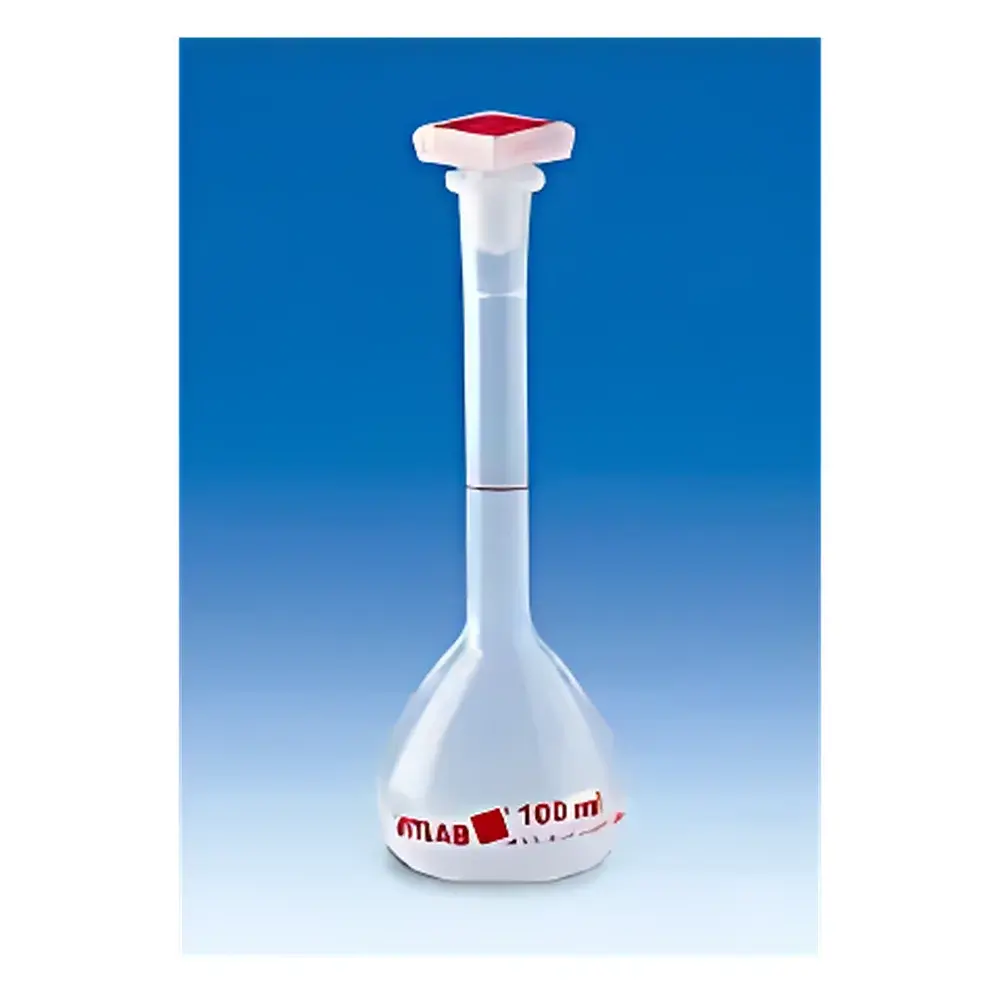
Vitlab PMP Class A Transparent Plastic Volumetric Flasks
| Brand | Vitlab |
|---|---|
| Origin | Germany |
| Capacity Range | 10–1000 mL |
| Calibration Type | “In” (TC), individually calibrated per batch |
| Compliance | DIN EN ISO 1042 Class A |
| Material | Poly(methylpentene) (PMP) |
| Max Sterilization Temp | 121 °C (autoclavable) |
| Max Cleaning Temp | ≤60 °C |
| Traceability | Batch number and manufacturing date laser-etched |
| Neck Size | NS 10/14 to NS 24/29 |
| Height (excl. stopper) | 90–310 mm |
| Tolerance | ±0.04 mL (10 mL) to ±0.40 mL (1000 mL) |
Overview
Vitlab PMP Class A Transparent Volumetric Flasks are precision-engineered liquid-volume calibration tools designed for high-accuracy preparation and dilution of standard solutions in analytical, pharmaceutical, and quality control laboratories. Constructed from poly(methylpentene) (PMP), these flasks combine exceptional optical clarity with chemical inertness and thermal stability—enabling reliable use across a wide range of solvents, including polar organics, aqueous buffers, and mild acids/bases. Unlike glass alternatives, PMP exhibits negligible extractables and zero risk of breakage during routine handling or centrifugation. Each flask is individually calibrated to “In” (to contain, TC) specification in accordance with DIN EN ISO 1042:2020, meeting the stringent tolerance requirements of Class A volumetric ware. The engraved ring graduation ensures permanent readability, while batch-specific certification supports full metrological traceability under GLP and ISO/IEC 17025 frameworks.
Key Features
- Optically transparent PMP body enables unobstructed meniscus observation and visual verification of solution homogeneity
- Individually calibrated per batch with documented uncertainty; certificate includes batch number, manufacturing date, and measured deviation against reference standards
- Autoclavable up to 121 °C for repeated sterilization without permanent dimensional drift or tolerance degradation
- Laser-etched volume markings and batch identifiers resist abrasion, solvent exposure, and standard lab cleaning protocols
- Chemical resistance validated against common laboratory reagents—including 70% ethanol, 1 M HCl, 1 M NaOH, and phosphate-buffered saline—per ASTM D543
- Thermal expansion coefficient (1.2 × 10⁻⁴ K⁻¹) optimized for stable volume retention across ambient to elevated temperature ranges (20–60 °C)
- Neck threads conform to standardized NS (Normalschliff) dimensions (NS 10/14 through NS 24/29), ensuring compatibility with Vitlab and third-party PTFE-lined caps and dispensing accessories
Sample Compatibility & Compliance
These flasks are intended for single-analyte or multi-component solution preparation where volumetric accuracy directly impacts assay validity—such as HPLC mobile phase preparation, titrant standardization, and reference material dilution. They comply fully with DIN EN ISO 1042 Class A tolerances, supporting regulatory submissions under USP , EP 2.2.17, and ICH Q2(R2). Batch-level documentation satisfies audit requirements for FDA 21 CFR Part 11-compliant environments when paired with electronic lab notebook (ELN) integration. No leachables detected per USP testing at 25 °C for 24 h in water and 50% ethanol/water mixtures. Not intended for long-term storage of strong oxidizers (e.g., concentrated HNO₃, KMnO₄) or halogenated hydrocarbons above 40 °C.
Software & Data Management
While inherently non-electronic, Vitlab PMP flasks integrate seamlessly into digital laboratory workflows via their unique batch-identifiable marking system. Each certificate of conformance is structured for import into LIMS or ELN platforms using standardized metadata fields (batch ID, calibration date, nominal volume, measured deviation, accredited lab ID). When used in conjunction with Vitlab’s SmartLog™ inventory tracking templates (available upon request), labs can maintain real-time traceability across calibration cycles, usage logs, and sterilization history—supporting internal audits and external inspections aligned with ISO/IEC 17025:2017 clause 6.4.2 (equipment management).
Applications
- Preparation of certified reference material (CRM) dilutions in environmental and clinical testing labs
- Standard solution calibration for UV-Vis spectrophotometry (e.g., Beer-Lambert law validation)
- Pharmaceutical QC release testing requiring adherence to USP Analytical Instrument Qualification guidelines
- Dilution series generation for ELISA, qPCR, and cell culture media formulation
- Educational laboratory instruction on volumetric technique, error propagation, and uncertainty budgeting
- On-site field analysis kits where shatter resistance and weight reduction are operationally critical
FAQ
Are these flasks suitable for use with hydrofluoric acid (HF)?
No. PMP exhibits limited resistance to HF and should not be used with concentrations ≥0.1% at any temperature.
Can I autoclave the flask with the stopper attached?
Only if using Vitlab’s autoclavable PTFE/silicone stoppers (Cat. No. 267xxx series); standard polypropylene caps may deform above 100 °C.
How often must recalibration be performed?
Per ISO/IEC 17025, recalibration is not required unless physical damage occurs or the flask undergoes >50 autoclave cycles; however, periodic verification against a NIST-traceable standard is recommended annually.
Is the engraved scale resistant to acetone wiping?
Yes—the laser etching penetrates the PMP surface layer and remains legible after repeated exposure to acetone, IPA, and sodium hypochlorite solutions.



