
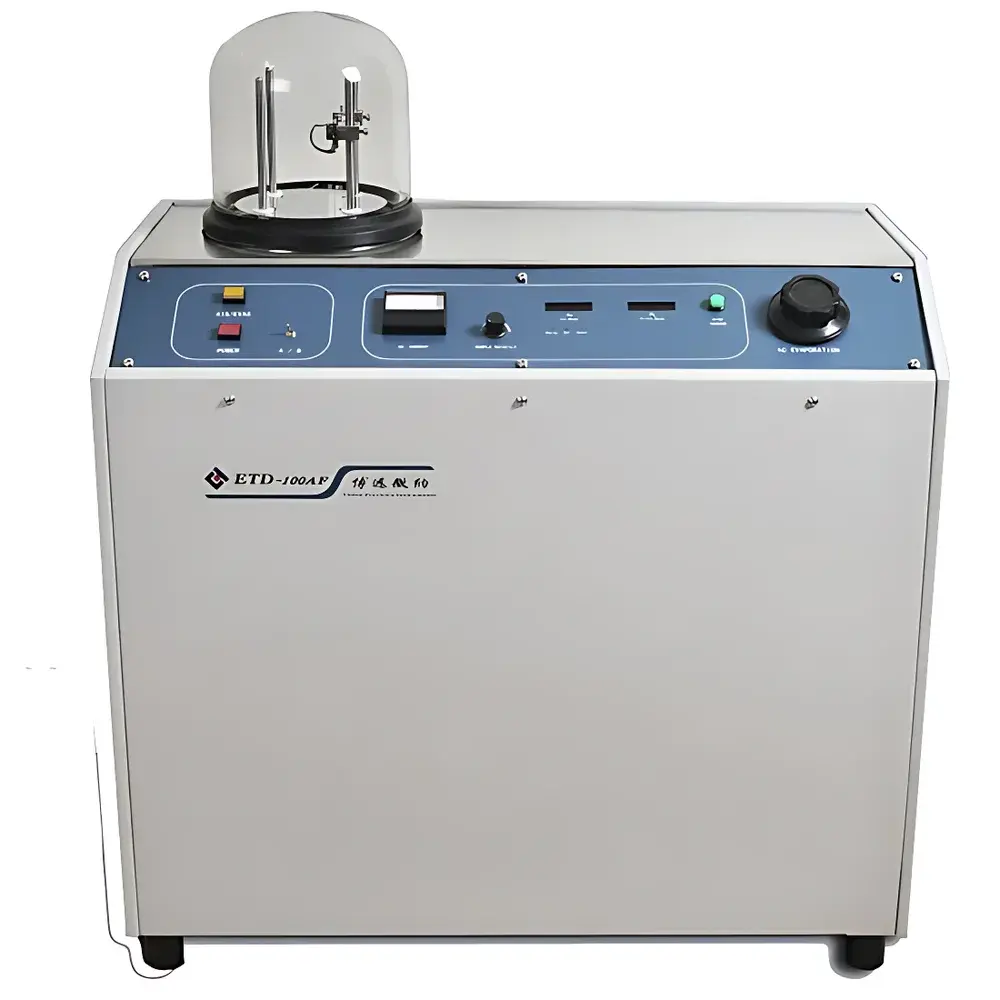
VPI ETD-100AF High-Vacuum Thermal Evaporation Coater
| Brand | VPI (BoYuan Micro-Nano) |
|---|---|
| Origin | Beijing, China |
| Model | ETD-100AF |
| Vacuum System | Feiyue Forepump + Compound Turbo-Molecular Pump (High Compression Ratio, Air-Cooled) |
| Base Pressure | ≤2×10⁻⁴ Pa |
| Chamber Dimensions | Ø230 mm × H280 mm |
| Evaporation Source | Molybdenum Boat / Tungsten Filament / Fixed Bracket |
| Max Evaporation Current | 100 A |
| Max Evaporation Voltage | 10 V |
| Max Power | 1000 W |
| Compatible Target Materials | C, Au, Cr, Pt, Ni, Al, Ti, Ag, and other standard evaporation metals |
| Sample Types | Biological specimens, polymers, ceramics, insulating substrates, beam-sensitive materials |
| Application Domain | SEM sample preparation, TEM grid coating, electrode fabrication, thin-film R&D, academic teaching labs |
Overview
The VPI ETD-100AF is a compact, high-vacuum thermal evaporation coater engineered for reproducible, contamination-controlled thin-film deposition in electron microscopy and materials science laboratories. It operates on the principle of resistive heating—where high-current DC power is applied to refractory metal sources (molybdenum boats or tungsten filaments), raising their temperature to induce controlled vaporization of solid precursor materials under ultra-low pressure conditions (≤2×10⁻⁴ Pa). This physical vapor deposition (PVD) process enables uniform, sub-nanometer-to-micrometer-thick metallic or carbonaceous coatings on substrates without chemical reaction or plasma involvement. The system’s vacuum architecture integrates a Feiyue rotary vane forepump with a high-compression-ratio, air-cooled compound turbo-molecular pump—ensuring rapid pump-down, minimal hydrocarbon backstreaming, and stable base pressure essential for high-resolution imaging and low-noise surface characterization.
Key Features
- Optimized vacuum train: Dual-stage pumping system achieves ≤2×10⁻⁴ Pa base pressure within <15 minutes; natural convection cooling eliminates need for external chillers or water lines.
- High-power evaporation control: Programmable DC power supply delivering up to 100 A at 10 V (1000 W max), enabling robust thermal evaporation of high-melting-point metals including Cr, Pt, and Ni.
- Modular source configuration: Supports interchangeable molybdenum boats, tungsten filament baskets, and fixed-substrate holders—facilitating rapid transition between carbon, gold, and alloy depositions.
- Compact chamber design: Cylindrical stainless-steel vacuum chamber (Ø230 mm × H280 mm) accommodates standard SEM stubs, TEM grids, wafers up to 4″, and custom fixtures.
- Operator safety & process stability: Integrated overcurrent/overtemperature protection, interlocked chamber lid, and real-time pressure monitoring via Pirani + cold cathode gauges.
Sample Compatibility & Compliance
The ETD-100AF is routinely deployed for preparing non-conductive, beam-sensitive, and heterogeneous samples prior to SEM, TEM, and FIB analysis. It supports direct coating of biological tissues (e.g., plant sections, insect cuticles), polymer films (PET, PDMS, PMMA), ceramic powders, and fragile nanostructures—all without thermal degradation or charging artifacts. Gold, platinum, and carbon coatings mitigate surface charging in insulating specimens while preserving morphological fidelity. Carbon-only evaporation meets ASTM E1558–22 requirements for charge dissipation in quantitative EDS analysis. The system complies with ISO 14644-1 Class 5 cleanroom handling protocols when operated in controlled environments and supports GLP documentation workflows through optional analog voltage output logging.
Software & Data Management
While the ETD-100AF operates via front-panel digital controls (no embedded PC required), it provides analog outputs (0–10 V) for external data acquisition systems. Users may log evaporation current, chamber pressure, and timer status using third-party DAQ hardware compatible with LabVIEW™ or Python-based acquisition scripts. All operational parameters—including preset current ramps, dwell times, and shutdown sequences—are manually configured and repeatable per SOP. For regulated environments, the unit supports 21 CFR Part 11–compliant audit trails when integrated with validated LIMS platforms via RS-232 or optional USB-to-serial interface.
Applications
- SEM sample preparation: Conductive metal layer deposition (Au/Pd, Pt, Cr) to eliminate charging during high-kV imaging and EBSD analysis.
- TEM support film enhancement: Thin carbon film reinforcement on holey carbon grids for cryo-EM specimen stabilization.
- Electrode fabrication: Patterned metal contacts on flexible substrates for organic electronics and sensor prototyping.
- Teaching & method development: Hands-on PVD training in undergraduate physics and materials engineering labs—demonstrating nucleation kinetics, thickness–current correlation, and shadow-mask lithography.
- Failure analysis: Rapid re-coating of delaminated or oxidized surfaces for cross-sectional SEM inspection.
FAQ
What vacuum level is required for stable thermal evaporation of gold?
Stable Au evaporation requires ≤5×10⁻⁴ Pa to minimize oxidation and scattering; the ETD-100AF consistently achieves ≤2×10⁻⁴ Pa, satisfying this threshold.
Can the system deposit alloys or multi-layer stacks?
Yes—sequential evaporation using dual-source fixtures (optional) enables bilayer structures (e.g., Cr/Au adhesion layers); alloy deposition requires pre-alloyed source material due to differential vapor pressures.
Is carbon coating suitable for EDS quantification?
Carbon-only coatings ≤10 nm thick introduce negligible X-ray absorption and are widely accepted per ISO 16700 for qualitative and semi-quantitative EDS work.
How is film thickness monitored in real time?
The ETD-100AF does not include an integrated quartz crystal microbalance (QCM); thickness estimation relies on empirical calibration curves correlating current/time to nominal thickness for each material.
Does the system meet electromagnetic compatibility (EMC) standards for lab integration?
It conforms to CISPR 11 Group 1, Class B emission limits and is certified for operation in shared instrumentation rooms without signal interference to adjacent SEMs or AFMs.
Related Products



