
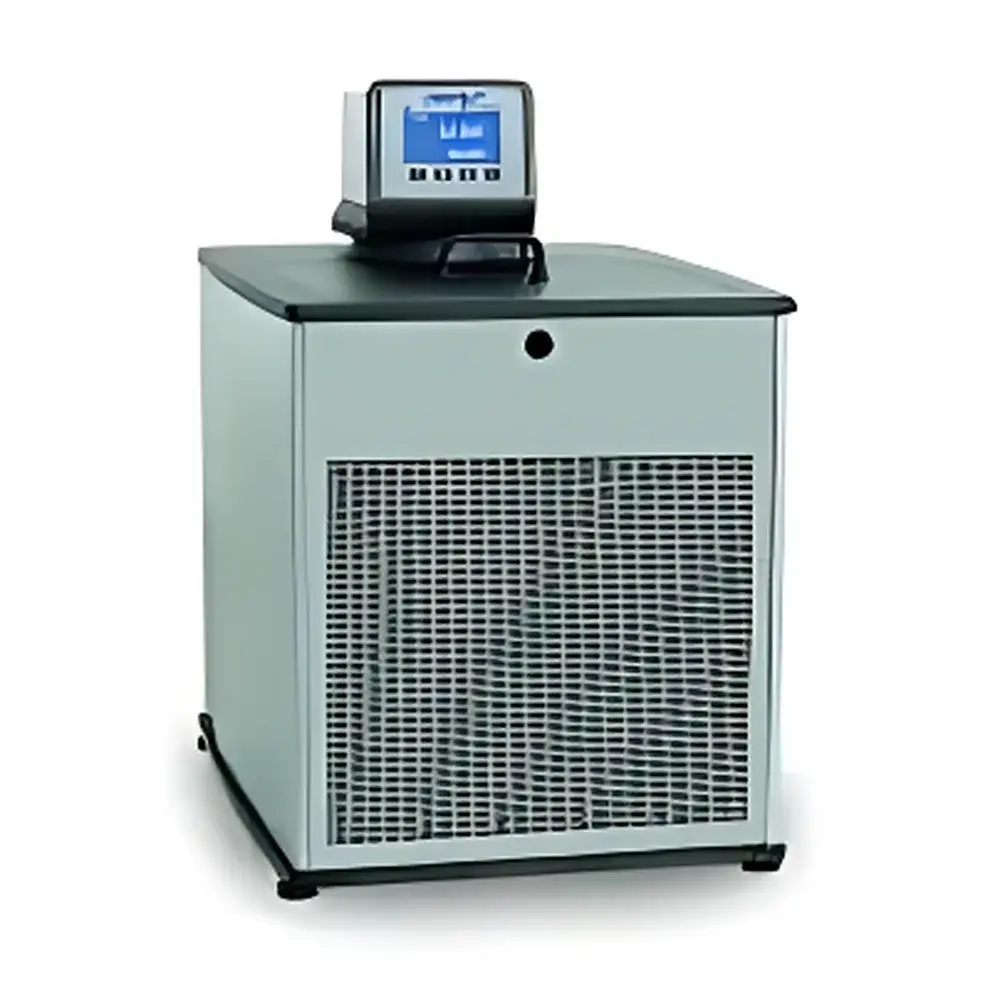
VWR 89202-984 Advanced Programmable Refrigerated Circulating Bath
| Brand | VWR |
|---|---|
| Origin | USA |
| Model | 89202-984 |
| Temperature Range | −40 °C to +200 °C |
| Reservoir Capacity | 7 L |
| Working Chamber Dimensions | 15.7 cm (L) × 14.2 cm (W) × 12.7 cm (D) |
| Max Flow Rate | 16.7 L/min (4.4 gpm) |
| Display | Full-touchscreen Advanced Programmable Controller with 10 × 100-step programmability |
| Controller Swivel | 180° independent rotation |
| Bath Top | DuraTop™ phenolic, chemically resistant and thermally stable |
| Lid System | LidDock™ integrated cover stowage |
| Included Accessories | Reservoir cover, bypass tubing, 3/8″ / 1/4″ / 3/16″ male inlet/outlet adapters, 1/4″ NPT to M16 adapters (50 Hz models) |
Overview
The VWR® 89202-984 Advanced Programmable Refrigerated Circulating Bath is an engineered thermal management system designed for high-precision temperature control in demanding laboratory applications. Utilizing a closed-loop refrigeration circuit with integrated heating elements, this unit maintains stable setpoint temperatures across a broad operational range—from −40 °C to +200 °C—enabling both cryogenic cooling and high-temperature circulation without external chiller or heater integration. Its compact 7 L reservoir supports consistent thermal transfer while minimizing footprint in space-constrained environments. The bath employs a positive-displacement centrifugal pump to deliver up to 16.7 L/min (4.4 gpm) of conditioned fluid at regulated pressure, ensuring uniform heat exchange across external jackets, reactors, or analytical instrumentation. Constructed for long-term reliability, the unit features corrosion-resistant internal wetted components and a sealed refrigerant system compliant with international environmental standards (e.g., ISO 5149, ASHRAE 34).
Key Features
- Advanced Programmable Touchscreen Controller: Full-graphical interface supporting ten independent 100-step temperature ramp/soak programs; real-time logging of setpoint, actual temperature, flow status, and error codes.
- Swivel 180™ Controller Mount: Enables ergonomic positioning of the display independent of bath orientation—critical for benchtop integration with tall apparatus or under-hood installations.
- DuraTop™ Phenolic Bath Top: Precision-molded, low-thermal-conductivity surface that remains safe to touch at elevated operating temperatures and exhibits resistance to common lab solvents (e.g., acetone, ethanol, dilute acids/bases).
- LidDock™ Integrated Cover Management: Mechanically secured lid stowage system prevents misplacement and maintains clean bench workflow during extended operation.
- Multi-Adapter Fluid Interface Kit: Includes standardized male NPT and metric (M16) adapters for 3/8″, 1/4″, and 3/16″ tubing—ensuring compatibility with OEM jackets, calorimeters, and spectrophotometer chillers.
- Self-Diagnostic Safety Architecture: Monitors refrigerant pressure, motor current draw, thermal cutoffs, and low-fluid-level conditions; triggers audible/visual alerts and automatic shutdown per IEC 61010-1 safety requirements.
Sample Compatibility & Compliance
This circulating bath is compatible with water, water-glycol mixtures (up to 60% v/v), silicone oils (within viscosity limits of ≤100 cSt at 25 °C), and other non-corrosive heat-transfer fluids meeting ASTM D1384 specifications. It is not rated for use with halogenated solvents, strong oxidizers, or flammable liquids above their flash point. The device complies with UL 61010-1 (2nd Ed.), CSA C22.2 No. 61010-1, and CE marking directives (EMC 2014/30/EU, LVD 2014/35/EU). All firmware and controller logic are validated for GLP/GMP-aligned environments, supporting audit-ready event logs and user-access controls required under FDA 21 CFR Part 11 when paired with compliant data acquisition software.
Software & Data Management
The Advanced Programmable Controller supports RS-232 and optional Ethernet (via add-on module) communication protocols for bidirectional command/response interaction. Native SCPI command sets enable seamless integration into LabVIEW, MATLAB, or custom Python-based automation frameworks. Logged temperature and program execution data export as CSV files via USB memory stick—retaining timestamps, operator ID (if enabled), and calibration metadata. Firmware updates are performed offline using signed .bin files to prevent unauthorized modification. All critical parameters—including calibration offsets, alarm thresholds, and password-protected admin settings—are stored in non-volatile memory with write-cycle redundancy.
Applications
- Temperature control of HPLC column ovens, UV-Vis spectrophotometer cells, and FTIR sample compartments.
- Cryogenic conditioning of polymer samples prior to DMA or DSC analysis (per ASTM D7028 and ISO 6721-1).
- Stabilization of laser cavities and photodetector housings in optical metrology setups.
- Thermal cycling validation of medical device packaging per ISO 11607-2 accelerated aging protocols.
- Process simulation in QC labs requiring precise thermal soak profiles for adhesives, coatings, or composite resins.
- Supporting ASTM E2877-compliant viscosity measurements using calibrated capillary viscometers with jacketed thermostats.
FAQ
What is the minimum recommended fluid volume to ensure stable temperature control?
The reservoir must be filled to at least 80% capacity (≥5.6 L) to maintain pump priming, thermal mass stability, and accurate sensor response. Operating below this level may trigger low-fluid alarms and reduce temperature uniformity.
Can this unit operate continuously at −40 °C with a 200 °C setpoint transition?
Yes—provided ambient conditions remain within 15–32 °C and relative humidity does not exceed 80% non-condensing. Rapid transitions require ≥15-minute stabilization intervals between extreme setpoints to prevent thermal shock to internal components.
Is remote monitoring possible without third-party software?
Basic status polling (temperature, setpoint, error flags) is supported via ASCII SCPI over RS-232 using standard terminal emulation. Full program editing and historical data retrieval require the optional VWR ThermalLink™ software suite.
Does the unit include factory calibration documentation?
Each unit ships with a NIST-traceable Certificate of Conformance, including as-shipped verification at −40 °C, 25 °C, and 150 °C using dual-sensor validation per ISO/IEC 17025 guidelines.
What maintenance intervals are specified for long-term reliability?
Refrigerant charge integrity and pump seal inspection are recommended annually; filter replacement every 6 months under continuous operation; full system performance verification every 24 months by authorized service centers.
Related Products



