
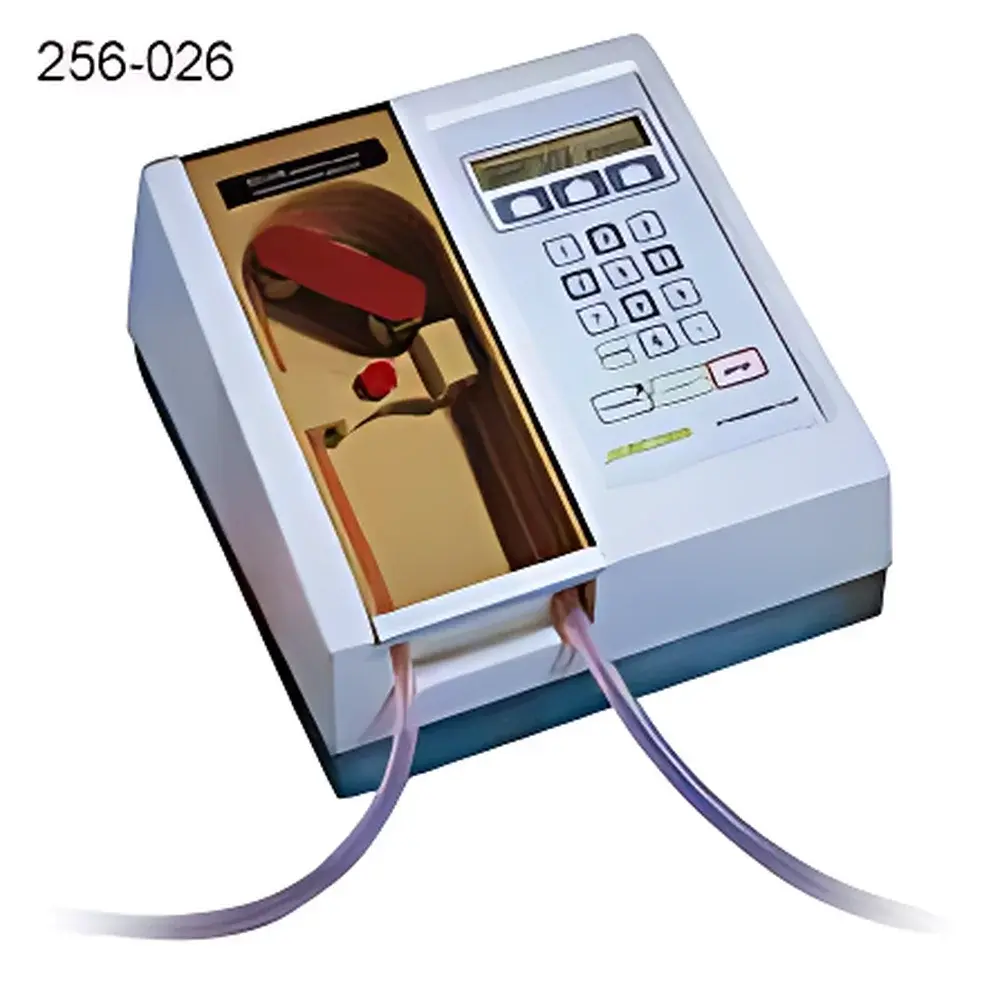
VWR Jencons Automated Peristaltic Liquid Dispenser with XY Robotic Arm
| Brand | VWR |
|---|---|
| Origin | United Kingdom |
| Model | 256-026 |
| Flow Rate Range | 0.5 mL to 9999.9 mL per dispense |
| Dispensing Speed | 2.1–22.0 mL/s (adjustable) |
| Accuracy | ±1.5% (5 mL), ±1.0% (10 mL), ±0.7% (25 mL) |
| Repeatability | ±1.75% (5 mL), ±1.0% (10 mL), ±0.5% (25 mL) |
| Tubing ID Options | 3 mm, 8 mm |
| Dimensions (L×W×H) | 290 × 250 × 150 mm |
| Weight | 7 kg |
| Control Interface | LCD display with touch-sensitive buttons |
| Operating Modes | Manual, foot-pedal, time-interval auto-dispense, ramped (slow-fast-slow) sequence |
| Memory | Calibration and volume presets retained after power-off |
| Compatible Tubing | GP silicone tubing (Cat. No. 256-027: 3×7 mm |
| 256-028 | 5×9 mm |
| 256-029 | 8×12 mm) |
Overview
The VWR Jencons Automated Peristaltic Liquid Dispenser (Model 256-026) is a precision-engineered laboratory dispensing system designed for high-accuracy, repeatable liquid handling across diverse sample types and container formats. Built upon proven peristaltic pumping technology—where rollers compress flexible tubing to generate positive displacement flow—the instrument delivers contamination-free, pulseless fluid transfer without contact between the pump mechanism and the liquid. Its modular architecture integrates a microprocessor-controlled peristaltic pump head with an optional XY robotic stage, enabling both standalone manual dispensing and fully automated, coordinate-driven multi-well or multi-vial filling. This dual-mode capability supports applications ranging from routine reagent aliquoting in QC labs to method-critical volume transfers in GLP-compliant assay development.
Key Features
- Microprocessor-based control system with non-contact capacitive touch interface and backlit LCD display for intuitive parameter entry and real-time status feedback.
- Programmable dispensing profiles: single-shot, time-interval repeats, and three-phase ramped delivery (slow → fast → slow) to minimize splashing, foaming, and meniscus disturbance—critical for viscous, volatile, or surface-tension-sensitive liquids.
- Volume memory function retains up to 10 user-defined calibration curves and preset volumes, ensuring consistent performance across shifts and operators without recalibration.
- Adjustable dispensing speed (2.1–22.0 mL/s) with dynamic flow regulation, optimized for varying fluid rheologies—including aqueous buffers, glycerol solutions, cell suspensions, and low-conductivity solvents.
- Modular design supports operation as a benchtop peristaltic pump only or integrated with the optional XY robotic arm for precise spatial positioning over 96-/384-well plates, vials, tubes, or custom labware.
- Compliance-ready firmware architecture supports audit trail generation (when connected to external logging systems) and facilitates alignment with ISO/IEC 17025 documentation requirements for volumetric accuracy verification.
Sample Compatibility & Compliance
The system accommodates a wide range of liquid classes—including aqueous, organic, mildly corrosive, and shear-sensitive biological samples—through chemically resistant silicone tubing (GP grade). Three standard tubing configurations (3×7 mm, 5×9 mm, and 8×12 mm ID/OD) allow optimization of flow rate, pressure tolerance, and minimum dispense volume. All tubing meets USP Class VI biocompatibility standards and is certified free of extractables per ASTM D4169. The instrument itself carries CE marking under the EU Machinery Directive 2006/42/EC and EMC Directive 2014/30/EU. While not intrinsically rated for hazardous environments, it complies with IEC 61010-1 for laboratory electrical safety. Routine verification against ISO 8655-3 (volumetric dispensers) is supported via built-in calibration mode and traceable gravimetric validation protocols.
Software & Data Management
No proprietary PC software is required for basic operation; all functions are accessible via the onboard interface. For integration into networked lab environments, the dispenser provides RS-232 serial output (DB9 connector) compatible with LabVIEW, Python pySerial, or custom LIMS interfaces. Logged events—including dispense volume, timestamp, tubing ID, and operator ID (via optional RFID badge reader)—can be exported as CSV for traceability. When deployed in regulated settings (e.g., pharmaceutical QC), the system supports 21 CFR Part 11-aligned workflows when paired with validated third-party electronic lab notebooks (ELNs) that enforce user authentication, electronic signatures, and immutable audit trails.
Applications
- High-throughput reagent preparation for ELISA, PCR setup, and cell culture media formulation.
- Calibration standard dilution series generation with sub-milliliter accuracy in analytical chemistry labs.
- Automated filling of HPLC vials, GC autosampler trays, and dissolution test vessels under GMP conditions.
- Consistent dosing of enzymes, antibodies, or viral vectors in bioprocessing R&D where batch-to-batch reproducibility is critical.
- Educational use in undergraduate laboratories for teaching volumetric metrology, fluid dynamics, and automation principles.
FAQ
What tubing sizes are supported, and how do they affect performance?
Three GP silicone tubing options are supplied: 3×7 mm, 5×9 mm, and 8×12 mm (ID×OD). Smaller IDs enable higher pressure generation and finer resolution at low volumes (e.g., 0.5 mL); larger IDs support faster flow rates up to 22 mL/s but require ≥5 mL for optimal accuracy.
Can the dispenser operate without the XY robotic arm?
Yes—the peristaltic pump module functions independently for manual, foot-pedal, or timed dispensing directly into beakers, flasks, or tubes on the benchtop.
Is calibration traceable to national standards?
Users perform gravimetric calibration using NIST-traceable analytical balances. The instrument stores slope/offset corrections per tubing set, enabling documented compliance with ISO/IEC 17025 clause 6.5.2 on measurement uncertainty estimation.
Does it support multi-language UI?
Yes—interface language can be selected among English, German, French, Spanish, and Chinese during initial setup, with firmware updates delivered via VWR technical support portal.
What maintenance is required for long-term accuracy?
Routine inspection of tubing wear (every 200–500 hours depending on flow rate and fluid abrasiveness) and periodic roller alignment verification per manufacturer’s service guide. No lubrication or internal calibration adjustments are user-serviceable.



