
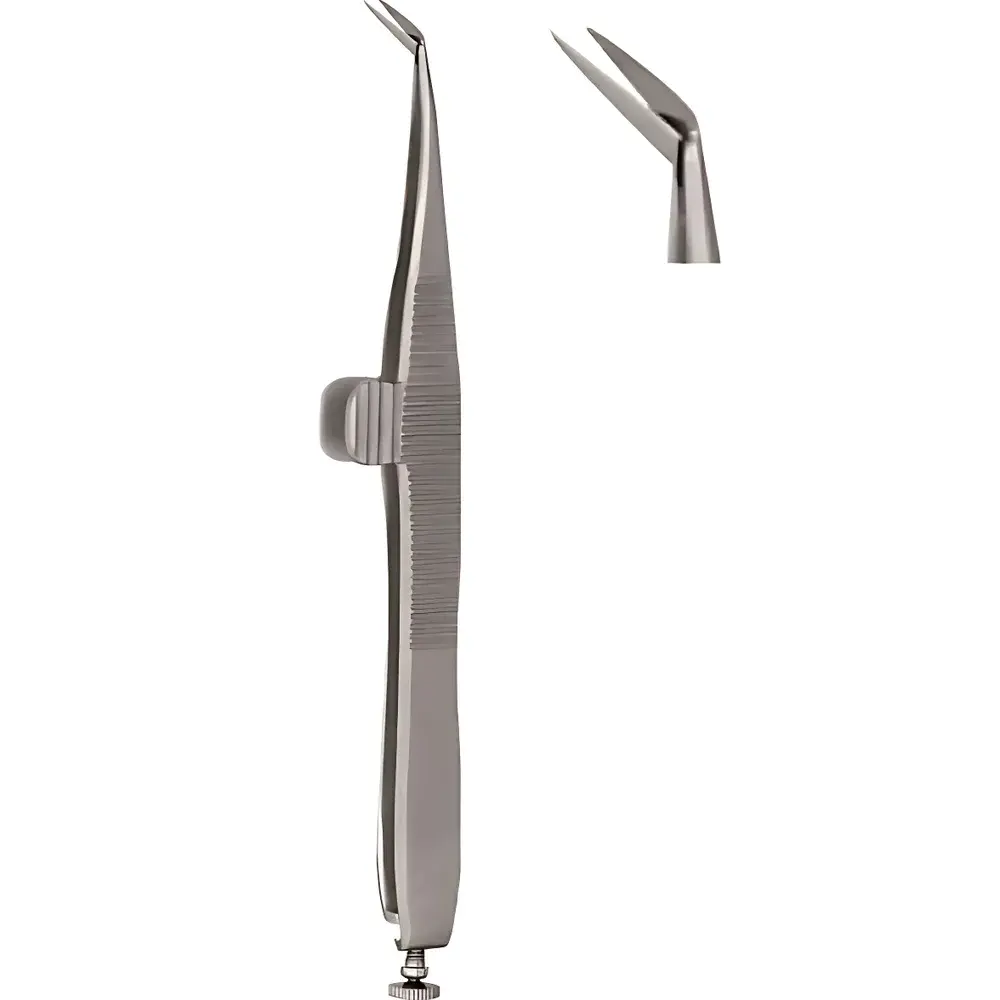
WECKER Micro Spring Scissors
| Brand | RWD |
|---|---|
| Origin | Shenzhen, China |
| Manufacturer Type | Direct Manufacturer |
| Origin Classification | Domestic (China) |
| Model Numbers | S11009-11 (Angled Curved / Fine Point), S11010-11 (Angled Curved / Blunt Tip) |
| Price | USD 63 (FOB Shenzhen) |
Overview
WECKER Micro Spring Scissors are precision hand-held surgical instruments engineered for high-accuracy microdissection tasks in life science research and preclinical laboratory settings. Designed with a patented spring-action mechanism, these scissors reduce operator fatigue during prolonged use while maintaining consistent tactile feedback and blade alignment. The instrument operates on mechanical leverage principles—transferring finger motion into controlled, low-force cutting action at the tip—making them ideal for delicate tissue manipulation where minimal lateral pressure and precise tip control are critical. Manufactured by RWD (Shenzhen), a certified ISO 13485 medical device component supplier, these scissors comply with general biocompatibility requirements per ISO 10993-5 and are intended for single-user, reusable applications under validated sterilization protocols (autoclave up to 134°C, 2 bar).
Key Features
- Spring-assisted handle design minimizes repetitive strain and enhances ergonomics during extended microsurgical procedures.
- High-carbon stainless steel blades (AISI 420 equivalent) with mirror-polished finish ensure corrosion resistance, sharp edge retention, and compatibility with standard autoclaving cycles.
- Two specialized tip configurations: S11009-11 features an angled curved shank with ultra-fine pointed tips for precise dissection of neural filaments or vasculature; S11010-11 combines the same angled curvature with one blunt and one fine tip—optimized for lifting, separating, or blunt dissection without puncturing underlying structures.
- 11 cm overall length provides optimal balance between maneuverability in confined spaces (e.g., stereotaxic rigs or petri dish workstations) and control leverage.
- Non-slip textured polymer grips ensure secure handling under wet or gloved conditions, meeting IEC 61000-4-2 ESD-safe material guidelines for cleanroom-adjacent environments.
Sample Compatibility & Compliance
These microscissors are routinely employed in rodent neuroanatomy, embryonic tissue explant culture, retinal layer isolation, and vascular ring preparation. They exhibit no measurable leaching of heavy metals or nickel under simulated physiological saline immersion (ASTM F2129 accelerated corrosion testing). While not classified as Class I or II medical devices under FDA 21 CFR Part 807, they conform to general lab instrument safety standards referenced in ISO 15223-1 for labeling and EN 61331-1 for mechanical hazard mitigation. Sterilization validation reports (including Bowie-Dick and Helix tests) are available upon request for GMP-aligned labs conducting GLP-compliant pharmacology studies.
Software & Data Management
As a purely mechanical hand instrument, the WECKER Micro Spring Scissors require no embedded firmware, drivers, or software integration. However, their consistent dimensional repeatability (blade gap tolerance ±0.02 mm, verified via optical comparator metrology) supports traceable documentation within electronic lab notebooks (ELN) such as LabArchives or Benchling. Users may log batch-specific calibration verification records—including sharpening history and autoclave cycle logs—to satisfy internal QA audit trails or ISO/IEC 17025 clause 7.7 requirements for equipment fitness-for-purpose assessment.
Applications
- Microdissection of hippocampal slices and cortical explants in electrophysiology prep.
- Transection of sciatic nerve branches during peripheral nerve regeneration assays.
- Trimming excess connective tissue from freshly isolated islets prior to glucose-stimulated insulin secretion (GSIS) assays.
- Excision of tumor spheroids from Matrigel matrices in 3D culture models.
- Dissection of zebrafish larvae yolk sacs for live imaging setup without compromising chorion integrity.
FAQ
Are these scissors compatible with standard autoclave cycles?
Yes—validated for 100+ cycles at 134°C, 2 bar saturated steam. Blade hardness remains stable (52–54 HRC post-sterilization), and polymer grips retain structural integrity.
What is the recommended maintenance protocol between uses?
Rinse immediately in deionized water, ultrasonicate for 5 minutes in enzymatic detergent (e.g., Enzol), air-dry vertically, and inspect tip alignment under 10× magnification before reuse.
Do you provide sharpening services or replacement blades?
RWD offers factory-certified re-sharpening for S11009-11/S11010-11 models (lead time: 10 business days); blade replacement is not supported due to integrated spring-hinge architecture.
Is there a CE mark or FDA listing for these instruments?
These are general-purpose lab tools—not medical devices—and therefore do not carry CE marking or FDA 510(k) clearance. Documentation confirms conformity with ISO 13485 manufacturing controls and RoHS 2011/65/EU material restrictions.
Can these be used in sterile laminar flow hoods without compromising performance?
Yes—the non-outgassing polymer handles and passivated stainless steel surfaces meet ISO 14644-1 Class 5 particulate limits when wiped with 70% IPA pre-use.





