
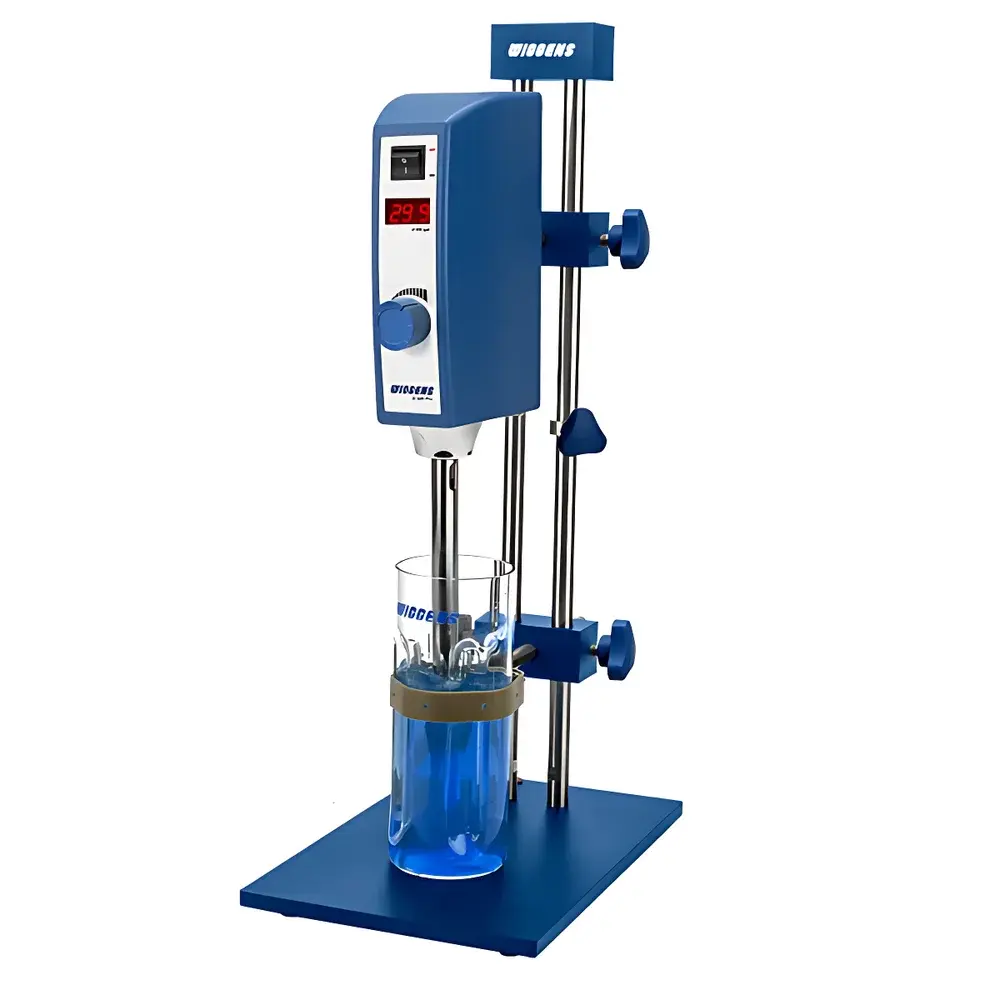
WIGGENS D-500Pro Digital High-Shear Homogenizer
| Brand | WIGGENS |
|---|---|
| Origin | Germany |
| Model | D-500 Pro |
| Temperature Range | 0–40 °C |
| Sample Volume | 10–40,000 mL |
| Speed Range | 500–30,000 rpm |
| Rotor Diameter | Ø4–Ø23 mm |
| Max. Viscosity | 10,000 cP |
| Tip Speed | ≤34.9 m/s |
| Power | 500 W |
| Noise Level | 66 dB (2,500 rpm), 72 dB (30,000 rpm) |
| IP Rating | IP20 |
| Dimensions (W×D×H) | 76×157×236 mm |
| Weight | 1.8 kg |
| Motor Type | Brushless DC |
| Voltage | 220 V / 50 Hz |
| Relative Humidity | ≤80 % RH |
Overview
The WIGGENS D-500Pro Digital High-Shear Homogenizer is a precision-engineered laboratory instrument designed for reproducible cell disruption, emulsification, dispersion, and homogenization of biological and chemical samples. Based on high-speed rotor-stator shear principle, it generates intense hydrodynamic forces—including cavitation, turbulent flow, and mechanical shearing—at the interface between the rotating rotor and fixed stator. This enables efficient lysis of mammalian, bacterial, and yeast cells; uniform emulsification of oil-in-water or water-in-oil systems; and nanoscale particle size reduction in suspensions and colloids. Its brushless DC motor delivers stable torque across the full speed range (500–30,000 rpm), ensuring consistent energy input regardless of sample viscosity or volume. The device is engineered for benchtop flexibility, with compact dimensions (76 × 157 × 236 mm) and low mass (1.8 kg), making it suitable for shared core facilities, QC labs, and mobile research setups.
Key Features
- Digital LED speed display and precise rotary encoder control for real-time monitoring and repeatable setpoint adjustment
- Interchangeable rotor-stator heads (Ø4–Ø23 mm) fabricated from ASTM-certified 316L stainless steel—fully autoclavable and resistant to corrosion by organic solvents, acids, and alkaline buffers
- Triple-safety architecture: electronic overload protection, soft-start ramping (0–3 s acceleration), and integrated safety switch that halts operation upon head disengagement
- Optimized thermal management system maintains ambient operating temperature (0–40 °C) without external cooling, validated per IEC 61000-6-2 for electromagnetic compatibility
- IP20-rated enclosure ensures operator safety under standard laboratory environmental conditions (≤80 % RH)
- Low-noise operation (66 dB at 2,500 rpm; 72 dB at max speed), compliant with ISO 7779 acoustic emission standards for lab equipment
Sample Compatibility & Compliance
The D-500Pro accommodates sample volumes from 10 mL to 40 L using scalable rotor-stator geometries and optional GS-series dispersing vessels (borosilicate glass or 316L stainless steel; 35 mL–2 L). Unlike conventional cylindrical cups that promote vortex formation and dead zones, GS vessels induce multidirectional fluid recirculation—enhancing homogenization efficiency by >40 % (per comparative trials with viscous CMC solutions). The system supports GMP-aligned workflows: all wetted parts meet USP Class VI biocompatibility requirements; rotor sterilization is validated per ISO 17665-1 for steam cycles (121 °C, 15 min). It complies with key regulatory frameworks including ISO 13485 (medical device manufacturing support), ASTM D3418 (viscoelastic characterization of polymer dispersions), and GLP Annex 11 principles for instrument qualification documentation.
Software & Data Management
While the D-500Pro operates as a stand-alone analog-digital hybrid unit (no embedded firmware or network interface), its speed setpoints and runtime are fully traceable via calibrated encoder feedback. For audit-ready environments, users may integrate the device into validated data acquisition systems using 0–10 V analog output (optional module) or TTL pulse signals synchronized to rotation count. All operational parameters—including speed, duration, and rotor ID—are manually logged in accordance with FDA 21 CFR Part 11 Annex A expectations for non-computerized systems. Calibration certificates (traceable to PTB Germany) and IQ/OQ protocols are available upon request to support laboratory accreditation (e.g., ISO/IEC 17025).
Applications
- Cell lysis for downstream nucleic acid (DNA/RNA) and protein extraction from tissues, bacteria, and cultured cells
- Preparation of homogeneous pharmaceutical suspensions (e.g., nanoparticle drug carriers, liposomal formulations)
- Routine QC homogenization of food emulsions (mayonnaise, dairy blends), cosmetics (creams, lotions), and polymer nanocomposites
- Tumor tissue homogenization for oncology biomarker profiling and single-cell suspension generation
- Rapid dissolution testing of coated tablets and controlled-release dosage forms per USP
- Dispersion of carbon nanotubes, graphene oxide, and metal oxide nanoparticles in aqueous or organic media
FAQ
Is the D-500Pro compatible with sterile processing environments?
Yes—316L stainless steel rotor-stator assemblies withstand repeated autoclaving (121 °C, 15 min, saturated steam); GS glass vessels are Class A borosilicate and chemically inert per DIN ISO 3585.
Can it process high-viscosity samples such as hydrogels or polymer melts?
It handles viscosities up to 10,000 cP at reduced speeds (≤5,000 rpm); for >5,000 cP, use Ø18–Ø23 mm rotors and GS vessels with baffles to prevent vortex-induced stratification.
What maintenance is required for long-term reliability?
Annual inspection of rotor concentricity (runout ≤0.02 mm), bearing lubrication check, and encoder calibration verification using certified tachometer standards.
Does WIGGENS provide validation support for regulated industries?
Yes—comprehensive IQ/OQ templates, calibration traceability documentation (PTB/NIST), and risk-based URS alignment services are available through authorized distributors.
How does the D-500Pro differ from the D-130 handheld model?
The D-500Pro is a benchtop unit optimized for larger volumes (10–40,000 mL), higher power (500 W vs. 130 W), and continuous operation; the D-130 prioritizes portability and rapid small-volume processing (0.1–250 mL) with interchangeable handheld probes.





