
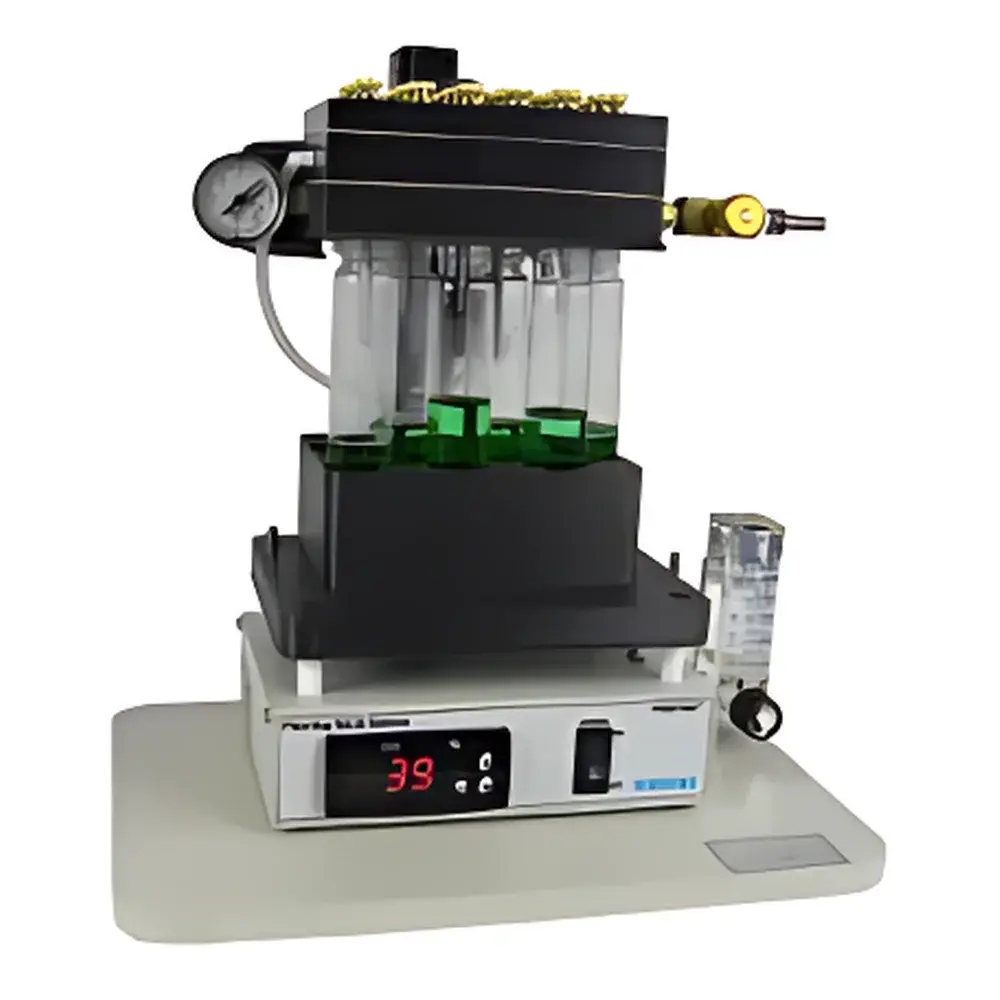
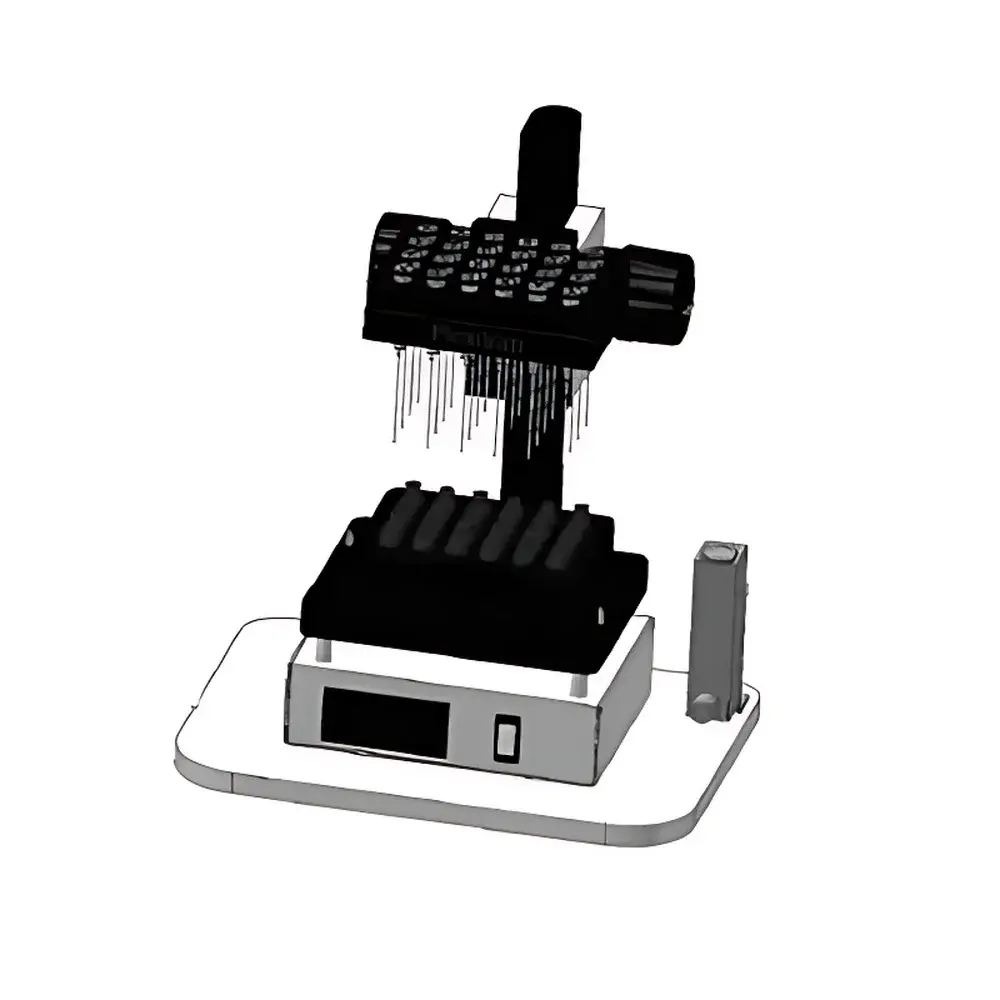
WIGGENS FlexiVap Series Nitrogen Evaporator
| Brand | WIGGENS |
|---|---|
| Origin | Germany |
| Model | FlexiVap |
| Heating Method | Dry-block heating |
| Temperature Range | Up to 100 °C |
| Temperature Stability | ±0.5 °C |
| Sample Positions | 24 or 48 |
| Heating Power | 150 W |
Overview
The WIGGENS FlexiVap Series Nitrogen Evaporator is a modular, dry-block heated concentration system engineered for precise, reproducible solvent evaporation and sample concentration in analytical laboratories. It operates on the principle of gentle inert-gas (typically nitrogen or compressed air) purging across the surface of liquid samples, accelerating solvent removal while minimizing thermal degradation of thermolabile analytes. Unlike traditional water-bath evaporators, the FlexiVap employs a solid aluminum heating block with integrated digital PID temperature control—ensuring uniform thermal distribution, rapid heat-up times, and high positional stability (±0.5 °C). Designed for compatibility with EPA-compliant workflows and routine QC/QA applications, it supports both high-throughput screening (e.g., environmental residue analysis, forensic toxicology) and low-volume method development (e.g., metabolomics, pharmaceutical impurity profiling). Its modular architecture allows seamless integration into GLP- and GMP-aligned environments where traceability, instrument qualification, and process consistency are critical.
Key Features
- Modular aluminum heating block with digital PID temperature control, calibrated to 100 °C maximum and stable within ±0.5 °C across all positions
- Independent gas flow control per channel via precision needle valves—enabling selective activation/deactivation of individual ports to conserve nitrogen and prevent particulate ingress during idle operation
- Uniform gas distribution architecture: constant mass flow per port regardless of the number of active channels, ensuring synchronized evaporation kinetics across heterogeneous sample sets
- Two interchangeable platform configurations: 24-position (optimized for larger vessels: 40 mL EPA vials, 28–50 mm centrifuge tubes) and 48-position (designed for micro-scale formats: 2–4 mL vials, 12–16 mm tubes)
- Interchangeable, autoclavable aluminum modules—including dedicated inserts for 12 mm, 15–16 mm, and 28 mm vials; 15 mm and 50 mm centrifuge tubes—each labeled with unique WIGGENS part numbers (e.g., YH-2412, YH-4815, YH-2429-50) for full traceability
- Dry-block design eliminates water contamination risk, simplifies cleaning, and avoids condensation-related cross-contamination—critical for volatile organic compound (VOC) analysis and isotopic labeling studies
Sample Compatibility & Compliance
The FlexiVap accommodates standard laboratory consumables without adapter modification, including EPA Method 500/600-series vials (20 mL and 40 mL), 2–4 mL autosampler vials, 12–16 mm culture tubes, and conical-bottom centrifuge tubes (15 mm and 50 mm diameters). Its mechanical design conforms to IEC 61010-1:2010 safety standards for laboratory electrical equipment. The digital controller supports audit-ready operation through non-volatile memory storage of setpoints and runtime logs—facilitating compliance with FDA 21 CFR Part 11 when paired with validated LIMS or ELN systems. All aluminum modules are compatible with ISO 17025-accredited calibration protocols, and the heating block’s traceable calibration certificate (optional upon request) meets ASTM E2251-22 requirements for temperature uniformity verification in dry-block systems.
Software & Data Management
While the FlexiVap operates as a standalone instrument with front-panel LED interface (4-digit display, self-tuning PID algorithm), its hardware architecture supports external integration via RS-232 or optional USB-to-serial interface (accessory YH-COM1). When connected to laboratory informatics platforms, it enables automated parameter logging—including target temperature, actual block temperature, elapsed time, and power consumption—for inclusion in electronic batch records (EBRs). The controller retains up to 10 user-defined methods with password-protected access, satisfying internal SOP requirements for method version control. All firmware updates are delivered via signed binary packages, ensuring integrity verification prior to installation—a prerequisite for regulated environments governed by Annex 11 and ALCOA+ data integrity principles.
Applications
- Environmental testing: Concentration of aqueous extracts prior to GC-MS analysis per EPA Methods 525.3, 8270, and 8082
- Clinical toxicology: Cleanup and concentration of urine and blood extracts for LC-MS/MS quantification of drugs of abuse
- Food safety: Residue analysis of pesticides and veterinary drugs in milk, honey, and produce matrices
- Geochemical research: Pre-concentration of trace metals from filtered seawater or porewater samples prior to ICP-MS measurement
- Pharmaceutical development: Parallel evaporation of reaction mixtures during synthetic route scouting and impurity isolation
- Forensic chemistry: Solvent exchange and final volume adjustment of seized drug extracts prior to confirmatory analysis
FAQ
Is the FlexiVap compatible with compressed air instead of nitrogen?
Yes—the gas inlet accepts any clean, oil-free, dry inert or non-reactive gas at pressures up to 50 psi. Air may be used for non-sensitive applications, though nitrogen is recommended for oxidation-prone analytes.
Can I use the same heating block for both 24- and 48-position configurations?
No—each configuration requires its dedicated heating block (YH-1/YH-2 for non-heated; YH-1-24/YH-2-24 for heated versions). Modules are mechanically keyed to prevent misalignment.
What is the recommended maintenance interval for the needle valves?
Under normal use (≤8 h/day), visual inspection and light cleaning with isopropanol every 3 months is sufficient. Full valve recalibration is advised annually or after 500 operational cycles.
Does the FlexiVap support validation documentation packages?
Yes—WIGGENS provides IQ/OQ templates compliant with ISO/IEC 17025 and ASTM E2500-22, including temperature mapping reports, gas flow linearity verification, and repeatability test protocols.
How does the FlexiVap ensure sample integrity during extended evaporation runs?
By maintaining consistent gas velocity (1–100 mL/min per port, adjustable), eliminating hot-spot formation via uniform block heating, and preventing aerosol carryover through optimized needle geometry and height-adjustable positioning—validated per USP extractables and leachables guidelines.



