
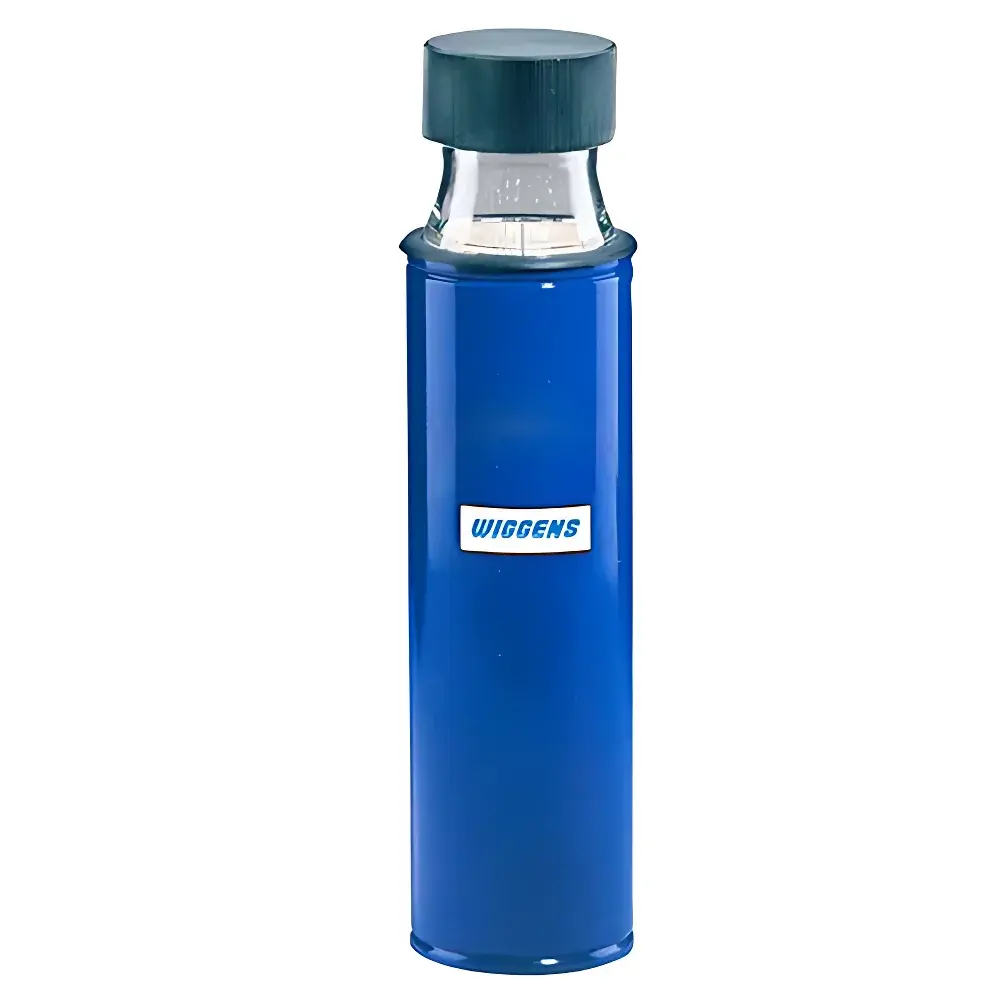
WIGGENS GEW001C/A Series Threaded-Neck Dewar Flasks
| Brand | WIGGENS |
|---|---|
| Origin | Germany |
| Manufacturer Type | Authorized Distributor |
| Import Status | Imported |
| Model Range | GEW00IC/GEW00IA, GEW0IC/GEW0IA, GEW1IC/GEW1IA, GEW2IC/GEW2IA, GEW00IIC/GEW00IIA, GEW0IIC/GEW0IIA, GEW1IIC/GEW1IIA, GEW3IIC/GEW3IIA, GEW4IIC/GEW4IIA, GEW6IIC/GEW6IIA, GEW7IIC/GEW7IIA |
| Capacity | 100–1200 mL |
| Material | Type 3.3 borosilicate glass inner vessel |
| Outer Shell | C-series — powder-coated steel (blue) |
| Neck Thread | GL32 or GL45 standard |
| Max Operating Pressure | ≤ 0.1 bar (for volatile cryogens) |
| Optional Configuration | Custom viewport-equipped variants available |
| Compliance | Designed for laboratory use in accordance with DIN ISO 4796-1 (laboratory glassware — specification for conical flasks), EN 13487 (cryogenic vessels — safety requirements), and general GLP-aligned handling protocols |
Overview
The WIGGENS GEW001C/A Series Threaded-Neck Dewar Flasks are precision-engineered cryogenic storage vessels designed for reliable, low-evaporation containment of liquid nitrogen, solid carbon dioxide (dry ice), and other low-temperature media in life science laboratories. Constructed around a high-purity Type 3.3 borosilicate glass inner vessel—resistant to thermal shock, chemical corrosion, and mechanical stress—the series employs a dual-design architecture: the C-series features a robust, blue epoxy-powder-coated steel outer shell for enhanced mechanical protection and thermal stability; the A-series utilizes an all-glass construction with reinforced neck sealing geometry, optimized for applications requiring optical clarity and minimal material interaction. The standardized GL32 or GL45 threaded neck interface ensures compatibility with a wide range of commercially available cryogenic stoppers, pressure-relief caps, sample holders, and sensor ports. These flasks operate under passive vacuum-free insulation principles—relying on low-conductivity gas fill (typically nitrogen or argon) between inner and outer walls—and are rated for continuous service at temperatures down to –196 °C (liquid nitrogen boiling point) with maximum allowable internal pressure limited to 0.1 bar to prevent rupture during phase change of volatile coolants.
Key Features
- High-integrity Type 3.3 borosilicate glass inner vessel certified to DIN ISO 3585 standards for thermal shock resistance (ΔT ≥ 150 °C) and hydrolytic class HGB 1.
- Dual-platform design: C-series with impact-resistant powder-coated steel jacket; A-series with seamless all-glass architecture and precision-ground neck threads for superior vacuum integrity and inertness.
- Standardized GL32 or GL45 metric thread interface—enabling interchangeability with ISO-compliant cryogenic closures, venting assemblies, and thermocouple feedthroughs.
- Optimized geometry across 11 capacity variants (100 mL to 1200 mL), each dimensionally calibrated to balance volumetric efficiency, ergonomic handling, and stable benchtop placement.
- Optional custom viewport integration—using fused quartz or UV-transmitting borosilicate windows—for real-time visual monitoring of liquid level or phase behavior without opening the system.
- Pressure-limited operational envelope (≤ 0.1 bar gauge) aligned with EN 13487 Annex B guidance for unregulated cryogenic containers used in non-industrial laboratory settings.
Sample Compatibility & Compliance
These Dewar flasks are validated for long-term storage of biological samples immersed in liquid nitrogen vapor phase (–150 °C to –190 °C), direct submersion in LN₂, or dry ice–acetone slurry baths. They support cryopreservation workflows compliant with ISO 20387:2018 (biobanking — general requirements) and support traceability under GLP environments when integrated with documented handling SOPs. While not classified as pressurized equipment per PED 2014/68/EU, their design adheres to EN 13487 safety thresholds for non-rebreather cryogenic vessels. No regulatory certification (e.g., CE marking for pressure equipment) applies due to intentional low-pressure operation; however, all units undergo factory leak testing and dimensional verification per DIN EN ISO 10523 procedures.
Software & Data Management
As passive storage hardware, the GEW001C/A series does not incorporate embedded electronics or firmware. However, it is fully compatible with third-party laboratory infrastructure: temperature loggers (e.g., Vaisala, Omega) may be mounted via GL-threaded adapters; RFID-tagged sample racks can be inserted using standardized neck diameters; and digital inventory systems (e.g., LabVantage, Quartzy) recognize model-specific part numbers (e.g., 1091, 1081, 1098) for automated asset tracking. For audit readiness, batch-specific CoA documentation—including glass composition certificates and dimensional inspection reports—is supplied upon request in English, supporting FDA 21 CFR Part 11–aligned record retention where electronic annotations are applied externally.
Applications
- Cryogenic transport and short-term holding of cell suspensions, sperm/embryo straws, and tissue fragments prior to controlled-rate freezing.
- Vapor-phase LN₂ storage of sensitive reagents (e.g., restriction enzymes, oligonucleotides) requiring consistent sub-zero stabilization without direct immersion artifacts.
- Calibration reference vessels for cryothermometers and infrared thermal imagers operating in the –200 °C to 0 °C range.
- Reaction quenching platforms in synthetic chemistry labs using dry ice–solvent baths with reproducible thermal gradients.
- Teaching laboratories demonstrating phase-change thermodynamics, heat transfer coefficients, and material behavior at cryogenic temperatures.
FAQ
Can these Dewars be used for long-term liquid nitrogen storage?
Yes—when fitted with appropriate vented or pressure-relief closures and maintained upright on stable surfaces, they support up to 72 hours of static LN₂ retention (varies by model and ambient conditions). For extended storage (>1 week), active monitoring and periodic replenishment are recommended.
Is the GL45 version compatible with standard lab bottle stoppers?
Yes—GL45 threading conforms to ISO 4796-1 and accepts all commercially available GL45-compatible silicone, PTFE, or phenolic stoppers rated for cryogenic service.
Do you offer validation documentation for GMP environments?
While the flasks themselves are not GMP-certified devices, full traceable CoA packages—including raw material certifications, dimensional QA reports, and packaging sterilization logs (if requested)—are available to support qualification protocols under ICH Q5C and EU Annex 15 guidelines.
Can I order a Dewar with a custom port for a thermocouple feedthrough?
Yes—custom machining of side ports or neck-integrated feedthrough sleeves is available upon engineering review; lead time extends by 4–6 weeks and requires formal mechanical drawings.
What is the maximum thermal cycling frequency supported?
The borosilicate glass vessel is rated for ≥ 500 cycles between ambient and –196 °C per DIN ISO 7888, provided ramp rates remain below 10 °C/min and no mechanical shock is applied during transitions.




