
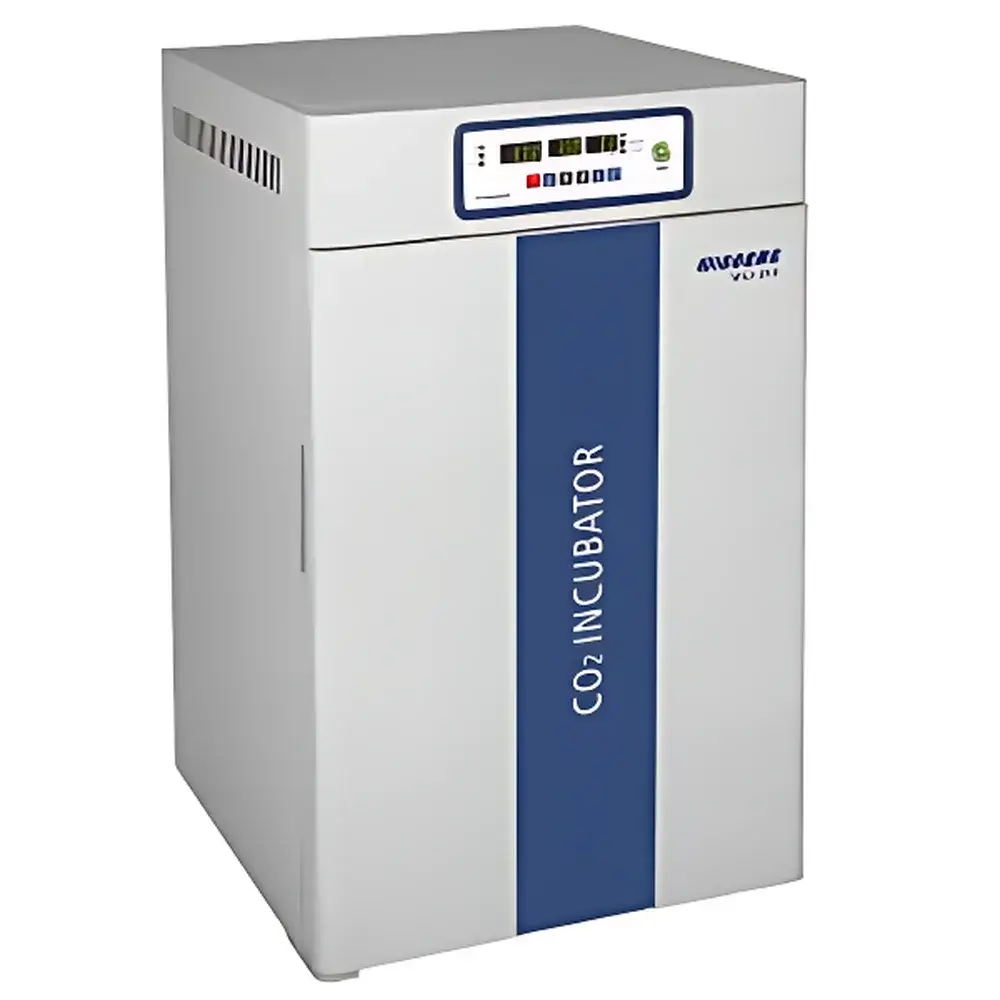
WIGGENS WCI-260Z Air-Jacketed CO₂ Incubator
| Brand | WIGGENS |
|---|---|
| Origin | Germany |
| Model | WCI-260Z |
| Instrument Type | Air-jacketed CO₂ Incubator |
| Temperature Range | Ambient +5°C to 60°C |
| Temperature Uniformity | ±0.4°C (at 37°C / ambient 20°C) |
| Chamber Volume | 260 L |
| External Dimensions | 630 × 680 × 1125 mm |
| Heating Power | 610 W |
| CO₂ Range | 0–20% |
| CO₂ Accuracy | ±0.1% (at 5% CO₂, 37°C) |
| CO₂ Sensor | Dual-beam infrared |
| Temperature Display Resolution | 0.1°C |
| CO₂ Display Resolution | 0.1% |
| Control System | Microprocessor-based PID |
| Chamber Material | AISI 304 stainless steel |
| Standard Shelves | 3 (max. 8) |
| Internal Dimensions | 530 × 590 × 900 mm |
| Net Weight | 115 kg |
Overview
The WIGGENS WCI-260Z is a precision-engineered air-jacketed CO₂ incubator designed for reliable, long-term cultivation of mammalian cells, primary tissues, stem cells, and microaerophilic or capnophilic microorganisms. Its operational principle centers on active thermal regulation via six-sided direct wall heating combined with forced-air convection—ensuring rapid temperature equilibration, exceptional spatial uniformity, and minimal thermal lag during door openings. Unlike water-jacketed systems, the air-jacket architecture eliminates fluid maintenance requirements while delivering superior energy efficiency and faster recovery times (<15 min to re-stabilize at 37°C after 30-second door opening). The chamber maintains physiological conditions through tightly coupled control of CO₂ concentration (via dual-beam NDIR sensor), temperature (PID-regulated), and relative humidity (passive water pan system with bottom-heated reservoir and axial fan-assisted distribution). This tri-variable stability meets the stringent environmental demands of sensitive cell lines used in biopharmaceutical development, regenerative medicine research, and GLP-compliant toxicology assays.
Key Features
- Six-sided independent heating elements integrated into all chamber walls—enabling gradient-free thermal distribution and eliminating cold spots.
- Dual-beam non-dispersive infrared (NDIR) CO₂ sensor with auto-calibration capability, delivering ±0.1% accuracy at 5% CO₂ and ensuring long-term drift resistance without routine zero-point adjustment.
- AISI 304 stainless-steel interior with fully rounded corners and seamless welds—designed for autoclavable compatibility and compliance with ISO 14644-1 Class 5 cleanroom handling protocols.
- Integrated HEPA filtration (≥99.99% @ 0.3 µm) on both intake and recirculation pathways, maintaining ISO Class 5-equivalent airborne particulate levels inside the chamber.
- Microprocessor-controlled PID algorithm governing simultaneous regulation of temperature, CO₂, and alarm thresholds—with independent setpoint memory for up to 10 user-defined protocols.
- Intelligent humidity management: heated water reservoir (bottom-mounted) coupled with top-positioned axial fan ensures uniform RH distribution (>95% RH at 37°C) without condensation on the inner observation window.
- Fail-safe thermal protection: independent high-limit cutoff circuit interrupts power if any sensor detects temperature exceeding user-defined upper threshold—meeting IEC 61010-1 safety requirements.
Sample Compatibility & Compliance
The WCI-260Z supports a broad spectrum of biological samples requiring stable CO₂ tension, including adherent and suspension mammalian cultures (e.g., CHO, HEK293, iPSCs), embryonic stem cell colonies, organoid systems, and fastidious bacteria such as Helicobacter pylori and Campylobacter jejuni. Its chamber geometry (530 × 590 × 900 mm internal) accommodates standard T-175 flasks, 10-layer cell factories, and multi-well plates stacked across up to eight optional shelves. All materials contacting the sample environment conform to USP Class VI biocompatibility standards. The unit complies with EN 61010-1 (electrical safety), EN 61326-1 (EMC), and supports audit-ready documentation per FDA 21 CFR Part 11 when paired with optional data logging software—making it suitable for GMP-aligned QC laboratories and clinical trial support facilities.
Software & Data Management
While the WCI-260Z operates via an intuitive LED interface with dedicated dual-channel keypad controls, optional RS-485/Modbus RTU connectivity enables integration into centralized laboratory monitoring systems (e.g., LabVantage, Siemens Desigo, or custom SCADA platforms). Real-time parameters—including chamber temperature, CO₂ concentration, humidity status, door-open events, and alarm logs—are timestamped and exportable in CSV format. When configured with the optional UV sterilization module or dry-heat decontamination cycle (180°C for 6 h), full-cycle validation reports—including thermal mapping and CO₂ purge verification—can be generated to satisfy ISO 13485 or Annex 1 requirements. Audit trail functionality records all parameter changes, user logins, and system interventions with immutable timestamps.
Applications
- Long-term expansion of human mesenchymal stem cells under hypoxic-mimetic CO₂ conditions (5–10%) for regenerative therapy manufacturing.
- High-fidelity co-culture models involving endothelial and epithelial layers where pH stability (via CO₂ buffering) is critical to barrier function integrity.
- Microbiological isolation workflows requiring controlled capnophilic environments for diagnostic culture of respiratory pathogens.
- Preclinical drug screening using 3D spheroid assays where uniform gas exchange and thermal homogeneity directly impact metabolic readout reproducibility.
- IVF laboratory embryo incubation support—when operated with optional O₂ control upgrade—for time-lapse morphokinetic analysis under physiologically relevant gas mixtures.
FAQ
What is the recommended calibration frequency for the CO₂ sensor?
The dual-beam infrared sensor is factory-calibrated and requires no routine recalibration; however, annual verification against a traceable NIST-certified gas standard is advised for GLP/GMP environments.
Can the incubator operate continuously at 45°C?
Yes—the temperature control system is rated for continuous operation from ambient +5°C to 60°C, with thermal uniformity validated across the full range.
Is the water pan system compatible with sterile water or antibiotic-supplemented media?
Only distilled or deionized water is permitted in the reservoir; addition of solutes may cause mineral deposition, corrosion, or microbial growth in the humidification pathway.
How does the air-jacket design compare to water-jacketed incubators in terms of energy consumption?
Air-jacketed units consume approximately 35–40% less standby power than equivalent water-jacketed models due to lower thermal mass and absence of parasitic heater cycling for jacket temperature maintenance.
Are shelf positions adjustable without tools?
Yes—shelves slide into pre-machined grooves along the stainless-steel sidewalls and lock securely without screws or clips, enabling rapid reconfiguration between experiments.
Related Products





