
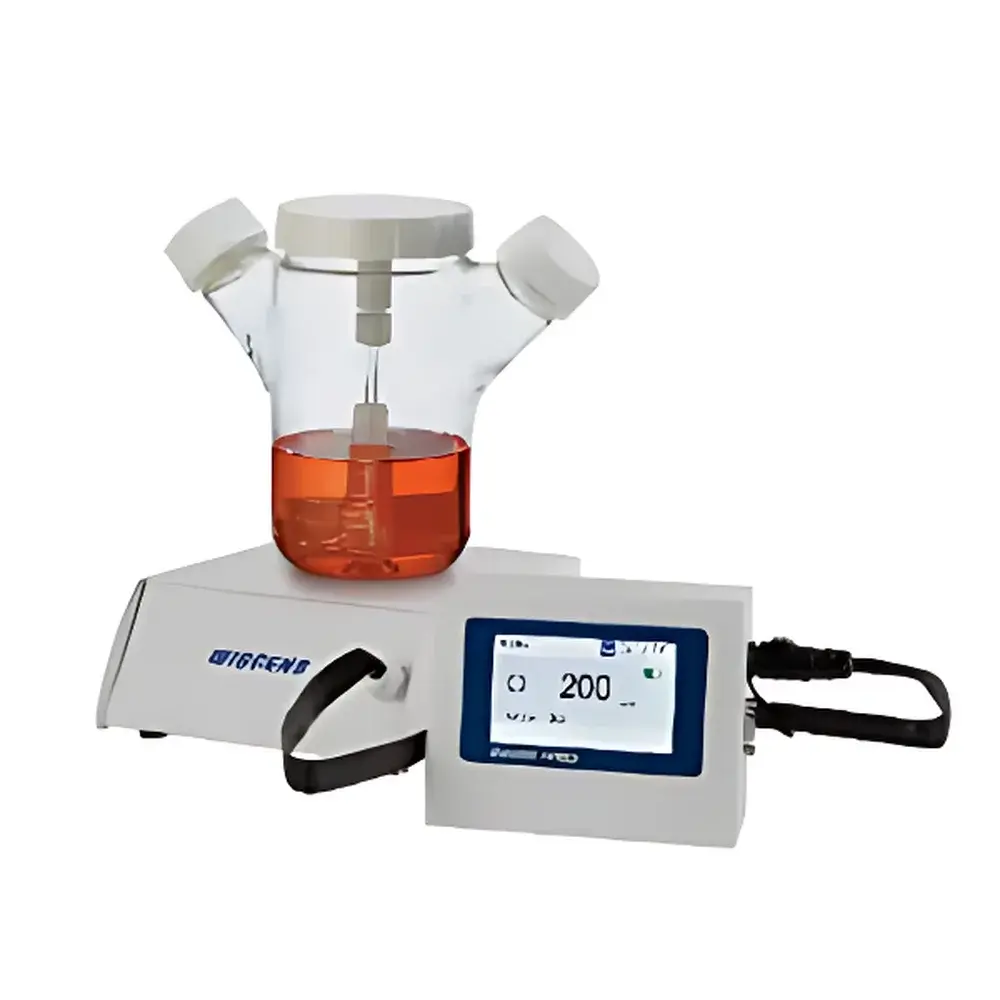
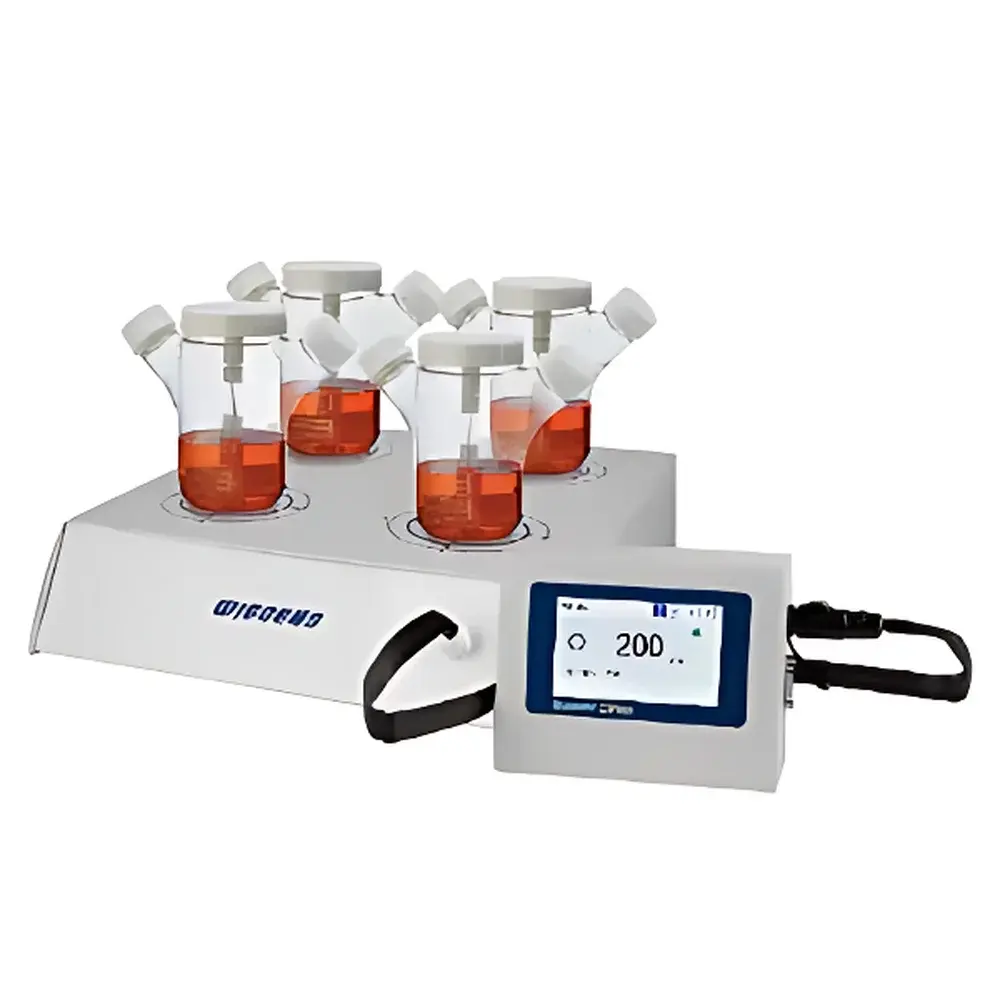
WIGGENS WH1200-C Biological Incubator-Compatible Magnetic Stirrer
| Brand | WIGGENS |
|---|---|
| Origin | Germany |
| Model | WH1200-C |
| Stirrer Type | Magnetic Stirrer |
| Max. Stirring Volume | 3 L |
| Speed Range | 150–1200 rpm |
| Operating Temperature | 14–40 °C |
| Relative Humidity Limit | ≤95% at 37 °C |
| Power Supply | 100–240 VAC, 50/60 Hz |
| Rated Power | 15 W |
| Dimensions (W×D×H, without controller) | 20.3 × 24.9 × 9.2 cm (1-position) / 44.5 × 39.4 × 10.2 cm (4-position) |
| Weight | 1.9 kg (1-position) / 4.5 kg (4-position) |
Overview
The WIGGENS WH1200-C Biological Incubator-Compatible Magnetic Stirrer is an engineered solution for gentle, precise, and contamination-free agitation of cell cultures and sensitive biological samples within controlled environmental chambers—including CO₂ incubators. Unlike mechanical stirrers with exposed drive shafts or motorized overhead units, this device operates on the principle of rotating magnetic field induction: a stationary electromagnetic coil beneath the platform generates a precisely controlled rotating magnetic field, which couples with a PTFE-coated magnetic stirring bar placed inside the culture vessel. This contactless actuation eliminates mechanical wear, thermal drift from motor friction, and acoustic noise—critical advantages for long-term suspension or microcarrier-based mammalian cell culture, microbial fermentation, and reagent equilibration under physiological conditions.
Designed specifically for integration into regulated life science workflows, the WH1200-C meets stringent requirements for sterility maintenance and environmental compatibility. Its corrosion-resistant housing and sealed electronics enable direct placement inside humidified, CO₂-enriched incubators without condensation risk or material degradation. The unit complies with IEC 61010-1 safety standards for laboratory electrical equipment and is constructed to support GLP-compliant documentation practices when used with validated protocols.
Key Features
- Gentle, low-shear mixing optimized for suspension and adherent cell cultures on microcarriers—minimizing cellular damage and preserving viability over extended operation periods.
- Three programmable agitation modes: (1) Constant-Speed Mode for stable suspension culture; (2) Intermittent Start Mode with timed on/off cycles (4–10 cycles) to facilitate initial cell attachment to microcarriers before transitioning to continuous rotation; (3) Dual-Speed Mode enabling staged ramp-up from low-speed conditioning to standard operational speed.
- Incubator-rated construction: IP54-rated enclosure, stainless steel and PTFE-compatible surfaces, and thermal management designed for uninterrupted operation at 37 °C and up to 95% relative humidity.
- Dual configuration options: Single-position (WH1200-C1) and four-position (WH1200-C4) platforms—both supporting vessels up to 3 L capacity per position.
- Programmable timer and audible/visual alarm system for unattended operation, with event logging capability via optional external interface (RS232 or analog output).
- Universal power input (100–240 VAC, 50/60 Hz) and low power consumption (15 W), ensuring energy efficiency and compatibility across global laboratory infrastructures.
Sample Compatibility & Compliance
The WH1200-C accommodates standard glass and polymer culture vessels—including Erlenmeyer flasks, spinner flasks, roller bottles, and custom bioreactor cartridges—provided internal dimensions permit effective magnetic coupling and fluid dynamics. It is validated for use with borosilicate glass, polycarbonate, PETG, and CO₂-permeable silicone membranes. The device conforms to ISO 13485 design control principles for medical device-associated laboratory equipment and supports alignment with USP Analytical Instrument Qualification guidelines. When integrated into GMP environments, its operational parameters can be included in IQ/OQ documentation packages; audit trails for speed settings and runtime are achievable through third-party data acquisition systems compliant with FDA 21 CFR Part 11.
Software & Data Management
While the WH1200-C operates as a standalone instrument with intuitive rotary encoder controls and LED display, it supports external data capture via analog voltage output (0–10 V corresponding to 0–1200 rpm) or RS232 serial communication (ASCII protocol). Integration with LabArchives, Benchling, or custom SCADA platforms enables timestamped recording of speed profiles, runtime duration, and alarm events—facilitating traceability in regulated QC/QA laboratories. Firmware updates are performed via secure USB connection, and configuration backups can be exported for version-controlled instrument setup replication.
Applications
- Suspension culture of CHO, HEK293, and hybridoma cells in serum-free or chemically defined media.
- Microcarrier-based expansion of mesenchymal stem cells (MSCs) and induced pluripotent stem cells (iPSCs) under dynamic conditions mimicking bioreactor hydrodynamics.
- Pre-incubation mixing of enzymatic digestion solutions, antibody conjugates, and cryopreservation media requiring uniform temperature and compositional homogeneity.
- Long-duration agitation of microbial cultures (e.g., E. coli, S. cerevisiae) during induction phases where shear sensitivity impacts protein expression yield.
- Buffer and media preparation in cleanroom environments where particulate generation from mechanical components must be avoided.
FAQ
Can the WH1200-C be operated inside a CO₂ incubator without modification?
Yes—the unit is explicitly rated for continuous operation at 37 °C and ≤95% RH, with materials selected to resist corrosion from CO₂-saturated humid air.
What is the minimum recommended stirring bar size for optimal torque transfer at 150 rpm?
A 30 mm × 8 mm PTFE-coated stir bar is recommended for 1–3 L volumes; smaller bars may exhibit reduced stability below 300 rpm.
Does the WH1200-C support remote start/stop or speed adjustment via software?
Direct USB or Ethernet control is not built-in, but RS232 and analog outputs enable integration with PLCs, DAQ systems, or custom LabVIEW applications.
Is calibration required, and does WIGGENS provide a calibration certificate?
Speed accuracy is factory-verified to ±2% of setpoint across the full range; NIST-traceable calibration certificates are available upon request as an add-on service.
How does the intermittent start mode sequence trigger the transition to continuous operation?
The number of cycles and dwell time per cycle are user-programmable; after the final off-cycle, the unit automatically ramps to the preset continuous speed using a smooth acceleration profile to avoid abrupt hydrodynamic shock.



