
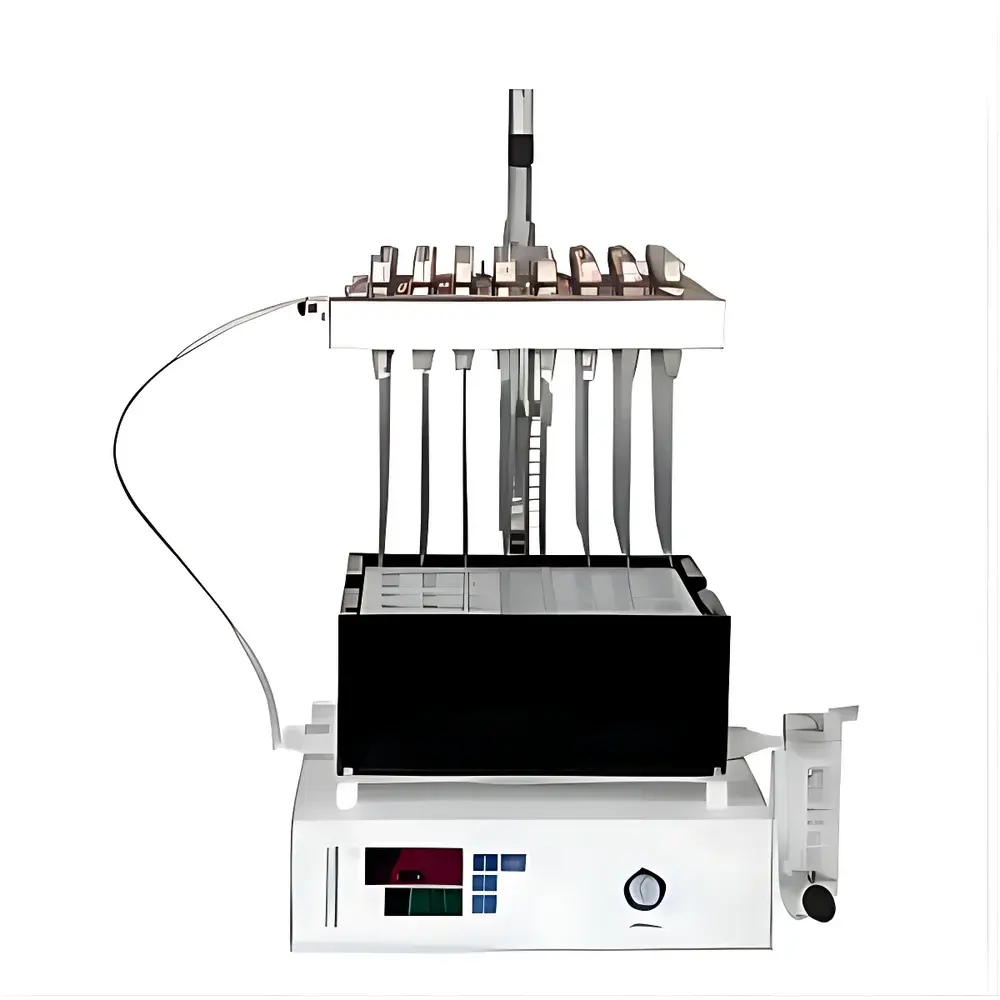
WIGGENS ZipVap Series Dry-Block Nitrogen Evaporator
| Brand | WIGGENS |
|---|---|
| Origin | Germany |
| Heating Method | Dry-block heating |
| Temperature Range | Ambient to 100 °C |
| Temperature Uniformity | ±0.5 °C |
| Sample Tube Diameter Compatibility | 12 mm to 62 mm |
| Gas Flow Rate | 1–100 mL/min |
| Throughput Options | 2, 8, 12, 24, 28, 48, or 96 positions |
| Heating Power | 500 W |
Overview
The WIGGENS ZipVap Series Dry-Block Nitrogen Evaporator is an engineered solution for controlled, parallel solvent removal in analytical and preparative laboratories. It operates on the principle of inert gas-assisted evaporation—introducing a regulated stream of nitrogen (or other inert gas) across the surface of liquid samples held in individual tubes or wells, while simultaneously applying precise conductive heating via a thermally uniform aluminum block. This dual-mode approach—combining convective gas flow with conductive thermal transfer—enables reproducible concentration or complete dry-down of volatile solvents without thermal degradation of analytes. Designed for compatibility with standard laboratory consumables—including 2 mL autosampler vials, 15 mL centrifuge tubes, and EPA-compliant 40 mL extraction vessels—the ZipVap system supports method consistency across environmental testing, pharmaceutical QC, forensic toxicology, and food safety workflows where residue analysis per ISO 17025 or EPA Method 502.2/8081B requires strict control over evaporation kinetics.
Key Features
- Dry-block heating architecture with high-purity anodized aluminum heating module ensures rapid thermal response and exceptional temperature homogeneity (±0.5 °C) across all sample positions.
- Independent gas flow regulation per channel—standard across all models—with integrated precision mass flow control (1–100 mL/min range) and visual flow indication via calibrated rotameters.
- Modular configuration support: interchangeable aluminum blocks accommodate tube diameters from 12 mm (e.g., GC autosampler vials) up to 62 mm (e.g., large-volume reaction vessels), enabling seamless transition between small-scale screening and high-throughput batch processing.
- Compact footprint optimized for benchtop use; base unit dimensions remain consistent across 2–96 position variants, minimizing lab space allocation without compromising accessibility or ergonomics.
- Heated gas inlet option available on select configurations (e.g., models ending in “-5”) to prevent condensation in humid environments or during low-temperature evaporation protocols.
- CE-marked design compliant with IEC 61010-1:2010 for electrical safety in laboratory equipment; RoHS-conformant materials used throughout construction.
Sample Compatibility & Compliance
The ZipVap evaporator accommodates a broad spectrum of container formats used in accredited testing labs—including 2 mL crimp-top vials (12 mm OD), 15 mL conical tubes (15–16 mm OD), 28 mm round-bottom flasks, and 40 mL EPA vials—via application-specific aluminum modules. All modules are CNC-machined for dimensional repeatability and thermal coupling efficiency. The system supports GLP/GMP-aligned workflows through traceable temperature calibration (NIST-traceable reference sensors available upon request) and meets requirements for method validation under USP , ISO/IEC 17025:2017 Clause 7.2.2 (method validation), and FDA 21 CFR Part 11 when paired with validated LIMS-integrated software (see Software & Data Management). No open flame or oil bath dependency eliminates fire hazard and cross-contamination risk inherent in traditional rotary evaporation.
Software & Data Management
While the ZipVap Series operates as a standalone instrument with intuitive front-panel digital controls (LED display, push-button interface), it integrates seamlessly into networked lab environments via optional RS-232 or USB-to-serial adapters. Third-party SCADA or LIMS platforms can log real-time temperature setpoints, elapsed run time, and user ID inputs when connected to compatible data acquisition modules. For full audit trail compliance, WIGGENS recommends pairing the ZipVap with validated electronic lab notebook (ELN) systems that enforce 21 CFR Part 11–compliant electronic signatures, change tracking, and retention policies. Calibration records—including date, technician ID, reference standard serial number, and deviation report—are exportable in CSV or PDF format.
Applications
- Residue analysis: Final concentration step prior to GC-MS or LC-MS injection in pesticide multiresidue methods (e.g., QuEChERS AOAC 2007.01).
- Environmental testing: EPA Methods 502.2 (VOCs), 525.3 (SVOCs), and 8081B (PCBs) require consistent nitrogen blow-down prior to instrumental analysis.
- Pharmaceutical development: Removal of reaction solvents post-Suzuki coupling or peptide synthesis; compatible with ICH Q5C stability-indicating protocols.
- Clinical toxicology: Plasma/urine sample cleanup for amphetamine, opioid, or benzodiazepine screening using immunoassay or LC-MS/MS confirmation.
- Food safety: Mycotoxin extraction (aflatoxin B1, ochratoxin A) per EN 14132:2022, where solvent removal must avoid analyte decomposition at elevated temperatures.
FAQ
What is the maximum recommended operating temperature for the ZipVap heating block?
The system is rated for continuous operation up to 100 °C. Exceeding this limit may compromise thermal sensor accuracy and accelerate gasket degradation in heated gas inlet variants.
Can the ZipVap be used with gases other than nitrogen?
Yes—argon or helium may be substituted where required by method specifications; however, nitrogen remains preferred for cost-efficiency and inertness in most organic solvent applications.
Is calibration documentation provided with each unit?
Each ZipVap ships with a factory calibration certificate indicating temperature verification at 40 °C, 70 °C, and 100 °C using NIST-traceable reference thermometers; full calibration kits and service contracts are available separately.
How is gas flow uniformity maintained across multiple open channels?
The integrated manifold design and pressure-compensated needle valves ensure consistent volumetric flow distribution regardless of the number of active channels—critical for inter-sample comparability in multi-well assays.
Are replacement modules available for non-standard tube sizes?
Custom-machined aluminum blocks can be ordered directly from WIGGENS Engineering Support with lead times of 6–8 weeks; standard modules cover 12–62 mm OD with ≤0.1 mm tolerance.



